Pull-Up to Dip
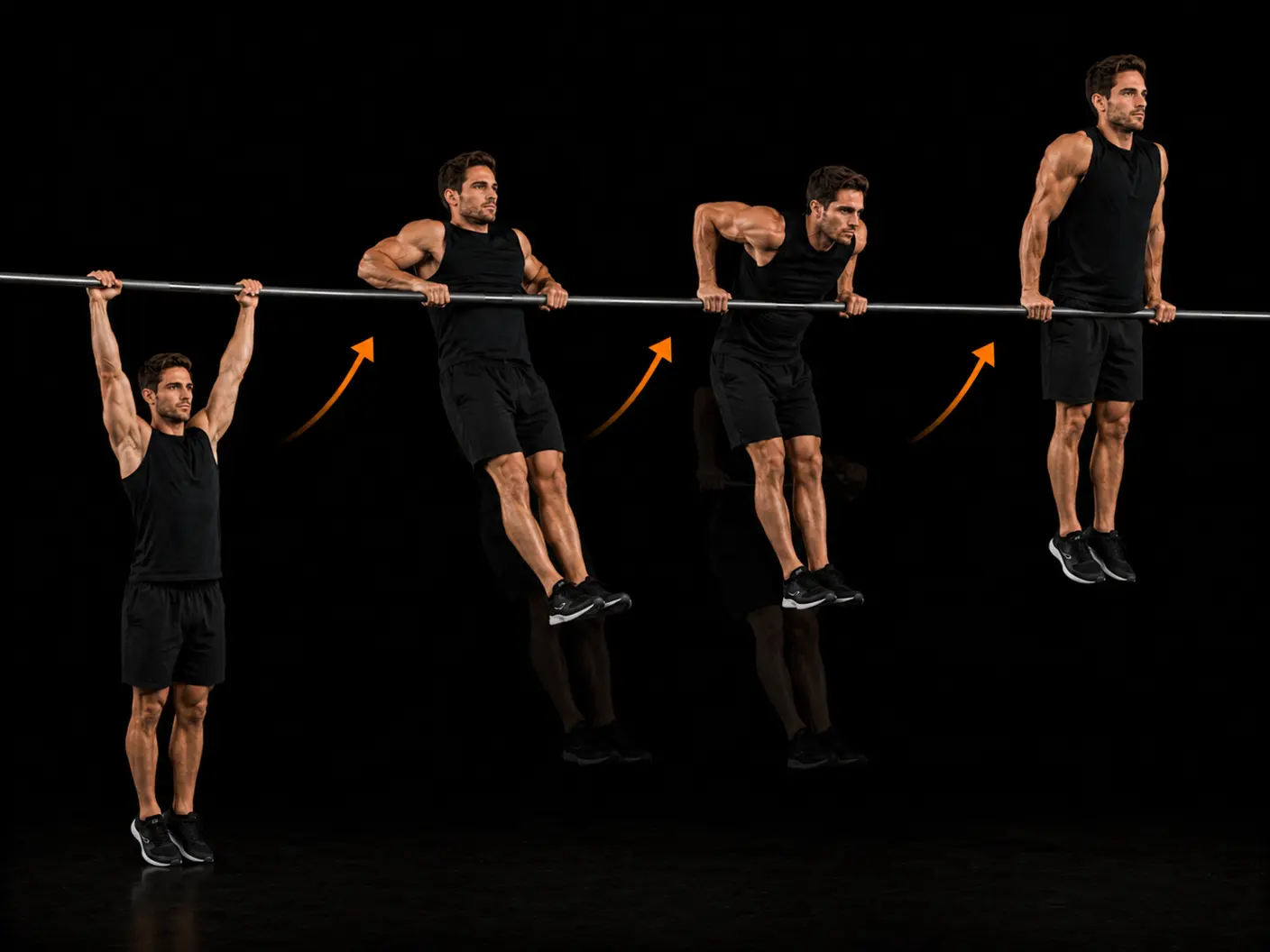
The pull-up to dip is an advanced compound superset that pairs a vertical pull with a vertical push, training the latissimus dorsi, biceps, pectoralis major, and triceps in a single unbroken sequence. The movement demands controlled transitions between a pull-up — chest to the bar — and a full-range dip on parallel bars or a dip station, making it one of the more technically demanding bodyweight pairings available. It suits experienced lifters who already own clean, controlled reps on both movements independently.
How to do it
Perform a pull-up (or chin-up) — chest to the bar, lower under control. From the top of the pull-up, transition into a bar muscle-up or, if bars are adjacent, move to parallel bars and immediately perform a dip. The superset creates a vertical pull/vertical push pairing. Repeat for the desired reps per movement.
Coaching cues
- Full pull-up first
- Controlled transition
- Dip with full range
- Shoulder blades down
Why train it
- Trains opposing upper-body patterns back-to-back, allowing one muscle group to recover while the other works and making the pairing highly time-efficient.
- The combination places meaningful mechanical load on the latissimus dorsi, biceps, pectoralis major, and triceps within a single set, supporting both strength and hypertrophy goals.
- Requiring the rhomboids, anterior deltoid, and core to stabilise throughout the transition develops shoulder girdle integrity that isolated pressing or pulling alone does not replicate.
- Because it relies only on a pull-up bar and parallel bars or a dip station, the pairing is accessible in most gym environments without requiring loaded equipment.
Common mistakes
- Shortening the pull-up range — bring the chest all the way to the bar on every rep rather than stopping when the chin clears it.
- Rushing the transition between movements — control the descent from the pull-up fully before moving to the dip station, as momentum through the changeover reduces the stimulus and increases shoulder strain.
- Letting the shoulders rise to the ears at the bottom of the dip — actively depress the shoulder blades throughout the dip to maintain joint stability and protect the shoulder girdle.
- Cutting the dip short — descend until the upper arms are at least parallel to the floor on each rep, otherwise the pectoralis major and triceps are not trained through a meaningful range of motion.
Primary: Latissimus Dorsi, Biceps Brachii, Pectoralis Major, Triceps Brachii.
Secondary: Rhomboids, Rectus Abdominis, Anterior Deltoid.
Equipment
Good for
Easier variation
Pull-up then dip as separate sets — rest between movements.
Similar movements
Frequently asked
- What muscles does the pull-up to dip work?
- The primary muscles are the latissimus dorsi and biceps during the pull-up phase, and the pectoralis major and triceps during the dip phase. The rhomboids, anterior deltoid, and core contribute as secondary stabilisers throughout both movements.
- How many sets and reps should I do for the pull-up to dip?
- A practical starting point for strength is 3–5 sets of 3–5 reps on each movement, with 2–3 minutes of rest between sets. For hypertrophy, 3–4 sets of 6–10 reps per movement with 90 seconds to 2 minutes of rest is a reasonable structure, provided technique remains controlled across all reps.
- Do I need to be able to do a muscle-up to perform this exercise?
- Not necessarily. If a pull-up bar and parallel bars are positioned adjacently, you can descend from the pull-up and step or swing across to the dip bars rather than transitioning over a single bar. If you are training on a single bar and want a true continuous movement, a muscle-up transition is required, which is a distinct and demanding skill in its own right.
- Is the pull-up to dip suitable for beginners?
- This exercise is classified as advanced and is best suited to lifters who can already perform multiple clean pull-ups and dips independently. Attempting the pairing without that foundation typically results in compromised technique on both movements, which reduces the training stimulus and increases the risk of shoulder discomfort.
- What are good alternatives if I cannot yet complete the full movement?
- Training pull-ups and dips as separate exercises in the same session is the most direct alternative, allowing you to build the strength base each movement requires. Band-assisted variations of both exercises can also be used to develop the pattern while managing load.
Want this movement in a plan built for you?
Adaptiv programmes the right exercises for your goal, equipment and experience — then adapts them as you train.
Build my programme