Rice Bucket Work
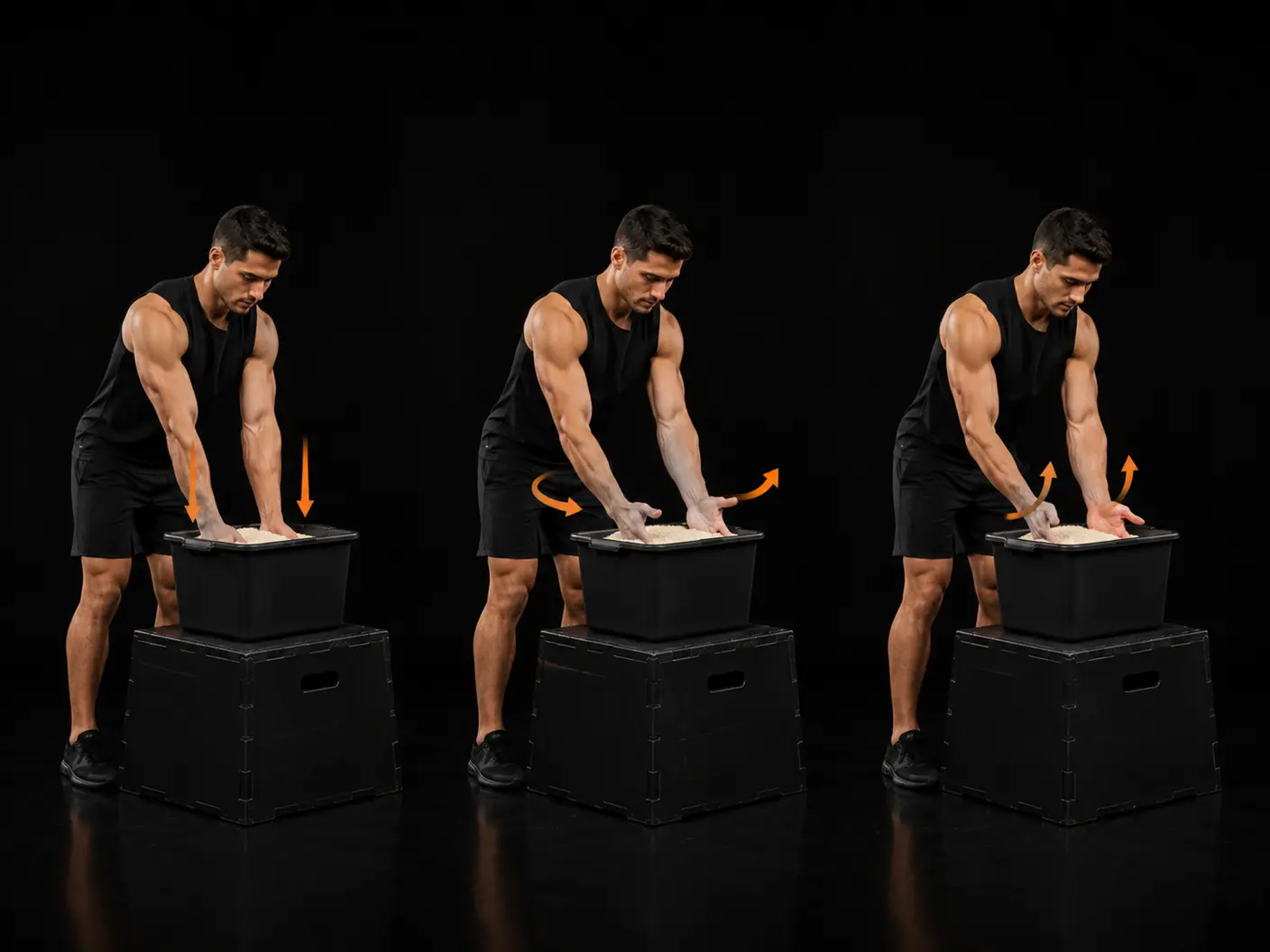
Rice bucket work is a low-tech, high-utility hand and forearm conditioning method in which the hands are plunged into a bucket of dry rice and moved through squeezing, opening, rotating, and flexing patterns against the rice's distributed resistance. It trains the forearm flexors, extensors, grip muscles, wrist stabilisers, and finger flexors through their full range of motion in a way that conventional free weights rarely replicate. It suits athletes in throwing, racket, combat, and climbing sports, as well as anyone looking to build resilient hands and wrists as part of a general fitness programme.
How to do it
Fill a bucket with dry rice. Plunge one or both hands into the rice and perform various hand movements — squeezing, opening, rotating, flexing, extending the wrist — all against the rice's resistance. Work for 60–90 second intervals. Focus on full range wrist and finger motion.
Coaching cues
- Varied movements
- Squeeze and open
- Rotate the wrists
- Work through fatigue
Why train it
- Develops grip endurance and forearm strength simultaneously by requiring the muscles to work continuously against a shifting, distributed load throughout each interval.
- Trains the often-neglected forearm extensors and wrist stabilisers, which helps balance the demands placed on the flexors by pulling and gripping work elsewhere in a programme.
- Requires minimal equipment — a bucket, dry rice, and a small amount of floor space — making it straightforward to include in home training or as a warm-up and cool-down tool at any facility.
- The varied movement patterns mean the hands and fingers are loaded across multiple planes and ranges, building more well-rounded hand resilience than single-plane grip implements alone.
Common mistakes
- Working only in one direction — vary between squeezing, opening, rotating, and flexing the wrist throughout each interval to ensure all target muscles are trained, not just the flexors.
- Using intervals that are too short to produce a meaningful training stimulus — aim for 60–90 seconds of continuous movement per set, working through the accumulated fatigue rather than stopping at the first signs of discomfort.
- Moving too quickly and losing range of motion — slow the movements down to ensure the wrist and fingers travel through their full range against the rice's resistance on each repetition.
- Letting the rice dry out and compact, which reduces resistance and limits the exercise's effectiveness — use clean, dry rice and replace it periodically to maintain consistent resistance throughout the bucket.
Primary: Forearm Flexors, Forearm Extensors.
Equipment
Good for
Easier variation
Wrist CARs or banded wrist extension — lower intensity forearm mobility and conditioning.
Similar movements
Frequently asked
- What muscles does rice bucket work target?
- The primary muscles are the forearm flexors, forearm extensors, and grip muscles. The wrist stabilisers and finger flexors also work as secondary contributors throughout the varied movement patterns.
- How many sets and reps should I do for rice bucket work?
- Because the exercise is time-based, work in intervals of 60–90 seconds rather than counting repetitions. Two to four sets per hand, or per session using both hands simultaneously, is a practical starting point depending on your current grip endurance.
- Is rice bucket work suitable for athletic performance?
- Yes — it is particularly well-suited to sports that place high demands on hand and wrist resilience, including throwing, racket, combat, and climbing disciplines. The combination of endurance, full-range motion, and multi-directional loading addresses qualities that heavier compound lifts do not directly target.
- Can I use rice bucket work as a warm-up?
- It works well as a low-intensity warm-up for sessions that involve heavy pulling, gripping, or throwing, as it increases blood flow to the forearms and moves the wrists and fingers through their full range before load is applied.
- Are there alternatives if I do not have a bucket of rice?
- Fine sand or dried lentils can provide a similar distributed resistance if rice is not available. The movement principles — squeezing, opening, rotating, and wrist flexion and extension against a granular medium — remain the same regardless of the material used.
Want this movement in a plan built for you?
Adaptiv programmes the right exercises for your goal, equipment and experience — then adapts them as you train.
Build my programme