Reverse Wrist Curl
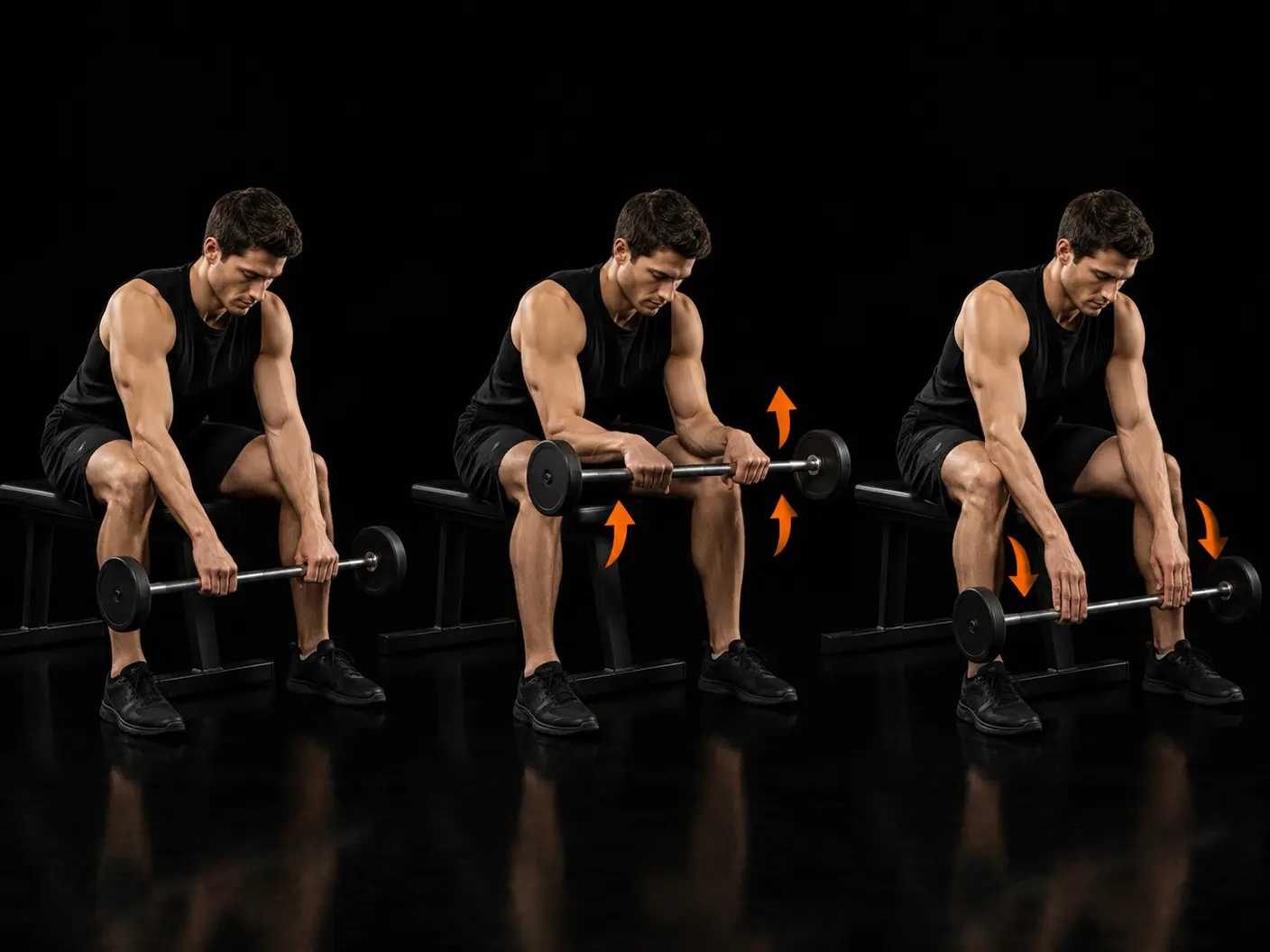
The reverse wrist curl is a foundational isolation exercise targeting the forearm extensors — the muscles that run along the back of the forearm. Performed seated with the forearms resting flat on a bench and the hands hanging off the edge, palms down, it trains the often-neglected wrist extension pattern through a short, controlled range of motion. It suits beginners building balanced forearm development and anyone looking to address the extensor side of the forearm that pressing and pulling work tends to leave undertrained.
How to do it
Sit with forearms flat on a bench, palms down, hands off the edge. Let the weight lower by extending the wrists. Curl the weight up by flexing the wrists backward (extending). Pause at peak. Lower under control.
Coaching cues
- Palms down
- Extend the wrists
- Pause at peak
- Slow descent
Why train it
- Directly targets the forearm extensors, which are commonly underdeveloped relative to the flexors trained by curling movements.
- The brachioradialis receives secondary stimulus, contributing to overall forearm thickness and elbow joint support.
- The slow, controlled tempo demanded by the movement builds the kind of deliberate muscular control that carries over to grip-intensive activities.
- Its foundational difficulty and minimal equipment requirement — a barbell or dumbbells and a bench — make it straightforward to programme into any training block.
Common mistakes
- Letting the forearms lift off the bench — keep them flat and stationary throughout so only the wrists move.
- Using too much weight and losing range of motion — choose a load that allows a full, controlled extension at the top and a slow descent.
- Rushing the lowering phase — the eccentric portion should be deliberate, matching the controlled tempo used on the way up.
- Allowing the wrists to collapse passively rather than lowering under muscular tension — maintain active control of the weight throughout the entire repetition.
Primary: Forearm Extensors.
Secondary: Brachioradialis.
Equipment
Good for
Easier variation
Banded wrist extension — lower intensity for elbow rehab.
Similar movements
Frequently asked
- What muscles does the reverse wrist curl work?
- The primary muscles trained are the forearm extensors, which run along the dorsal side of the forearm. The brachioradialis acts as a secondary muscle and receives additional stimulus during the movement.
- How many sets and reps should I do for reverse wrist curls?
- For general fitness and forearm development, two to three sets of twelve to twenty repetitions works well. The short range of motion and the endurance characteristics of forearm musculature mean higher rep ranges are typically productive here.
- What is the difference between a wrist curl and a reverse wrist curl?
- A standard wrist curl is performed palms up and trains the forearm flexors on the underside of the forearm. The reverse wrist curl is performed palms down and targets the forearm extensors on the back of the forearm — the two movements complement each other for balanced forearm development.
- Can I do reverse wrist curls with dumbbells instead of a barbell?
- Yes — both barbells and dumbbells are listed as suitable equipment for this exercise. Dumbbells allow each wrist to move independently, which can be useful if one side is weaker or if a straight bar causes discomfort.
- Where does the reverse wrist curl fit in a training session?
- As an isolation exercise, it is best placed towards the end of a session after compound upper-body work. Fatiguing the forearm extensors early could compromise your grip and wrist stability on heavier movements performed later in the workout.
Want this movement in a plan built for you?
Adaptiv programmes the right exercises for your goal, equipment and experience — then adapts them as you train.
Build my programme