Banded Wrist Extension
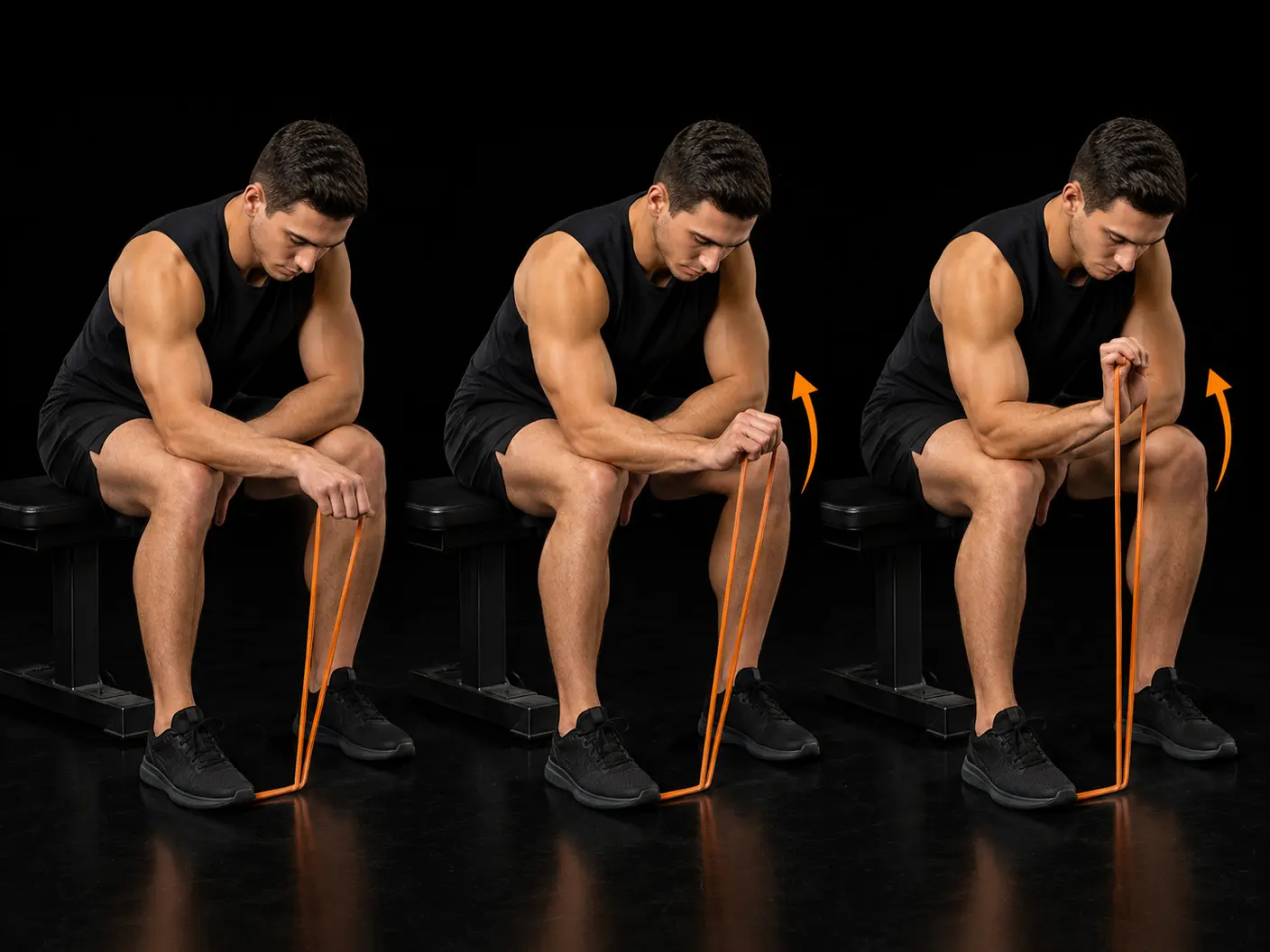
The banded wrist extension is a foundational isolation movement that trains the forearm extensor muscles through a controlled range of wrist motion against light band resistance. It sits within the isolation category, meaning the workload is concentrated at a single joint — the wrist — making it a precise tool for developing the often-neglected extensor side of the forearm. It suits beginners establishing forearm resilience, as well as more experienced trainees looking to address muscular imbalance between the flexors and extensors.
How to do it
Anchor a light resistance band at a low point or stand on it. Hold the free end with palm facing down. Rest the forearm on your thigh or a bench. Extend the wrist upward against the band, lifting the back of the hand. Pause at peak extension. Lower under control.
Coaching cues
- Forearm flat
- Extend the wrist back
- Pause at peak
- Slow eccentric
Why train it
- Directly develops the forearm extensors — extensor carpi radialis and extensor digitorum — which are frequently undertrained relative to the flexor side of the forearm.
- The slow eccentric tempo prescribed in the coaching cues places meaningful mechanical load through the muscle during the lowering phase, supporting adaptation with minimal equipment.
- A resistance band keeps the load modest and adjustable, making this an accessible entry point for general fitness trainees who are building forearm capacity for the first time.
- Pausing at peak extension reinforces mind-muscle connection and encourages full range of motion, both of which improve training quality over time.
Common mistakes
- Lifting the forearm off the thigh or bench during the movement — keep the forearm flat throughout so the wrist joint does the work, not the elbow or shoulder.
- Rushing the lowering phase — the coaching cues specifically call for a slow eccentric, so resist the band deliberately rather than letting the hand drop back to the start position.
- Selecting a band that is too heavy — if the wrist cannot reach a clear peak extension or the movement becomes jerky, reduce the band resistance to restore smooth, controlled mechanics.
- Allowing the wrist to deviate sideways during extension — move the hand straight back along the line of the forearm to keep stress on the target extensors rather than shifting it to adjacent structures.
Primary: Forearm Extensors.
Secondary: Brachioradialis.
Equipment
Good for
Easier variation
Unloaded wrist circles — full-range motion without resistance.
Similar movements
Frequently asked
- What muscles does the banded wrist extension work?
- The primary muscles are the forearm extensors — specifically the extensor carpi radialis and extensor digitorum. The brachioradialis acts as a secondary muscle, contributing support during the movement.
- How many sets and reps should I do for banded wrist extensions?
- For general fitness and foundational forearm development, two to three sets of 12–20 repetitions per side works well. The priority is quality — a genuine pause at peak extension and a controlled lowering phase — rather than accumulating volume too quickly.
- Is this exercise suitable for beginners?
- Yes — it is classified as foundational difficulty, which makes it an appropriate starting point. The light band resistance and stable forearm position keep the movement manageable while still delivering a useful training stimulus.
- Can I do banded wrist extensions without a bench?
- Yes. The form description notes you can rest the forearm on your thigh when seated, which is a practical option if a bench is not available. The key requirement is that the forearm remains flat and supported so the wrist can move freely through its range.
- How does the banded wrist extension differ from a dumbbell wrist extension?
- The mechanics of the movement are essentially the same, but a resistance band provides accommodating resistance — meaning the load increases as the wrist reaches peak extension where the band is most stretched. A dumbbell delivers a fixed load throughout, with gravity dictating where the movement feels hardest.
Want this movement in a plan built for you?
Adaptiv programmes the right exercises for your goal, equipment and experience — then adapts them as you train.
Build my programme