Reverse Pec Deck
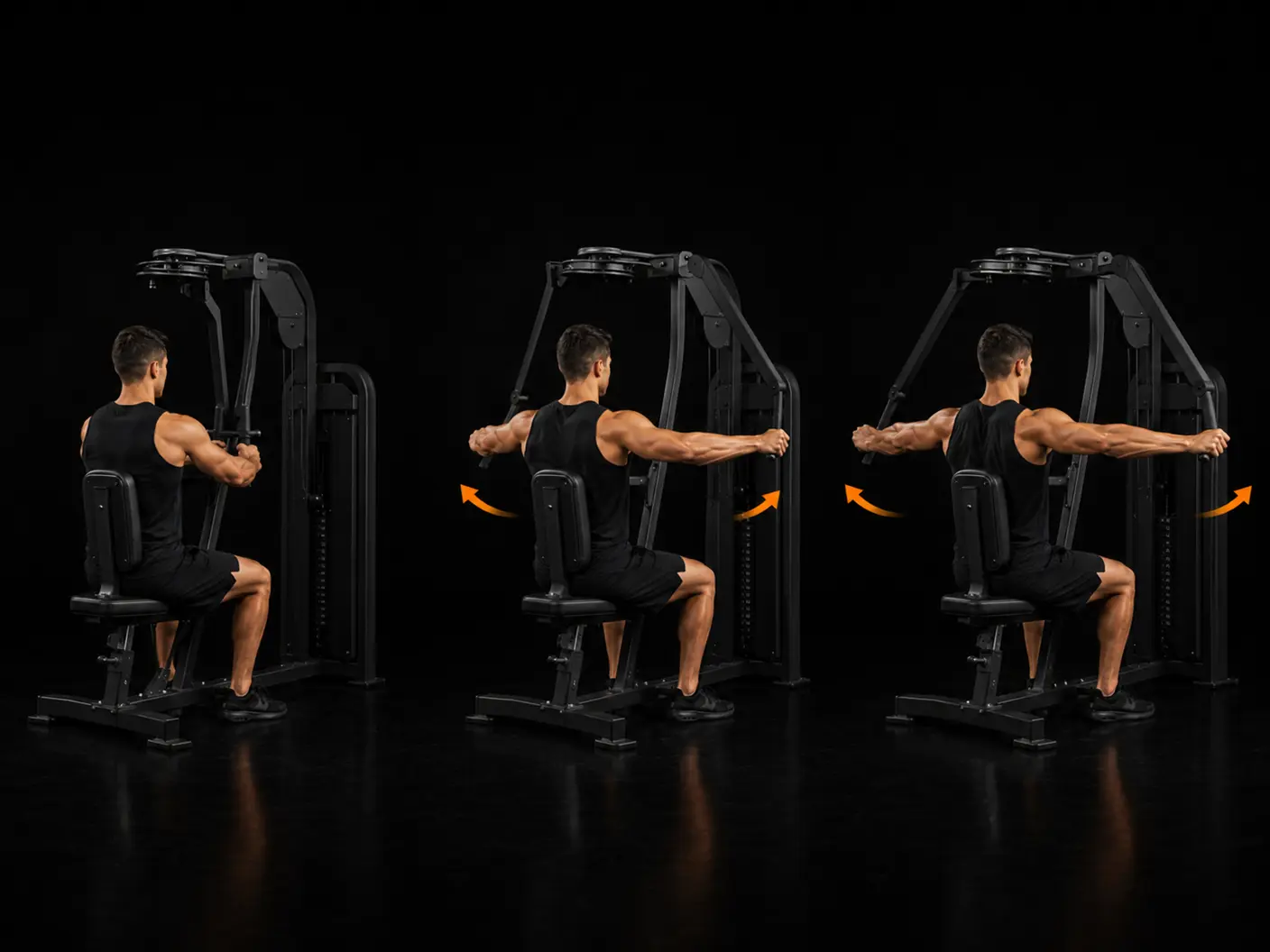
The reverse pec deck is a machine-based isolation exercise targeting the posterior deltoid, performed seated with the chest pinned against the pad and the arms moving through a wide horizontal arc. It trains the horizontal abduction pattern in a stable, guided environment that keeps tension on the rear delts throughout the full range of motion. The fixed movement path and low technical demand make it a reliable option for lifters at any stage who want to develop the back of the shoulder without relying on free-weight coordination.
How to do it
Sit facing the pec deck with the chest against the pad. Grip the handles with arms extended straight out. Pull the handles back in a wide arc, elbows soft. Squeeze the rear delts at peak. Return under control to a deep stretch.
Coaching cues
- Lead with elbows
- Wide arc
- Squeeze at peak
- Chest pinned to the pad
Why train it
- The machine's guided arc maintains consistent tension on the posterior deltoid across both the eccentric and concentric phases, making it well suited to hypertrophy-focused programming.
- Pinning the chest to the pad eliminates trunk momentum, ensuring the rear delts and upper back musculature — rather than the lower back — produce the movement.
- The reverse pec deck also recruits the middle trapezius and rhomboids as secondary movers, contributing to broader upper-back development within a single exercise.
- As a foundational isolation movement, it integrates cleanly into a session as either a warm-up to prime the rear delts before compound pulling work or as a finishing exercise to accumulate volume.
Common mistakes
- Letting the elbows drop below shoulder height — keep the arms elevated so the arc stays horizontal and the posterior deltoid remains the primary mover throughout.
- Using excessive load that causes the chest to lift off the pad — reduce the weight and keep the sternum in contact with the support to prevent the lower back and traps from compensating.
- Cutting the range of motion short at the peak — drive through the full arc and hold briefly at maximum retraction so the rear delts complete their contraction before returning.
- Allowing the elbows to lock out on the return — keep a soft bend in the arms and control the descent to maintain tension through the stretch rather than letting the weight stack bear it.
Primary: Posterior Deltoid.
Secondary: Trapezius, Rhomboids.
Equipment
Good for
Easier variation
Cable reverse fly — same target with free cable path.
Similar movements
Frequently asked
- What muscles does the reverse pec deck work?
- The primary muscle is the posterior deltoid, which drives horizontal abduction of the arm. The middle trapezius and rhomboids act as secondary movers, assisting with scapular retraction at the peak of the movement.
- How many sets and reps should I do on the reverse pec deck?
- For hypertrophy, three to four sets of 12 to 20 repetitions works well, as the posterior deltoid responds to moderate-to-high rep ranges and consistent tension. Prioritise a controlled tempo and a genuine squeeze at the peak over loading the stack heavily.
- What are good alternatives to the reverse pec deck?
- Dumbbell rear delt flyes and face pulls train a comparable pattern if the machine is unavailable. Cable rear delt flyes performed at shoulder height are also a close substitute, offering a similarly consistent resistance curve.
- Is the reverse pec deck useful for improving posture?
- Strengthening the posterior deltoid, middle trapezius, and rhomboids can support better shoulder positioning, particularly for people who spend extended periods in a seated or forward-flexed position. It is best viewed as one component of a balanced programme that includes rowing and scapular stability work.
- Can beginners use the reverse pec deck?
- Yes — its foundational difficulty rating reflects the fact that the machine stabilises the movement, removing the balance and coordination demands of free-weight alternatives. Focus on setting the seat height correctly so the handles align with shoulder height before adding load.
Want this movement in a plan built for you?
Adaptiv programmes the right exercises for your goal, equipment and experience — then adapts them as you train.
Build my programme