Cable Rear Delt Fly
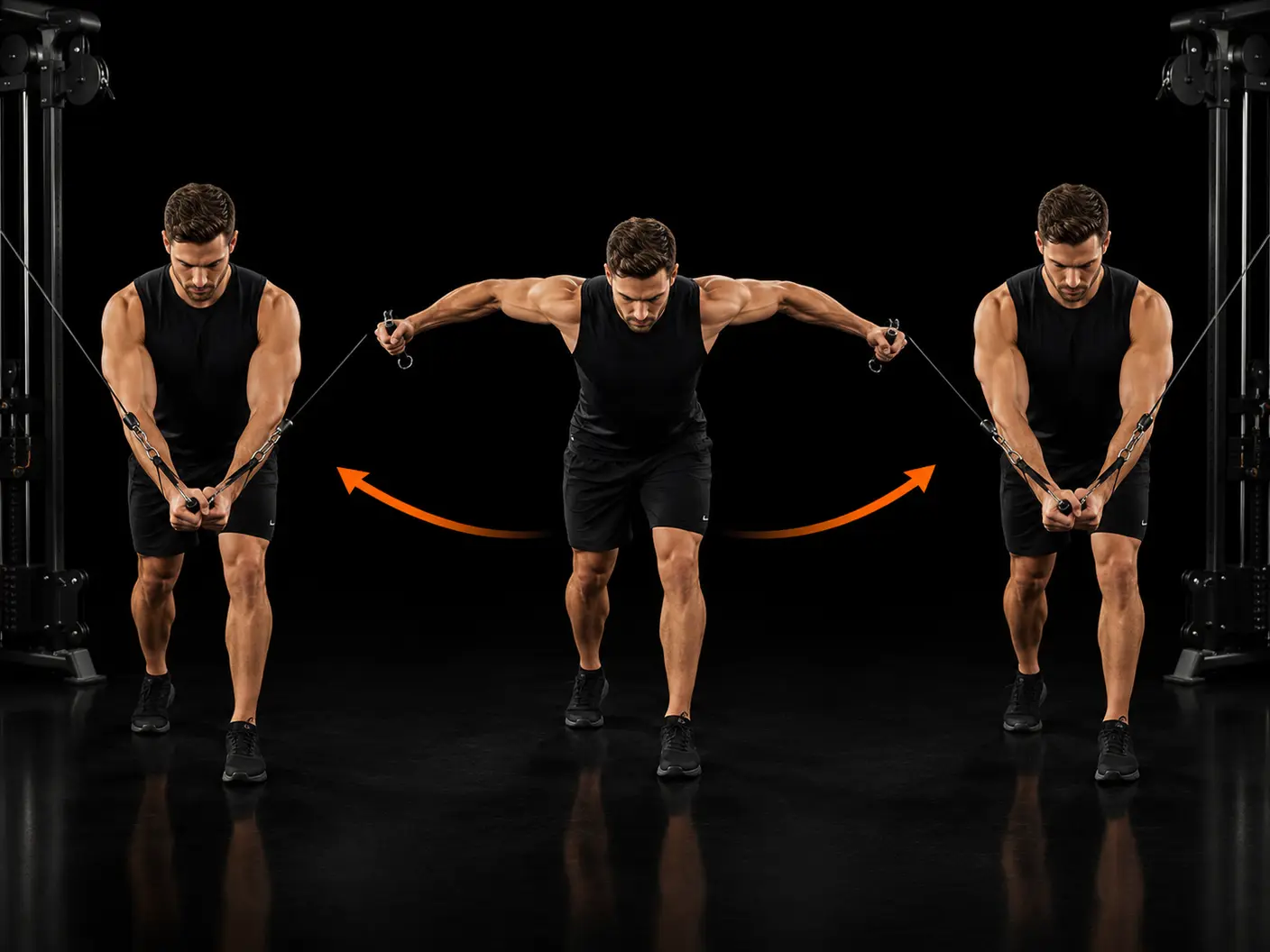
The cable rear delt fly is an isolation exercise performed on a cable machine, targeting the posterior deltoid through a horizontal abduction arc against constant cable tension. Unlike free-weight alternatives, the crossed-cable setup maintains resistance throughout the full range of motion, making it particularly effective for developing the rear delts. It suits lifters at any training age who want to address rear deltoid development as part of a balanced shoulder programme.
How to do it
Set two cables at shoulder height. Stand between them, grip opposite handles so the cables cross in front of the chest. Slight elbow bend. Pull the handles apart and back in a wide arc to shoulder height. Pause; squeeze. Return under control.
Coaching cues
- Slight elbow bend
- Cross-pull through the chest
- Wide arc
- Squeeze the rear delts
Why train it
- Constant cable tension across the full arc means the posterior deltoid is loaded throughout the movement, not just at the peak or bottom of the rep.
- Directly targets the posterior deltoid, a muscle commonly underdeveloped relative to the front and middle heads, supporting more balanced shoulder aesthetics and function.
- The secondary involvement of the middle trapezius and rhomboids reinforces scapular retraction patterns, which complements pulling work in a well-rounded programme.
- The foundational difficulty level makes it accessible for those new to isolation shoulder training, while remaining a reliable staple for more experienced lifters managing volume.
Common mistakes
- Using too much weight and turning the movement into a row — keep the elbows at a fixed, slight bend and lead with a wide arc rather than driving the elbows back behind the body.
- Letting the cables pull the arms back to centre too quickly — control the return phase deliberately so the posterior deltoid works through the full range in both directions.
- Setting the cables too high or too low — position both pulleys at shoulder height so the pulling arc stays in the horizontal plane where the posterior deltoid is most effectively recruited.
- Shrugging the shoulders during the pull — keep the traps depressed and the neck long throughout, directing effort into the rear delts rather than the upper trapezius.
Primary: Posterior Deltoid.
Secondary: Trapezius, Rhomboids.
Equipment
Good for
Easier variation
Reverse pec deck — similar target on a machine.
Similar movements
Frequently asked
- What muscles does the cable rear delt fly work?
- The primary muscle is the posterior deltoid. The middle trapezius and rhomboids act as secondary movers, assisting with scapular retraction as the arms move through the arc.
- How many sets and reps should I do for the cable rear delt fly?
- For hypertrophy, three to four sets of 12–20 reps works well, as the posterior deltoid responds effectively to moderate-to-higher rep ranges under consistent tension. Rest 60–90 seconds between sets.
- What is the difference between the cable rear delt fly and the dumbbell rear delt fly?
- The cable variation maintains tension throughout the entire arc due to the pulley system, whereas a dumbbell fly loses meaningful resistance near the bottom of the movement. The cable version is generally preferred when consistent mechanical loading across the range of motion is the priority.
- Can I do this exercise as a beginner?
- Yes — it is classified as a foundational movement, meaning the technique is learnable without an advanced training background. Start with a light load to establish the arc and the squeeze before progressing the weight.
- Where does the cable rear delt fly fit in a shoulder or upper-body session?
- It is best placed towards the end of a session, after compound pressing or pulling movements, as a targeted finisher for the posterior deltoid rather than a primary loading exercise.
Want this movement in a plan built for you?
Adaptiv programmes the right exercises for your goal, equipment and experience — then adapts them as you train.
Build my programme