Bent-Over Dumbbell Reverse Fly
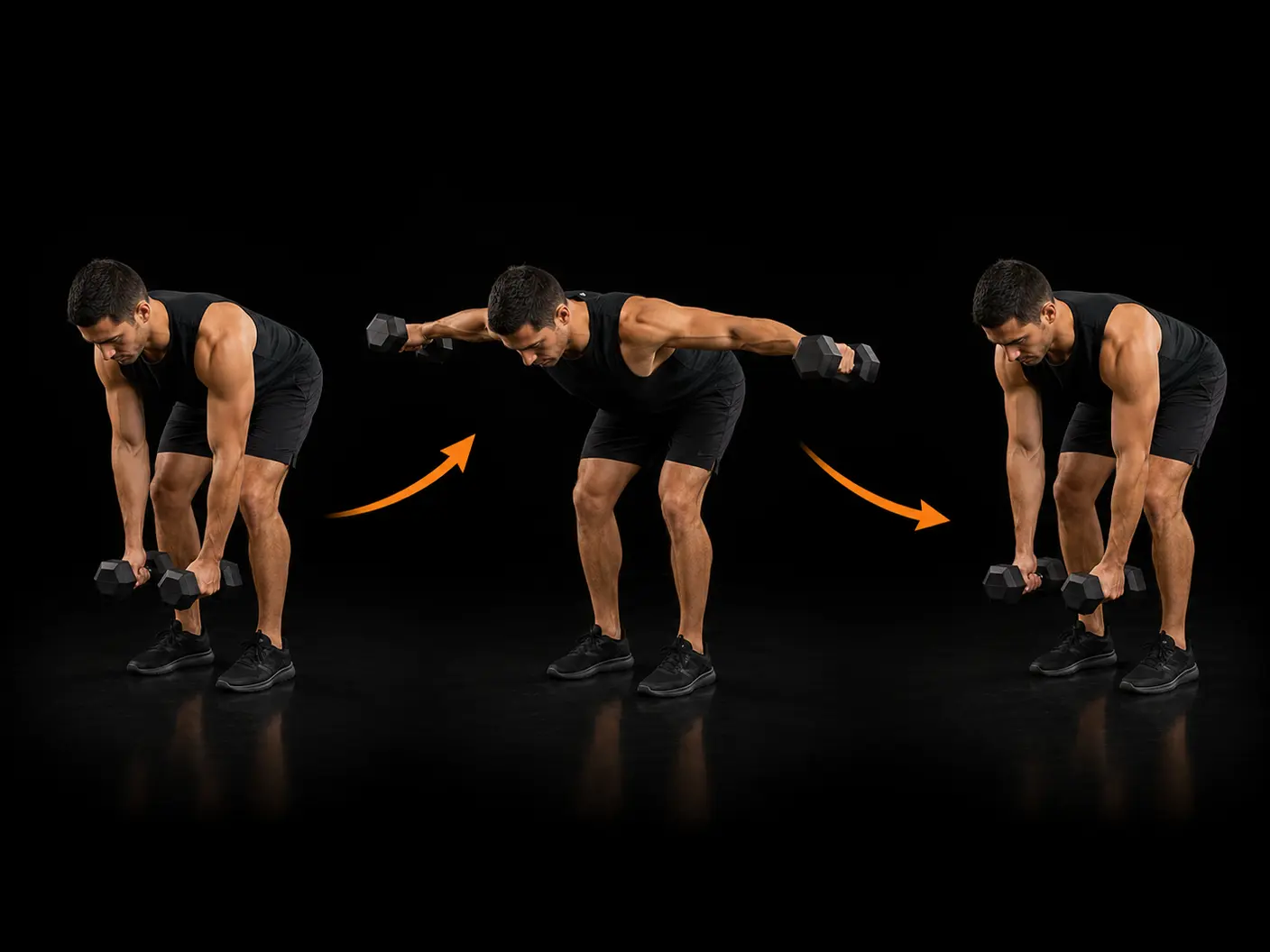
The bent-over dumbbell reverse fly is an isolation exercise that targets the posterior deltoid through a horizontal abduction pattern performed in a hip-hinged position. It develops the rear aspect of the shoulder — an area frequently underdeveloped relative to the pressing muscles — making it a reliable corrective and hypertrophy tool. It suits lifters at any stage, from those addressing postural imbalances to more advanced athletes seeking to balance shoulder development.
How to do it
Hinge at the hips to ~45° torso angle, slight knee bend. Dumbbells hang, palms facing each other, slight elbow bend. Raise the arms out to the sides in a wide arc to shoulder height. Pause; squeeze rear delts. Lower under control.
Coaching cues
- Slight elbow bend
- Lead with elbows
- Squeeze at peak
- Control the eccentric
Why train it
- Directly targets the posterior deltoid, a muscle that is chronically under-stimulated in programmes built around pressing and vertical pulling movements.
- The hip-hinged position isolates the rear delts by removing momentum and reducing the contribution of larger muscle groups, improving training precision.
- Secondary involvement of the middle trapezius and rhomboids supports upper-back thickness and contributes to scapular retraction strength.
- Because only dumbbells are required, the exercise is accessible across most training environments and easily scaled by adjusting load or rep range.
Common mistakes
- Using too much weight and swinging the torso upright — reduce the load and maintain a stable 45° hip hinge throughout every repetition.
- Straightening the arms fully, turning the movement into a straight-arm raise — keep a slight, consistent elbow bend to place the stress on the rear delts rather than the elbow joint.
- Shrugging the shoulders towards the ears as the arms rise — actively depress the shoulders and lead with the elbows to keep the trapezius from dominating the movement.
- Dropping the dumbbells quickly on the way down — control the eccentric phase deliberately, as this portion of the lift contributes significantly to muscle development.
Primary: Posterior Deltoid.
Secondary: Trapezius, Rhomboids.
Equipment
Good for
Easier variation
Chest-supported reverse fly on an incline bench.
Similar movements
Frequently asked
- What muscles does the bent-over dumbbell reverse fly work?
- The primary muscle worked is the posterior deltoid. The middle trapezius and rhomboids act as secondary muscles, assisting with scapular retraction at the top of the movement.
- How many sets and reps should I do for the bent-over reverse fly?
- For hypertrophy, 3–4 sets of 12–20 repetitions is a practical range, as the posterior deltoid responds well to moderate-to-higher rep work under controlled tempo. Keep rest periods to 60–90 seconds to maintain sufficient stimulus.
- What is the correct body angle for the bent-over reverse fly?
- Hinge at the hips until the torso is approximately 45° to the floor, with a slight bend in the knees for stability. A more horizontal torso increases the demand on the rear delts but requires good hamstring flexibility to hold safely.
- Can the bent-over reverse fly replace the face pull?
- Both exercises target the posterior deltoid, but they are not direct substitutes — the face pull also trains external rotation and involves the rotator cuff more directly. The reverse fly is a sound alternative when cables are unavailable, though including both in a programme is worthwhile where possible.
- Is the bent-over reverse fly suitable for beginners?
- Yes, it is classified as a foundational movement, meaning the mechanics are straightforward enough for newer lifters to learn with modest loads. Prioritise controlled technique and a stable hip-hinge position before increasing weight.
Want this movement in a plan built for you?
Adaptiv programmes the right exercises for your goal, equipment and experience — then adapts them as you train.
Build my programme