Rack Pause Back Squat
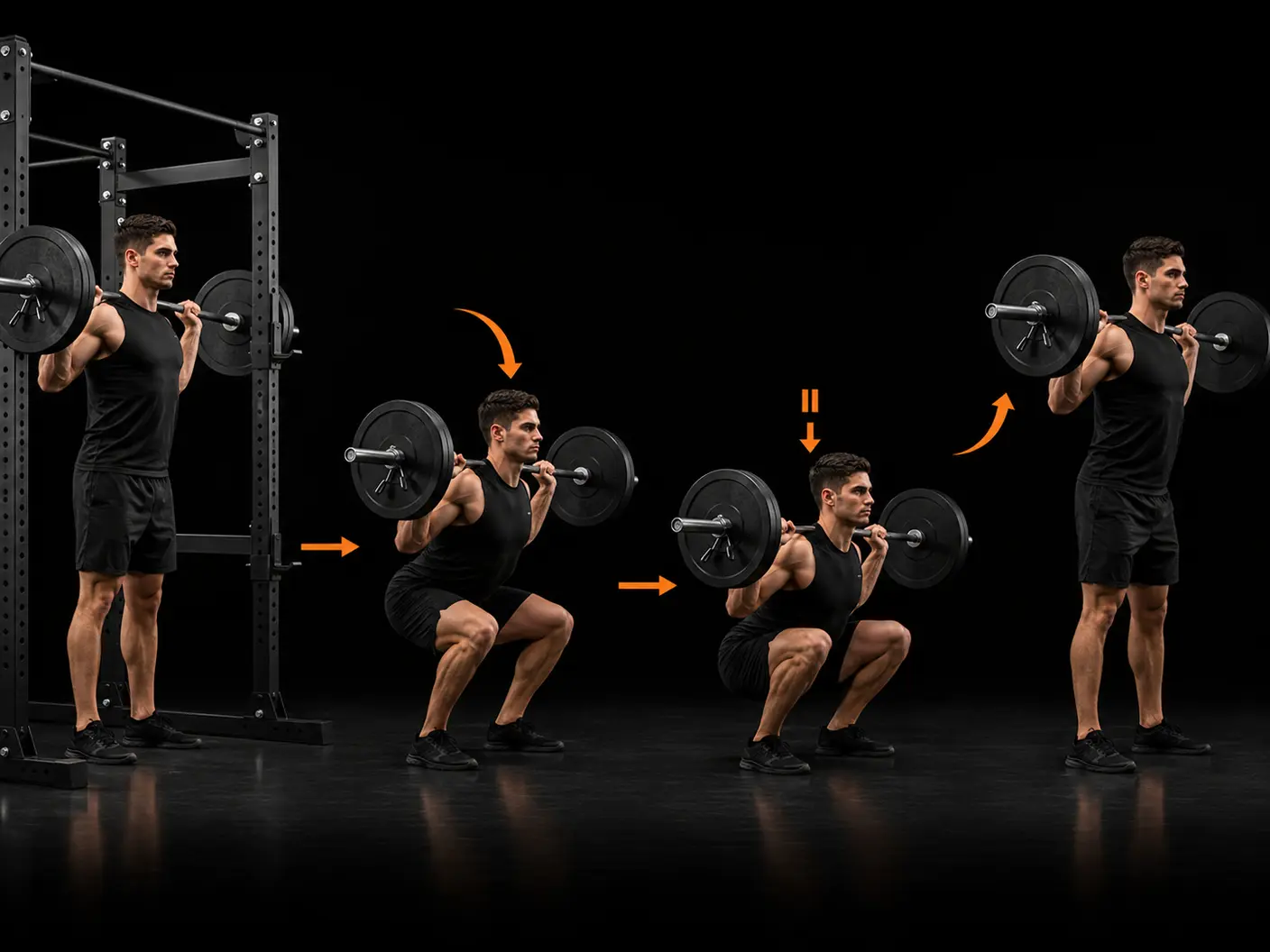
The rack pause back squat is a barbell compound movement in which the lifter descends to the bottom of a standard back squat and holds the position for two to three seconds before driving back to standing. By eliminating the stretch reflex — the natural elastic rebound that assists a conventional squat — the pause forces the muscles to produce force from a dead stop, exposing and addressing weaknesses in the bottom position. It is best suited to intermediate and advanced lifters who already possess sound squat mechanics and are looking to build maximal strength or break through sticking points.
How to do it
Execute a back squat, but pause for 2–3 seconds at the bottom. Stay tight — do not relax. Drive up explosively from the dead pause. The pause eliminates stretch reflex and exposes any weak points in the bottom position.
Coaching cues
- Hit depth and hold
- Stay tight
- No bounce
- Drive up hard
Why train it
- Removing the stretch reflex increases the muscular demand on the quadriceps and glutes, making each repetition significantly harder than its conventional counterpart at equivalent loads.
- The enforced pause develops positional strength and confidence in the deepest part of the squat, which is where most lifters experience their greatest technical breakdown under heavy loading.
- Sustained tension at the bottom of the movement reinforces core and erector bracing, building the trunk stability required to handle heavier barbell work over time.
- Because weak points cannot be masked by momentum, the exercise serves as an honest diagnostic tool for identifying and correcting technical inefficiencies in a lifter's squat pattern.
Common mistakes
- Relaxing into the pause — maintain full-body tension throughout the hold; any collapse in position will compromise the subsequent drive and place undue stress on the joints.
- Bouncing out of the bottom rather than pausing — count a genuine two to three seconds at depth before initiating the ascent, otherwise the purpose of the variation is entirely lost.
- Allowing the torso to fold forward during the hold — keep the chest up and the upper back braced so that the barbell stays centred over the mid-foot.
- Using loads that are too heavy for the bottom position — reduce the working weight relative to your conventional squat maximum, as the absence of the stretch reflex means significantly less load can be controlled with good form.
Primary: Quadriceps, Gluteus Maximus.
Secondary: Hamstrings, Rectus Abdominis, Erector Spinae.
Equipment
Good for
Easier variation
Back squat — remove the pause.
Similar movements
Frequently asked
- What muscles does the rack pause back squat work?
- The primary muscles trained are the quadriceps and glutes, which must produce force without elastic assistance from the bottom position. The hamstrings, core, and spinal erectors work as secondary stabilisers throughout the hold and the ascent.
- How much lighter should I go compared to my regular back squat?
- Most lifters find they need to reduce the bar weight by roughly 10–20 percent compared to their conventional back squat working loads. The exact reduction depends on individual strength in the bottom position, so treat your first session as a technical assessment rather than a max-effort session.
- What sets and reps work best for this exercise?
- For strength development, three to five sets of two to four repetitions at a challenging but technically sound load is a reliable starting point. Higher rep sets become difficult to execute with consistent pause quality, so keep volume per set conservative.
- Is this exercise suitable for beginners?
- No — the rack pause back squat is classified as an advanced movement and requires a well-established squat pattern before the variation adds value. Beginners should develop technique and positional awareness with a conventional back squat before introducing the pause.
- What are the best alternatives if I cannot yet do this movement?
- The goblet squat pause is a more accessible introduction to bottom-position holds, as the counterbalance of the weight makes it easier to maintain an upright torso. A box squat is another option that trains strength from a stopped position while offering a degree of additional stability.
Want this movement in a plan built for you?
Adaptiv programmes the right exercises for your goal, equipment and experience — then adapts them as you train.
Build my programme