Preacher Curl (Barbell or Dumbbell)
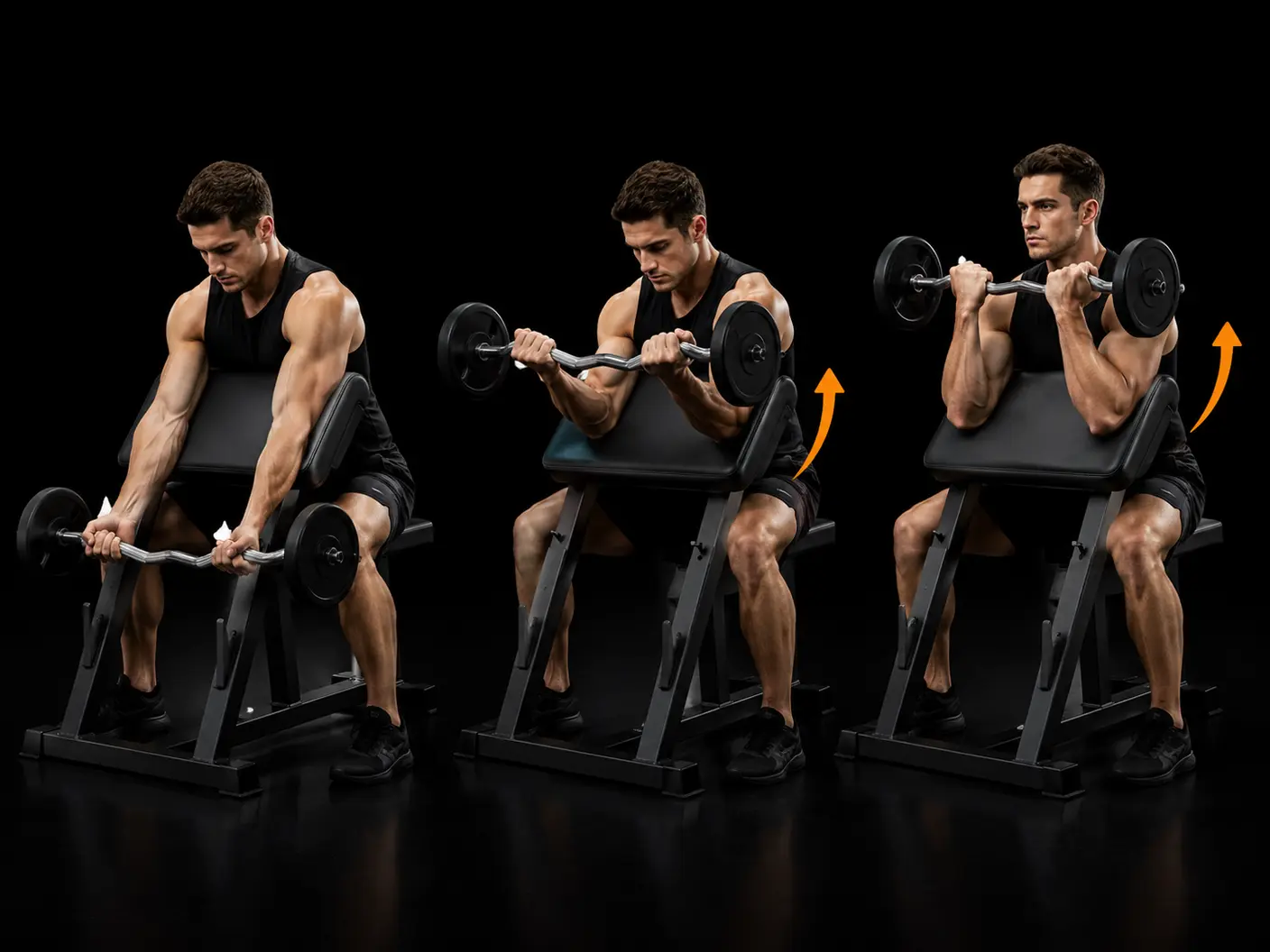
The preacher curl is an isolation exercise for the elbow flexors, performed on a preacher bench that pins the upper arms against an angled pad throughout the lift. By removing the ability to swing or cheat, it places sustained mechanical tension on the biceps brachii — particularly the short head — across a full range of motion. It suits lifters at any experience level who want to develop arm size and are comfortable with foundational isolation work.
How to do it
Sit at a preacher bench, upper arms flat on the pad. Grip the bar or dumbbells. Start in the fully extended position. Curl up to peak contraction; do not let the elbows lift off the pad. Lower under control to full extension.
Coaching cues
- Arms pinned to pad
- Full range
- Slow eccentric
- No rest at the bottom
Why train it
- The preacher bench eliminates momentum and body English, ensuring the biceps brachii and brachialis do the work rather than the shoulders or torso.
- Keeping the arms fully extended at the bottom of each rep places the biceps under load at a long muscle length, a position associated with meaningful hypertrophic stimulus.
- Using dumbbells allows each arm to work independently, which is useful for identifying and addressing strength or size asymmetries between limbs.
- The fixed arm position makes technique straightforward to self-monitor, making this a reliable exercise to programme consistently across a mesocycle.
Common mistakes
- Allowing the elbows to rise off the pad during the curl — keep them pressed firmly into the pad for the entire repetition so the biceps cannot offload tension to the shoulder.
- Resting at the bottom of the rep — maintain muscular tension through the fully extended position and begin the next curl immediately to preserve time under tension.
- Using a load that forces a shortened range — select a weight that allows full extension and a genuine peak contraction; partial reps here largely defeat the purpose of the setup.
- Rushing the eccentric — lower the bar or dumbbells under deliberate control, as a slow lowering phase extends time under tension and reinforces the strength gains the exercise is designed to produce.
Primary: Biceps Brachii.
Secondary: Brachialis.
Equipment
Good for
Easier variation
EZ-bar preacher curl — easier on the wrists.
Similar movements
Frequently asked
- What muscles does the preacher curl work?
- The primary muscle trained is the biceps brachii, with particular emphasis on its short head due to the forward position of the upper arm. The brachialis, which runs beneath the biceps, works as a secondary elbow flexor throughout the movement.
- How many sets and reps should I do on the preacher curl?
- For hypertrophy — the primary goal this exercise is designed to support — three to four sets of eight to twelve repetitions works well for most lifters. Rest ninety seconds to two minutes between sets and prioritise full range of motion over load.
- Is the preacher curl better with a barbell or dumbbells?
- Both are effective. The barbell allows you to manage a single load across both arms and is often easier to progress in small increments, while dumbbells allow independent range of motion and can help correct side-to-side imbalances. Rotating between the two across a programme is a practical approach.
- Can the preacher curl replace the standing barbell curl?
- The preacher curl and standing curl are complementary rather than interchangeable. The preacher version constrains the arms and emphasises the short head at a lengthened position, whereas standing curls allow more natural shoulder involvement and tend to suit heavier loading. Including both in a programme is more effective than choosing one exclusively.
- Is the preacher curl suitable for beginners?
- Yes — it is classified as a foundational movement, and the preacher bench actually makes technique easier to maintain than free-standing curl variations because it removes the temptation to swing. Beginners should focus on selecting a manageable load, achieving full extension at the bottom, and controlling the lowering phase.
Want this movement in a plan built for you?
Adaptiv programmes the right exercises for your goal, equipment and experience — then adapts them as you train.
Build my programme