One-Arm Landmine Row
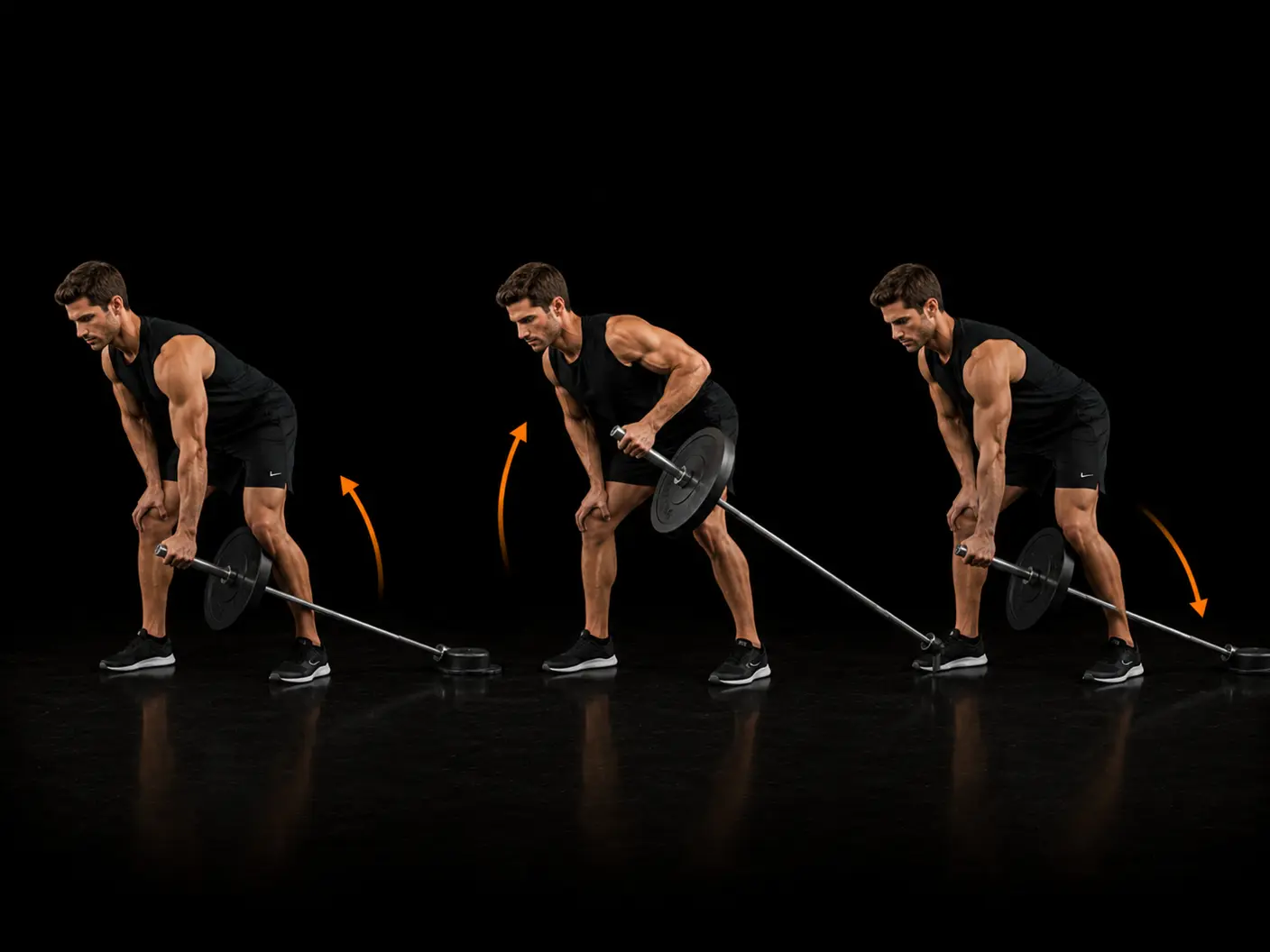
The one-arm landmine row is a compound horizontal pulling movement performed with a barbell fixed in a landmine attachment. One hand rows the bar end to the hip while the opposite hand braces on the knee, demanding active anti-rotation through the torso throughout the lift. It suits intermediate trainees looking to build unilateral back strength with a loading angle that is naturally joint-friendly and easy to learn.
How to do it
Set a barbell in a landmine. Hinge into a row position, one hand braced on the knee, the other gripping the end of the bar. Row the bar end to the hip by driving the elbow back. Resist rotation through the torso. Lower under control.
Coaching cues
- Elbow drives back
- Resist rotation
- Hinge and hold
- Squeeze the lat
Why train it
- Training one side at a time exposes and addresses strength imbalances between the left and right sides of the upper back.
- The fixed arc of the landmine attachment guides the bar through a consistent path, making it easier to maintain a strong hinge position under load than with a free dumbbell.
- The demand to resist torso rotation recruits the core as a stabiliser, adding trunk anti-rotation work without a dedicated accessory exercise.
- Directly loading the latissimus dorsi, rhomboids, and middle trapezius in a single movement makes it an efficient choice for back hypertrophy within a programme.
Common mistakes
- Rotating the torso to complete the rep — brace the core and keep the hips square so only the arm moves, not the entire upper body.
- Pulling with the biceps rather than driving the elbow back — cue the elbow to lead the movement so the back musculature does the work.
- Losing the hip hinge and standing upright — maintain the hinge position throughout the set so the torso angle stays consistent from first rep to last.
- Lowering the bar too quickly — control the descent at the same tempo as the pull to keep the lats under tension through the full range of motion.
Primary: Latissimus Dorsi, Rhomboids, Trapezius.
Secondary: Biceps Brachii, Posterior Deltoid, Obliques.
Equipment
Good for
Easier variation
Single-arm DB row — same unilateral target.
Similar movements
Frequently asked
- What muscles does the one-arm landmine row work?
- The primary muscles are the latissimus dorsi, rhomboids, and middle trapezius. The biceps and rear deltoid contribute as secondary movers, and the core works isometrically to resist rotation throughout each rep.
- How many sets and reps should I do for the one-arm landmine row?
- For hypertrophy, three to four sets of eight to twelve reps per side works well, with load chosen so the final two reps are genuinely challenging. For athletic performance with a strength emphasis, four sets of five to eight reps at a heavier load is a reasonable starting point.
- Do I need a landmine attachment, or can I improvise?
- A dedicated landmine attachment is the most stable option, but many gyms allow the barbell to be wedged into a corner with a folded towel to protect the floor — check your gym's policy before doing so, as this is not universally permitted.
- Is the one-arm landmine row suitable for beginners?
- It is rated as an intermediate movement primarily because it requires a stable hip hinge and the coordination to resist rotation under load simultaneously. Beginners who have already developed a reliable hinge pattern can progress to it relatively quickly, but those new to resistance training may benefit from mastering a dumbbell row first.
- What are good alternatives if I do not have landmine equipment?
- The dumbbell single-arm row follows the same horizontal pull pattern and targets the same primary muscles. A cable seated row or chest-supported dumbbell row can also replicate the movement demand if a landmine setup is unavailable.
Want this movement in a plan built for you?
Adaptiv programmes the right exercises for your goal, equipment and experience — then adapts them as you train.
Build my programme