Low-Bar Squat
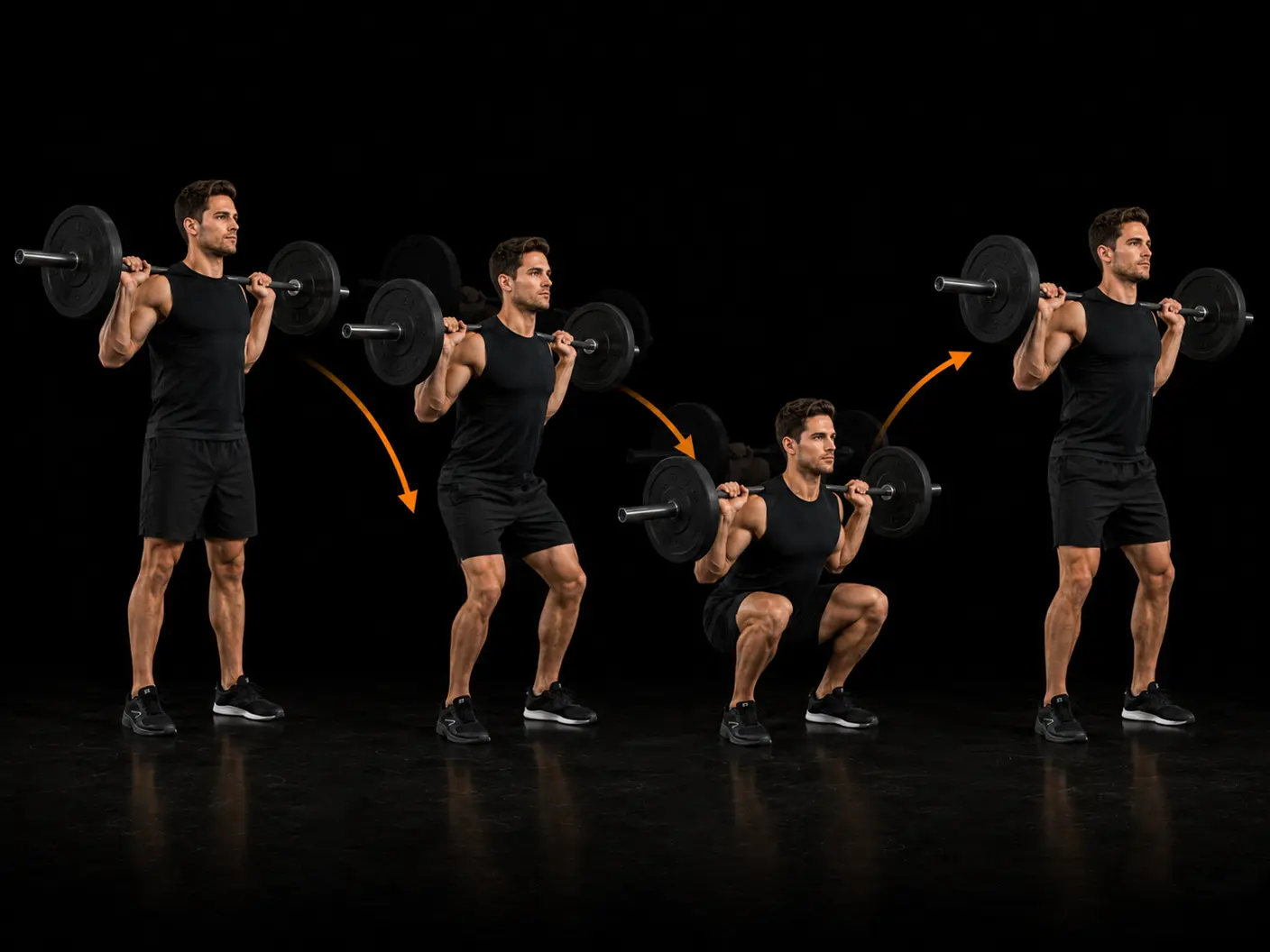
The low-bar squat is a barbell compound movement in which the bar rests on the rear deltoids rather than the upper traps, shifting the load posterior and demanding greater hip and hamstring involvement than its high-bar counterpart. The forward torso lean this position requires places significant demand on the posterior chain — glutes, hamstrings, and erectors — making it the squat variation of choice for maximising total load moved. It suits intermediate to advanced lifters who have already built a reliable squat pattern and are pursuing strength, hypertrophy, or sport-specific power output.
How to do it
Set the bar low on the upper back, resting on the rear deltoids just below the spine of the scapula. Grip wide to lock the bar in place; elbows pointing down and back. Feet shoulder-width, toes 15–30° out. Break at hips and knees simultaneously; sit back more than down — torso leans forward more than in high-bar. Descend to parallel. Drive through mid-foot, hips and shoulders rising together.
Coaching cues
- Bar on the rear delts
- Elbows down
- Sit back
- Hips and shoulders rise together
Why train it
- The lower bar position increases the moment arm at the hip, allowing most lifters to squat heavier absolute loads than with a high-bar setup, making it highly effective for building maximal strength.
- By distributing work across the glutes, hamstrings, quadriceps, and adductors simultaneously, the movement delivers a substantial hypertrophy stimulus to the entire lower body in a single pattern.
- The demand placed on the erectors and upper back to maintain bar position under load develops the posterior chain musculature that underpins performance in most field and court sports.
- Because the movement requires co-ordination across multiple joints and muscle groups under a heavy barbell, it is an efficient use of training time for athletes and strength-focused lifters alike.
Common mistakes
- Allowing the elbows to drift upward — keep them pointed down and back throughout the lift to maintain bar security on the rear deltoids and prevent the bar rolling up the spine.
- Descending straight down rather than sitting back — initiate by pushing the hips rearward so the torso leans forward appropriately, keeping the bar over mid-foot.
- Letting the hips rise faster than the shoulders out of the bottom — cue hips and shoulders to ascend at the same rate to avoid the lift collapsing into a good morning.
- Placing the feet too narrow or toes too forward — a shoulder-width stance with toes turned 15–30° out gives the hips room to track correctly and reach depth without compensation.
Primary: Gluteus Maximus, Hamstrings, Quadriceps.
Secondary: Erector Spinae, Adductors, Rhomboids, Rectus Abdominis.
Equipment
Good for
Easier variation
Box squat — teaches the hip-back movement pattern with a safety landing.
Similar movements
Frequently asked
- What muscles does the low-bar squat work?
- The primary muscles trained are the glutes, hamstrings, and quadriceps. The erectors, adductors, upper back, and core all contribute as secondary stabilisers, making it one of the most complete lower-body movements available.
- How is the low-bar squat different from the high-bar squat?
- In the low-bar squat the bar sits on the rear deltoids, which creates a more forward torso angle and shifts emphasis toward the glutes, hamstrings, and adductors. The high-bar variation keeps the torso more upright and places comparatively greater demand on the quadriceps.
- What sets and reps should I use for the low-bar squat?
- For maximal strength, sets of 1–5 reps at 80–95% of one-rep max with ample rest between sets is a well-established approach. For hypertrophy, 3–5 sets of 5–8 reps at moderate to high intensity allows sufficient volume while managing fatigue on a technically demanding lift.
- Is the low-bar squat suitable for beginners?
- This variation is rated advanced and is best approached once a lifter has developed reliable squat mechanics, hip mobility, and wrist and shoulder flexibility adequate to hold the bar position safely. Beginners are generally better served starting with a goblet squat or high-bar barbell squat before progressing here.
- What are good alternatives if I cannot get into the low-bar position?
- Limited wrist, shoulder, or thoracic mobility can make the low-bar position uncomfortable; in those cases a high-bar squat, safety-bar squat, or leg press can provide a comparable lower-body stimulus while the relevant mobility is developed. A qualified coach can assess which alternative best suits your current capacity.
Want this movement in a plan built for you?
Adaptiv programmes the right exercises for your goal, equipment and experience — then adapts them as you train.
Build my programme