Kettlebell Snatch
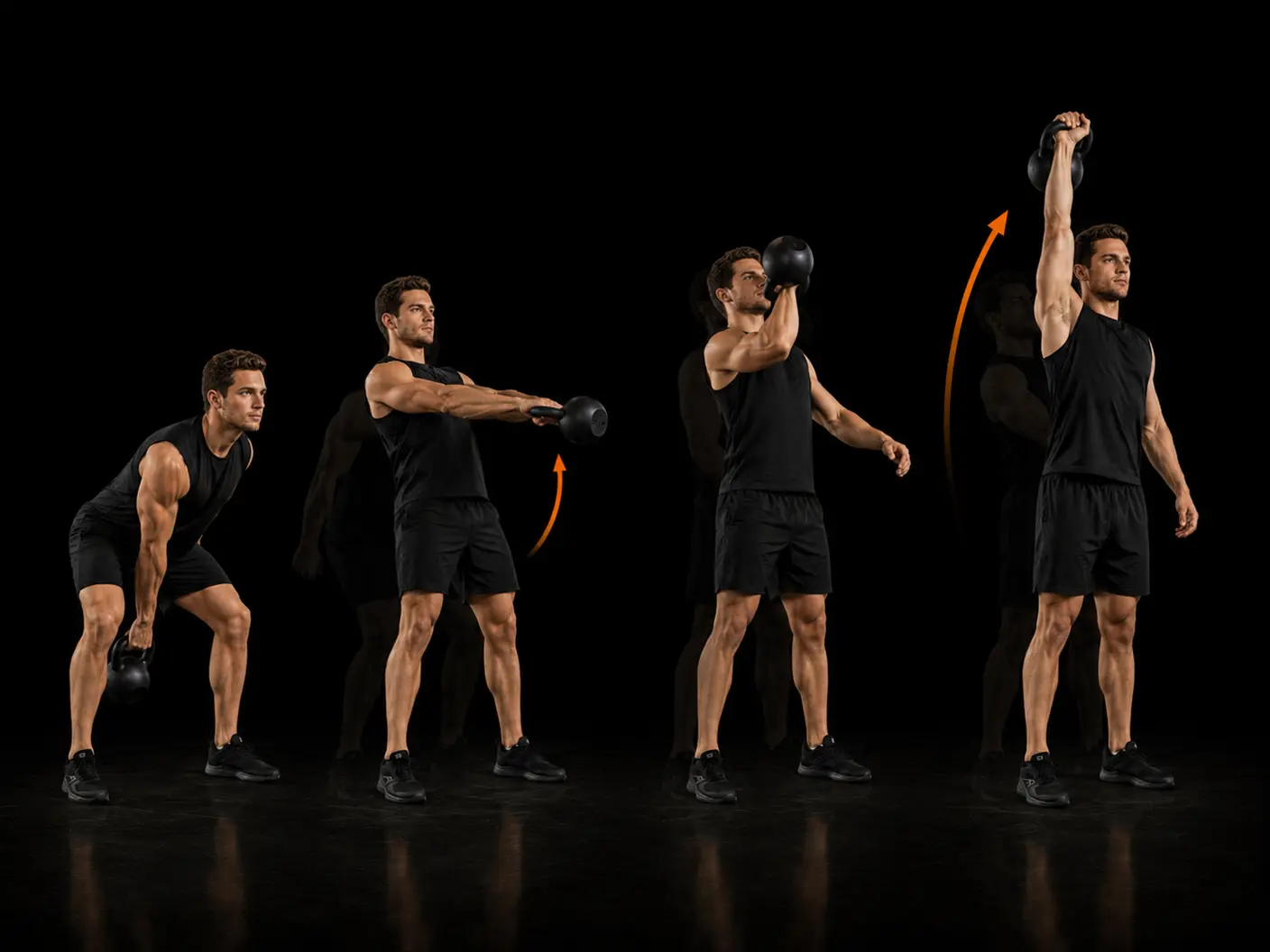
The kettlebell snatch is a single-arm ballistic movement that trains the full power pattern — loading the posterior chain through a hike pass and converting hip drive into overhead lockout in one continuous arc. It demands coordination across the glutes, hamstrings, quads, shoulders, traps, lats, core, and forearms, making it one of the most complete exercises a single implement can offer. It suits advanced trainees who already have a solid hip hinge, a confident swing, and the wrist mobility to receive the bell overhead without force.
How to do it
Set a kettlebell between the feet. Hinge and grip with one hand. Swing the bell back between the thighs. Drive the hips forward; as the bell rises, pull the elbow high and punch the hand through to lock out overhead. The bell rotates around the wrist — receive softly.
Coaching cues
- Hike pass
- Hip drive
- Punch through
- Soft lockout
Why train it
- The ballistic hip extension recruits the glutes and hamstrings maximally, developing the kind of rate-of-force development that transfers directly to athletic performance.
- Because the movement is cyclical and full-body, it elevates heart rate rapidly, making it an efficient choice within fat-loss programmes where training time is limited.
- Locking out a single-arm load overhead challenges the shoulder stabilisers and the lats simultaneously, building overhead strength and scapular control in a dynamic rather than purely static context.
- The rotational demand placed on the forearms and the grip throughout the hike, pull, and punch sequence builds grip endurance that carries over to a wide range of pulling movements.
Common mistakes
- Muscling the bell up with the arm — let the hip drive generate the momentum and keep the arm relaxed until the high-pull phase begins.
- Allowing the bell to crash onto the wrist at lockout — practise the punch-through cue deliberately so the hand rotates around the bell smoothly and the wrist receives it softly.
- Cutting the hike pass short — swing the bell back firmly between the thighs to create sufficient load on the posterior chain before the hip drive fires.
- Hyperextending at the top — brace the core and glutes at lockout rather than leaning back, keeping the body in a tall, stacked position under the bell.
Primary: Gluteus Maximus, Hamstrings, Quadriceps, Trapezius.
Secondary: Rectus Abdominis, Latissimus Dorsi, Forearm Flexors, Anterior Deltoid.
Equipment
Good for
Easier variation
Kettlebell swing — power generation without the overhead catch.
Similar movements
Frequently asked
- What muscles does the kettlebell snatch work?
- The primary muscles are the glutes, hamstrings, quads, and shoulders, which drive the movement and stabilise the overhead lockout. The core, traps, lats, and forearms work as secondary contributors throughout the pull and the receiving position.
- How many sets and reps should I do for the kettlebell snatch?
- For athletic performance, sets of 5–8 reps per arm with adequate rest — typically 90 seconds to 2 minutes — allow you to maintain quality across each rep. For conditioning or fat-loss goals, timed sets of 20–40 seconds per arm with shorter rest periods are commonly programmed, though only once technique is reliable under fatigue.
- Is the kettlebell snatch suitable for beginners?
- It is classified as an advanced movement and is not well-suited to beginners. A solid foundation in the hip hinge, the two-arm swing, and the single-arm swing should be in place before attempting the snatch.
- What are good alternatives to the kettlebell snatch?
- The kettlebell swing trains the same posterior-chain power pattern with lower technical demand and is the most direct regression. The dumbbell hang power snatch is another option for those without kettlebell access, though the wrist rotation element differs.
- Can the kettlebell snatch help with fat loss?
- It is well-suited to fat-loss programmes because the compound, ballistic nature of the movement involves a large amount of muscle mass and sustains an elevated metabolic demand throughout the set. It is most effective in this context when programmed with appropriate work-to-rest ratios and consistent technique.
Want this movement in a plan built for you?
Adaptiv programmes the right exercises for your goal, equipment and experience — then adapts them as you train.
Build my programme