JM Press
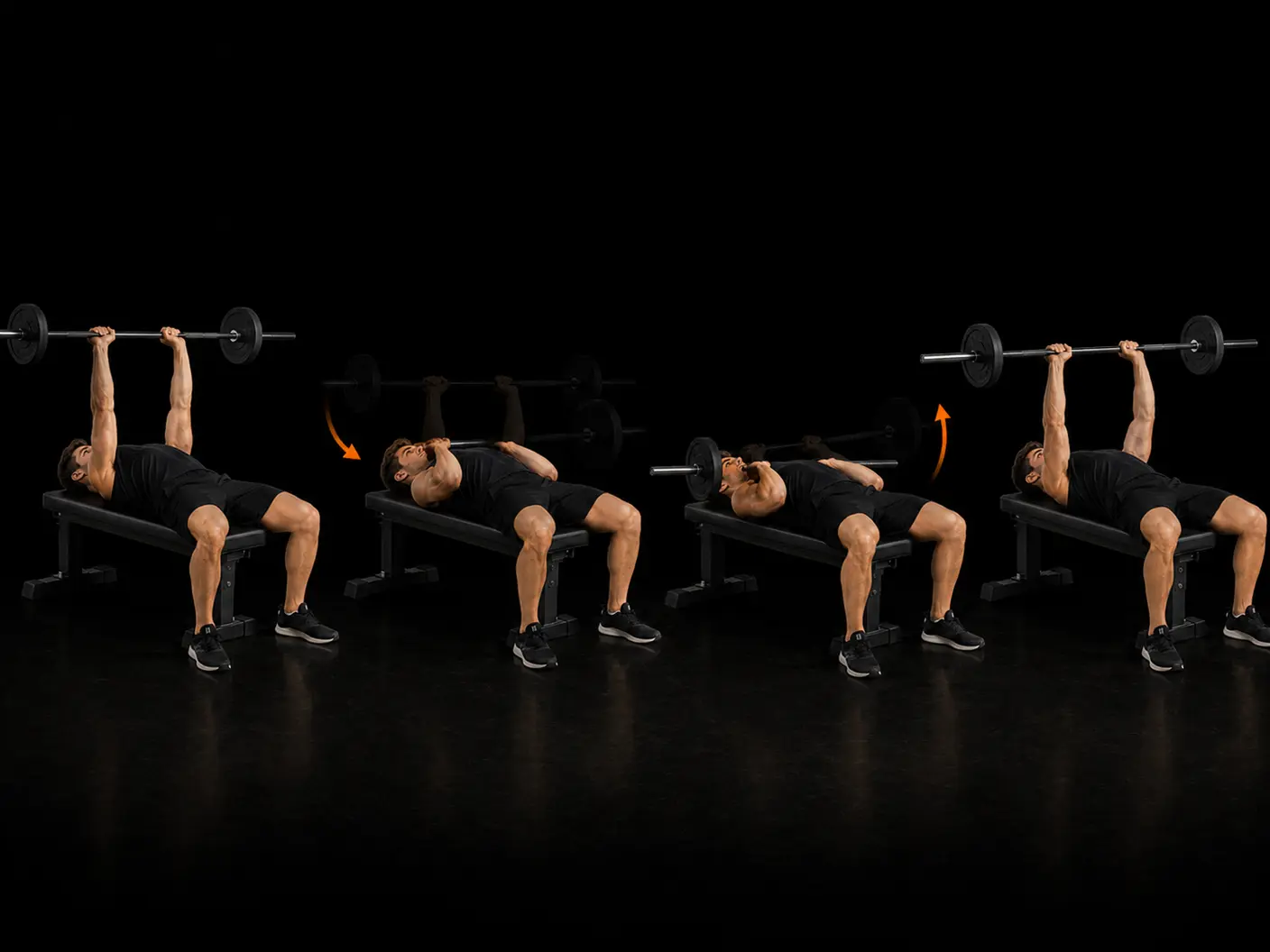
The JM press is an advanced barbell compound movement performed on a flat bench that blends the mechanics of a close-grip bench press and a skull crusher into a single hybrid action. The bar travels a diagonal path — elbows angled forward, lowering to the upper chest or lower neck — placing sustained tension through the triceps brachii and pectoralis major simultaneously. It suits intermediate to advanced lifters who already have a solid foundation in both pressing and triceps isolation work and are looking to build upper-body pressing strength.
How to do it
Lie on a bench as for close-grip bench. Grip shoulder-width. Lower the bar in a hybrid path — halfway between a bench press and a skull crusher. The bar travels to the upper chest / lower neck with elbows forward. Press back up.
Coaching cues
- Hybrid path
- Elbows forward
- Bar to the upper chest
- Powerful lockout
Why train it
- The hybrid bar path maximises triceps brachii involvement across a longer range of motion than a standard close-grip press, making it highly effective for triceps hypertrophy.
- Loading the pectoralis major alongside the triceps means the JM press builds compound pressing strength that transfers directly to the lockout phase of the bench press.
- The fixed barbell demands precise bilateral coordination and elbow control, developing the motor patterns and structural resilience needed for heavier overhead and horizontal pressing work.
- As a single movement, it reduces the need for multiple isolation exercises when programming time is limited, efficiently targeting the primary movers in one working set.
Common mistakes
- Letting the elbows flare out wide — keep them angled forward throughout the descent so the bar travels the intended hybrid path rather than defaulting to a standard bench press arc.
- Allowing the bar to drift too low toward the sternum — aim for the upper chest or lower neck area to preserve the correct diagonal path and maintain triceps tension.
- Using a grip that is too wide — a shoulder-width grip is correct for this movement; a wider grip shifts mechanics toward a conventional press and reduces triceps contribution.
- Rushing through the lockout — finish each repetition with a deliberate, powerful elbow extension rather than bouncing out of the bottom, which undermines both strength adaptation and control.
Primary: Triceps Brachii, Pectoralis Major.
Secondary: Anterior Deltoid.
Equipment
Good for
Easier variation
Close-grip bench press — standard path, easier to learn.
Similar movements
Frequently asked
- What muscles does the JM press work?
- The primary muscles are the triceps brachii and pectoralis major. The anterior deltoid works as a secondary contributor to stabilise and assist the pressing action.
- How many sets and reps should I do for the JM press?
- For strength, three to five sets of three to six repetitions at a challenging load works well. For hypertrophy, three to four sets of six to ten repetitions with controlled eccentric tempo is a practical starting point. Allow adequate rest between sets given the compound demand on the elbows and shoulders.
- Is the JM press suitable for beginners?
- It is rated advanced and is not recommended as a starting point. A lifter should first demonstrate consistent technique on the close-grip bench press and skull crusher separately before combining the two movement patterns under load.
- What are good alternatives to the JM press?
- The close-grip bench press and the barbell skull crusher are the most direct alternatives, as they share the same equipment and target the same primary muscles. Either can be substituted if the hybrid path proves difficult to control.
- Will the JM press help my bench press?
- Because the movement heavily loads the triceps through a pressing pattern, it can contribute to improved lockout strength, which is a common limiting factor in the bench press. It should be programmed as an accessory lift rather than a replacement for the bench press itself.
Want this movement in a plan built for you?
Adaptiv programmes the right exercises for your goal, equipment and experience — then adapts them as you train.
Build my programme