Inverted Row (Table Row)
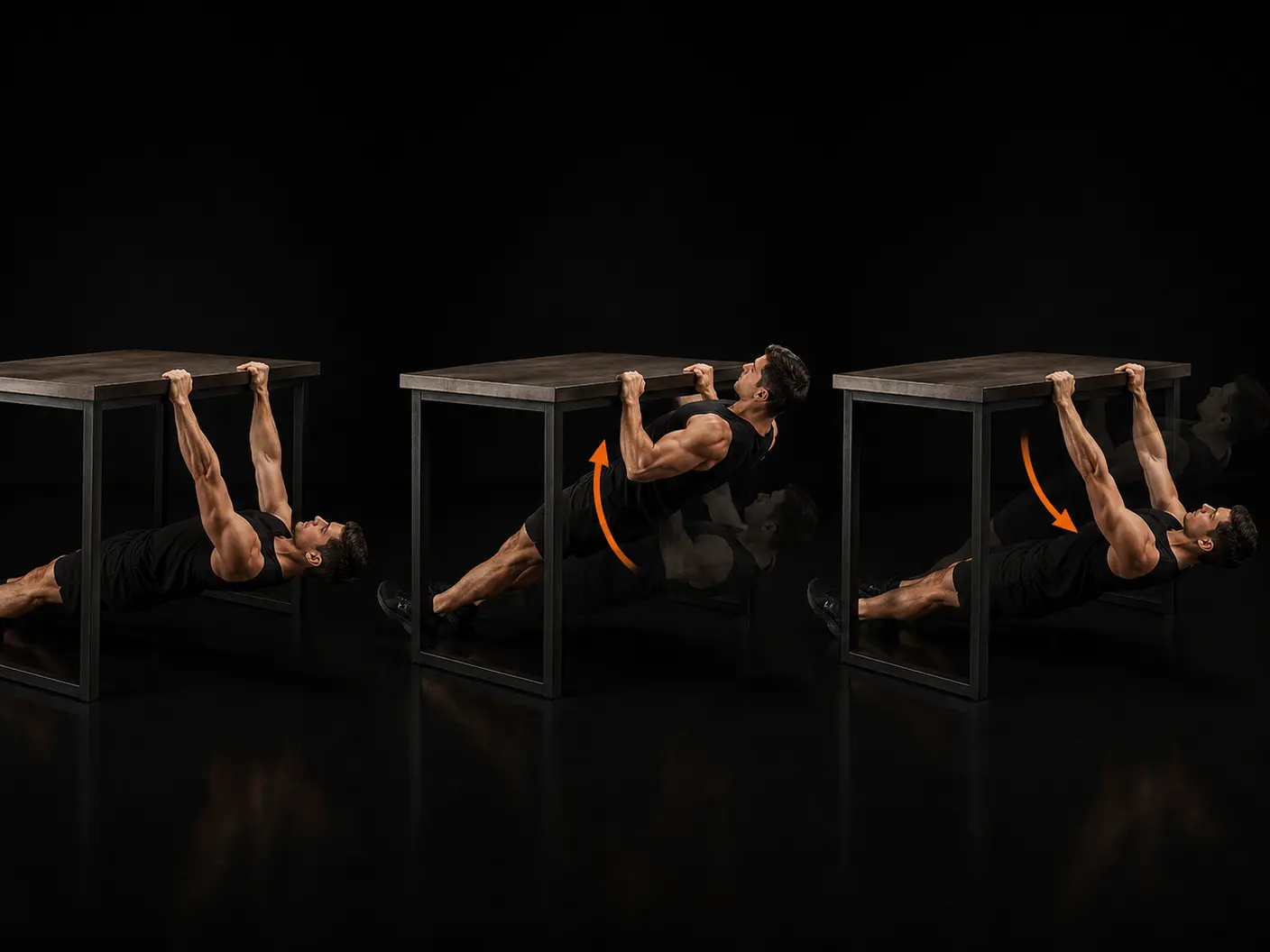
The inverted row, sometimes called the table row, is a horizontal pulling exercise performed lying beneath a sturdy table or low bar and rowing the bodyweight upward to the surface. It trains the same pulling pattern as a bent-over row or cable row but uses bodyweight as resistance, making load management straightforward — simply adjust foot position to increase or decrease difficulty. It suits beginners building a foundation in pulling mechanics as well as intermediate lifters who want a low-equipment option for upper-back development.
How to do it
Lie under a sturdy table or low bar positioned at hip height. Grip the edge with an overhand grip slightly wider than shoulder-width. Extend the body in a straight line from heel to head, arms fully extended. Pull the chest up to the bar by driving the elbows toward the hips and squeezing the shoulder blades together. Lower under control.
Coaching cues
- Body stays straight
- Pull elbows to hips
- Chest to bar
- Shoulders back and down
Why train it
- It develops the latissimus dorsi, rhomboids, and middle trapezius simultaneously, reinforcing the scapular retraction and depression that underpins healthy shoulder mechanics.
- Because the body is supported horizontally, the lumbar spine is under minimal compressive load, making it a practical pulling option when heavy barbell work is not appropriate.
- Foot position can be adjusted in seconds — heels closer to the body reduces the load, feet further away increases it — giving a wide effective rep range without additional equipment.
- The requirement to hold a rigid plank position throughout the set means the core and rear deltoids are trained as secondary movers alongside the primary back muscles.
Common mistakes
- Letting the hips sag toward the floor — brace the core and glutes before the first rep and maintain that tension so the body moves as a single unit throughout the set.
- Flaring the elbows out to the sides rather than driving them toward the hips — keep the elbows tracking close to the torso to ensure the lats and rhomboids do the majority of the work.
- Using momentum or a swinging motion to initiate the pull — start each rep from a dead hang with arms fully extended and initiate deliberately through the shoulder blades before the arms bend.
- Allowing the shoulders to shrug upward toward the ears at the top of the movement — actively retract and depress the shoulder blades so the chest reaches the bar with the shoulders packed back and down.
Primary: Latissimus Dorsi, Rhomboids, Trapezius.
Secondary: Biceps Brachii, Posterior Deltoid, Rectus Abdominis.
Equipment
Good for
Easier variation
Bent-knee inverted row — bend the knees to reduce the load.
Similar movements
Frequently asked
- What muscles does the inverted row work?
- The primary movers are the latissimus dorsi, rhomboids, and middle trapezius, which drive scapular retraction and shoulder extension. The biceps and rear deltoids contribute as secondary movers, and the core musculature works continuously to keep the body in a straight line.
- How many sets and reps should I do for the inverted row?
- For hypertrophy, three to four sets of eight to fifteen reps with two minutes' rest works well. For general strength and movement quality, three sets of six to ten controlled reps is a sensible starting point. Adjust foot position to ensure the chosen rep range is genuinely challenging by the final two reps.
- Is the inverted row suitable for beginners?
- It is accessible to most beginners because the movement pattern is intuitive and the load can be reduced immediately by bending the knees and placing the feet flat on the floor. Once that variation is manageable for sets of twelve to fifteen reps with good form, progressing to straight legs is a natural next step.
- What are good alternatives if I cannot do an inverted row?
- Seated cable rows and resistance band rows train the same horizontal pulling pattern and allow precise load selection. If the goal is specifically to build toward pull-ups or chin-ups, lat pulldowns are a close vertical-pull alternative that shares much of the same primary musculature.
- Can I do the inverted row to build a bigger back?
- Yes — when programmed with sufficient volume and progressive overload (achieved by adjusting foot position, adding a weighted vest, or slowing the eccentric), the inverted row provides meaningful stimulus for hypertrophy in the rhomboids, middle trapezius, and lats. It works particularly well as an accessory movement alongside heavier compound lifts such as deadlifts or barbell rows.
Want this movement in a plan built for you?
Adaptiv programmes the right exercises for your goal, equipment and experience — then adapts them as you train.
Build my programme