Inverted Row (Ring Row)
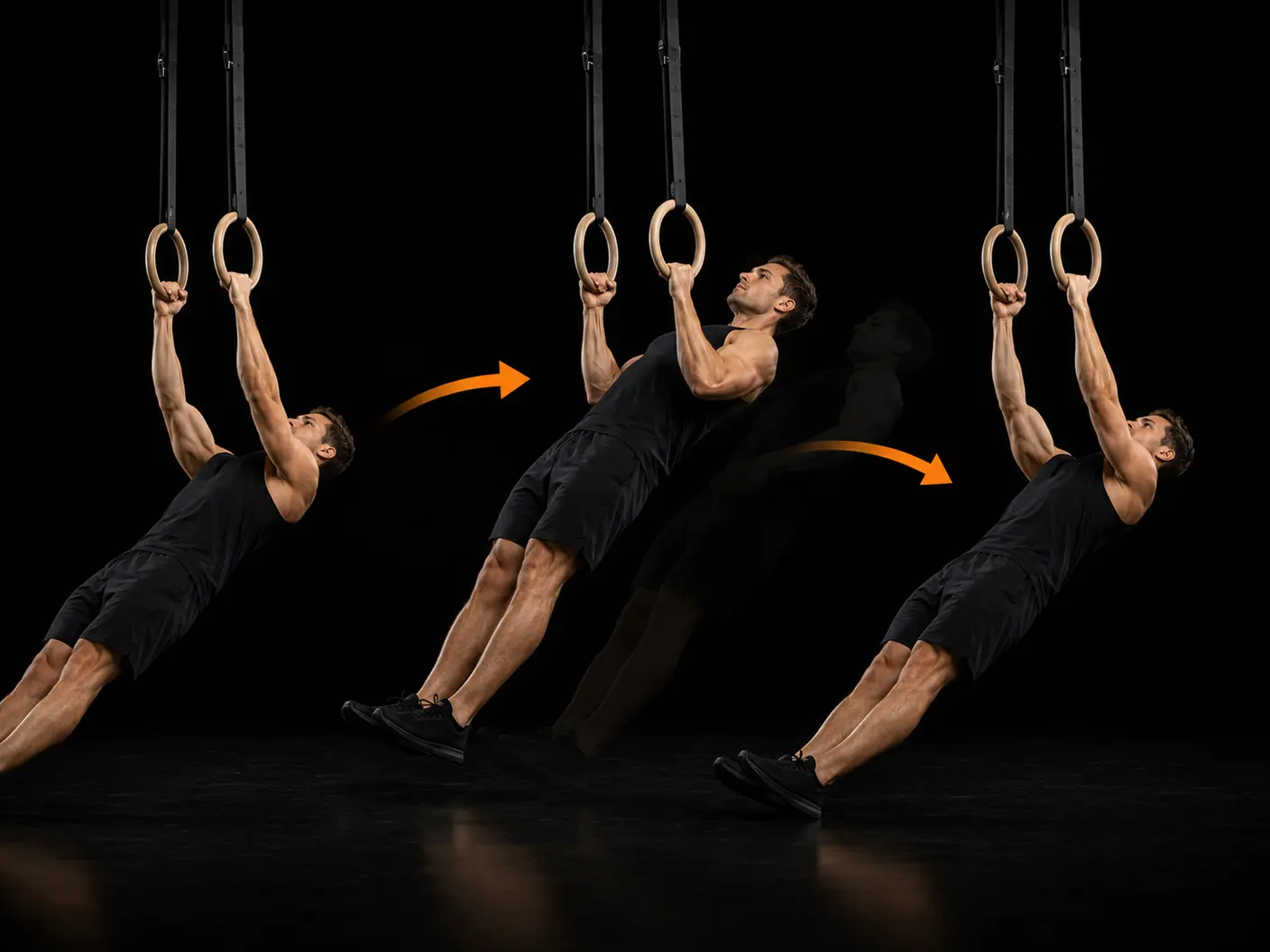
The inverted row — performed on a fixed bar, gymnastic rings, or TRX — is a horizontal pulling exercise that trains the mid-back, lats, and rear shoulder in a bodyweight or partially loaded environment. Because the lifter controls difficulty by adjusting body angle, it suits a wide range of trainees, from those building a base for more demanding pulling work to intermediate lifters seeking additional horizontal pull volume. It is a reliable complement to any pressing-heavy programme.
How to do it
Set a bar in a rack at hip height, or rings/TRX similar. Lie underneath; grip the bar shoulder-width. Heels on the floor, body in a straight line. Pull the chest to the bar by driving the elbows back and squeezing the shoulder blades. Lower under control.
Coaching cues
- Plank from head to heels
- Drive elbows back
- Chest to the bar
- Squeeze the mid-back
Why train it
- It develops the middle trapezius, rhomboids, and latissimus dorsi simultaneously, making it an efficient choice for improving overall posterior chain thickness and posture.
- The requirement to maintain a straight line from head to heels means the core is trained as a stabiliser throughout every repetition, adding trunk work without a dedicated isolation exercise.
- Difficulty scales simply by raising or lowering the bar or rings, allowing the same movement to serve a beginner and an experienced lifter within the same session structure.
- Performing horizontal pulls alongside vertical pressing movements helps balance shoulder loading, which is a practical consideration in programmes that include significant bench or overhead work.
Common mistakes
- Allowing the hips to sag toward the floor — brace the glutes and abdomen before the pull and maintain a rigid plank position from head to heels throughout the set.
- Pulling with the arms rather than initiating through the shoulder blades — focus on driving the elbows back and squeezing the mid-back first, letting the biceps follow rather than lead.
- Flaring the elbows out wide — keep them tracking back and slightly in toward the torso to ensure the rhomboids and mid-traps are the primary drivers of the movement.
- Using momentum to complete the final reps — lower each repetition under deliberate control so the posterior shoulder and mid-back receive stimulus in both the concentric and eccentric phases.
Primary: Trapezius, Rhomboids, Latissimus Dorsi.
Secondary: Biceps Brachii, Posterior Deltoid, Rectus Abdominis.
Equipment
Good for
Easier variation
Incline inverted row (bar higher) — reduces bodyweight load.
Similar movements
Frequently asked
- What muscles does the inverted row work?
- The primary muscles are the middle trapezius, rhomboids, and latissimus dorsi, which drive the horizontal pulling motion. The biceps, rear deltoid, and core all contribute as secondary muscles, with the core acting as a stabiliser to keep the body in a straight line.
- How many sets and reps should I do for the inverted row?
- For general fitness and hypertrophy, three to four sets of eight to fifteen repetitions works well, with a controlled tempo on the way down. For strength-focused work, four to five sets in the five to eight rep range with added load or a more challenging body angle is appropriate.
- How do I make the inverted row harder or easier?
- To reduce difficulty, raise the bar or rings so your body is at a steeper angle to the floor, which decreases the proportion of bodyweight you are lifting. To increase difficulty, lower the bar so your body is more horizontal, elevate your feet on a bench, or use gymnastic rings to introduce instability.
- Is the inverted row a good alternative to the barbell row?
- It trains a similar horizontal pull pattern and the same primary muscle groups, so it is a reasonable substitute when a loaded barbell row is not suitable or when additional pulling volume is needed. The key difference is that load is governed by body angle and bodyweight rather than external plates, which limits progressive overload over the long term.
- Can I do the inverted row on rings or TRX instead of a bar?
- Yes — rings or TRX straps allow the hands to rotate freely throughout the movement, which some lifters find more comfortable at the shoulder. The increased instability also demands greater contribution from the stabilising muscles, making it a useful progression once consistent form on a fixed bar has been established.
Want this movement in a plan built for you?
Adaptiv programmes the right exercises for your goal, equipment and experience — then adapts them as you train.
Build my programme