Hollow Body Rock
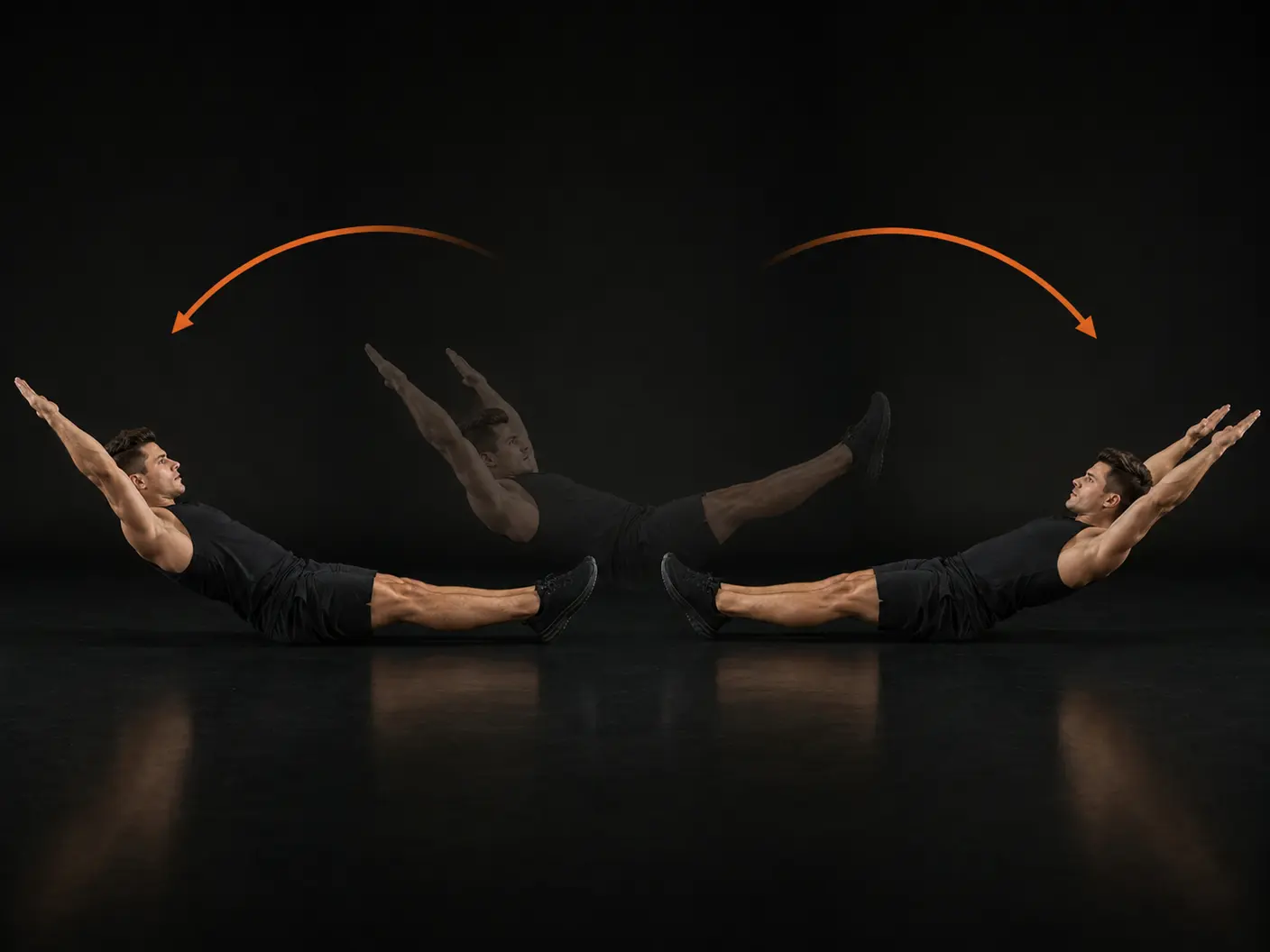
The hollow body rock is a gymnastics-derived bodyweight movement that trains the core in an anti-extension pattern — demanding that the rectus abdominis and hip flexors maintain a braced, curved position whilst the body moves as a single unit. Unlike static holds, the rocking motion introduces a continuous challenge to positional control, requiring the core to resist extension with every cycle. It suits intermediate trainees who have already established a solid hollow hold and want to progress the demand on midline stability.
How to do it
Lie on your back with arms extended overhead and legs straight. Press the lower back into the floor by engaging the abs and lifting the arms, head, shoulders, and legs slightly off the floor until only the lower back remains in contact. Rock the body forward and back in a controlled arc, maintaining the hollow position throughout.
Coaching cues
- Press lower back into floor
- Arms long
- Legs together and tight
- Rock from the core
Why train it
- It develops the ability to maintain spinal position under dynamic load, a quality that transfers directly to compound lifts, gymnastics movements, and athletic change of direction.
- The rocking arc progressively challenges the rectus abdominis and hip flexors through a range of motion, building endurance and control rather than isolated strength alone.
- Because the movement is entirely bodyweight, it can be programmed into warm-ups, skill work, or accessory blocks without the need for any equipment.
- Training the serratus anterior and obliques as secondary stabilisers means the exercise reinforces shoulder and torso integration that supports pressing and overhead patterns.
Common mistakes
- Letting the lower back arch away from the floor — brace the abs forcefully and press the lumbar spine down before initiating any rock.
- Allowing the arms and legs to separate or drift — keep the limbs long and tight so the body moves as one rigid unit throughout the arc.
- Using momentum rather than core tension to drive the rock — initiate each cycle from the abdominals and control the return, rather than swinging through the movement passively.
- Breaking at the hips to reduce the difficulty — maintain the full hollow curve by keeping the legs together and the glutes engaged rather than letting the position sag mid-set.
Primary: Rectus Abdominis, Hip Flexors.
Secondary: Obliques, Serratus Anterior.
Equipment
Good for
Easier variation
Hollow hold — maintain the position without rocking.
Similar movements
Frequently asked
- What muscles does the hollow body rock work?
- The primary muscles are the rectus abdominis and hip flexors, which create and maintain the curved hollow position throughout the movement. The obliques and serratus anterior work as secondary stabilisers to keep the torso and shoulders integrated during the rocking arc.
- How many sets and reps should I do?
- A practical starting point is three to four sets of 20 to 30 seconds of continuous rocking, resting 60 to 90 seconds between sets. Once you can sustain smooth, controlled movement for 45 seconds without losing position, you can increase total volume or pair the exercise with other core work.
- What is the difference between a hollow body hold and a hollow body rock?
- The hold is a static isometric exercise where you simply maintain the hollow position without moving. The rock adds a dynamic element — the body travels forward and back in a controlled arc — which increases the anti-extension demand because the core must resist positional breakdown throughout the movement rather than against a fixed load.
- Is this exercise suitable for beginners?
- It is rated as intermediate because it requires the ability to establish and hold a true hollow position before introducing movement. A beginner would typically work on the hollow body hold first, progressing to the rock once they can sustain a clean static position for 20 to 30 seconds without the lower back lifting from the floor.
- What are good alternatives if I find this too difficult?
- Regressing to the hollow body hold removes the dynamic component and allows you to build the necessary positional strength first. You can also reduce the lever by bending the knees, which shortens the moment arm and makes the position easier to maintain while you develop core endurance.
Want this movement in a plan built for you?
Adaptiv programmes the right exercises for your goal, equipment and experience — then adapts them as you train.
Build my programme