Handstand Push-Up (Wall-Supported)
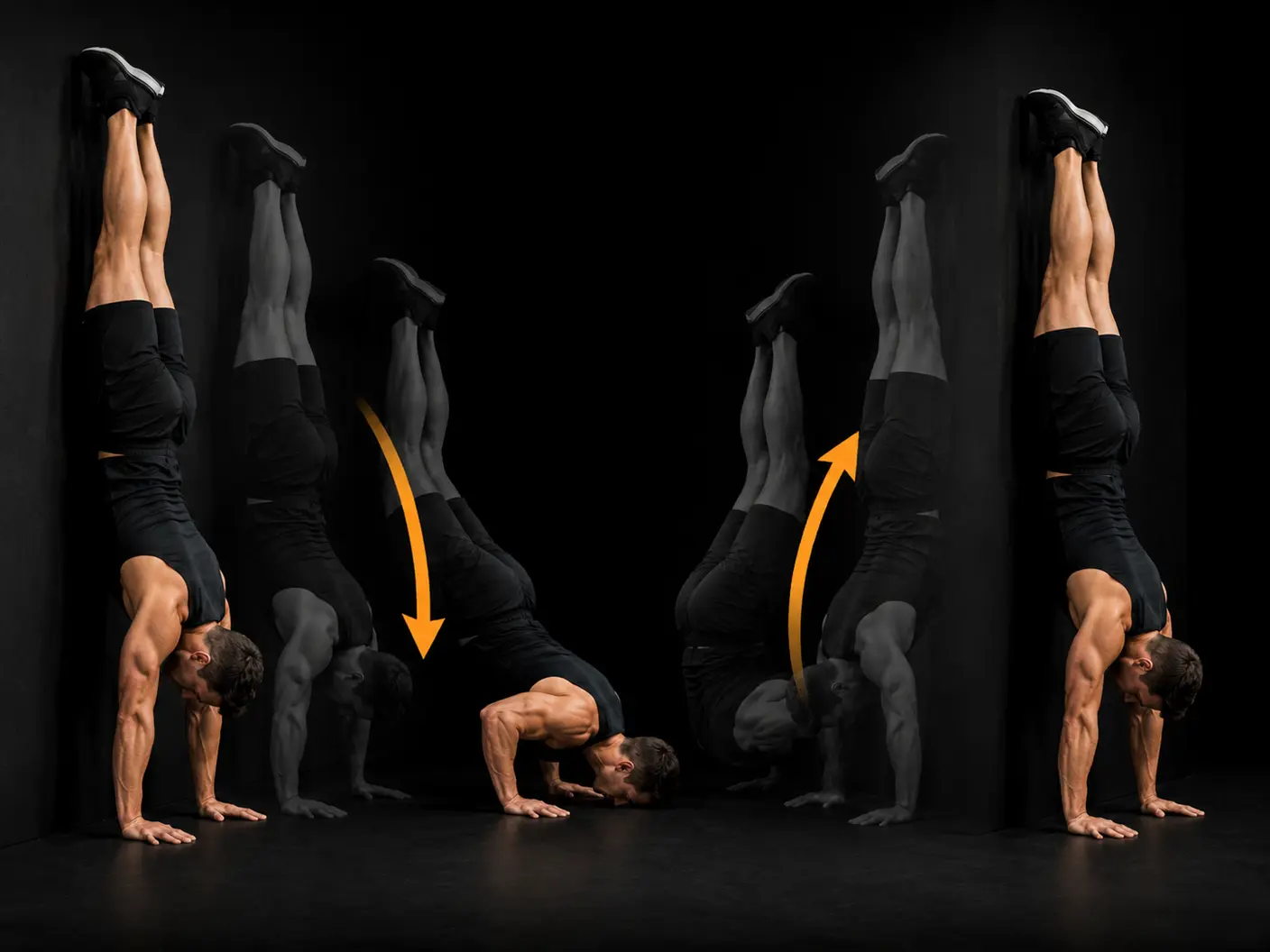
The wall-supported handstand push-up is a bodyweight vertical pressing movement performed inverted, with the heels braced against a wall for balance. It trains the shoulder girdle and triceps through a demanding overhead press pattern that requires both strength and positional control. The movement suits experienced trainees who have already built a reliable handstand hold and solid pressing foundation.
How to do it
Kick up to a handstand with the heels resting against a wall. Place hands slightly wider than shoulder-width with fingers spread for stability. Lower the crown of the head toward the floor under control, keeping elbows at roughly 45° from the body. Press back to full lockout. Maintain a hollow body position rather than arching.
Coaching cues
- Fingers spread
- Elbows at 45°
- Head to floor
- Press to full lockout
Why train it
- It develops significant deltoid and triceps strength using only bodyweight and a wall, making it a practical option when loaded equipment is unavailable.
- The inverted position demands active engagement from the trapezius and serratus anterior to stabilise the shoulder blades throughout the full range of motion.
- Maintaining a hollow body rather than an arch requires sustained core engagement, reinforcing full-body tension that carries over to other athletic tasks.
- Pressing through a full range of motion — crown of the head to the floor and back to lockout — builds overhead strength through positions that conventional pressing rarely reaches.
Common mistakes
- Flaring the elbows out to 90° — keep them at roughly 45° from the torso to reduce shoulder stress and maintain a stronger pressing angle.
- Arching through the lower back instead of holding a hollow body — brace the core and squeeze the glutes to keep the spine neutral throughout the set.
- Lowering the forehead or nose to the floor rather than the crown of the head — the crown contacts the floor first to keep the pressing path vertical and protect the cervical spine.
- Kicking up with excessive force and losing positional control before the set begins — practise a controlled kick-up and establish a stable hollow body hold before initiating the first rep.
Primary: Anterior Deltoid, Triceps Brachii.
Secondary: Trapezius, Serratus Anterior, Rectus Abdominis.
Equipment
Good for
Easier variation
Pike push-up — same pressing pattern from a high-hip pike position on the floor.
Similar movements
Frequently asked
- What muscles do wall-supported handstand push-ups work?
- The primary muscles are the deltoids and triceps. The trapezius, serratus anterior, and core musculature work as secondary stabilisers throughout the movement.
- How many sets and reps should I do for handstand push-ups?
- For strength development, 3–5 sets of 3–6 controlled reps works well, prioritising quality over volume. Because the movement is technically demanding and places high load through the shoulder girdle, err on the side of fewer reps with full recovery between sets rather than chasing fatigue.
- What progressions should I complete before attempting handstand push-ups?
- You should be able to hold a stable wall-supported handstand for at least 30–60 seconds and press confidently overhead with loaded movements such as the overhead press before attempting this variation. A negatives-only approach — lowering slowly to the floor and stepping down — is a sensible intermediate step.
- Are handstand push-ups a good alternative to the overhead press?
- They train a comparable vertical push pattern and share the same primary muscles, so they can serve as a bodyweight substitute when a barbell or dumbbells are unavailable. Load is fixed at a proportion of bodyweight, however, so progression relies on technical refinement and volume rather than incremental loading.
- Is this exercise suitable for people with shoulder issues?
- The inverted position places the shoulder joint under substantial load and requires full range of motion overhead, so anyone with a history of shoulder problems should check with a qualified professional before including this movement in their programme.
Want this movement in a plan built for you?
Adaptiv programmes the right exercises for your goal, equipment and experience — then adapts them as you train.
Build my programme