GHR Sit-Up
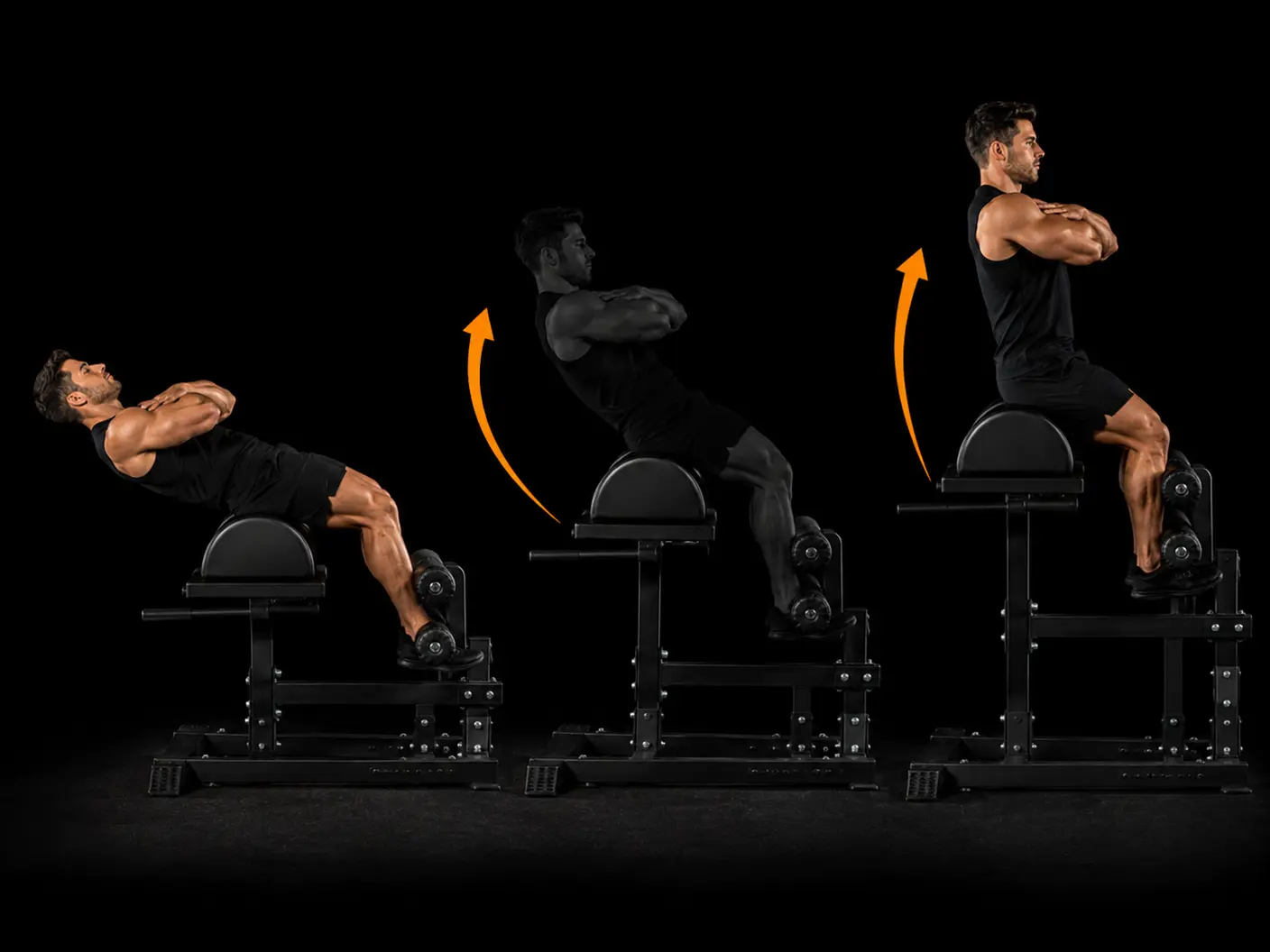
The GHR sit-up is a compound core exercise performed on a glute-ham developer, in which the torso lowers under control and returns to vertical against the resistance of bodyweight. It trains anti-extension strength through the rectus abdominis and hip flexors, with the obliques contributing as secondary stabilisers. The movement suits intermediate trainees who are already comfortable on the GHD and want to build meaningful trunk strength and hypertrophy.
How to do it
Set up on a GHD as for a GHR but reversed — sit on the pad with feet locked. Lower the torso back, arms overhead or at the chest. Stop when parallel or slightly below; do not hyperextend. Crunch back up to vertical.
Coaching cues
- Control the descent
- Stop at parallel
- No hyperextension
- Sit up strong
Why train it
- The anchored foot position and long lever arm of the GHD create significant demand on the rectus abdominis, making this an effective exercise for core hypertrophy.
- Training through a controlled range of motion — lowering to parallel and returning to vertical — develops functional hip flexor strength that transfers to athletic and lifting contexts.
- The compound nature of the movement requires the obliques to work as stabilisers throughout, promoting integrated trunk development rather than isolating a single muscle.
- Programming the GHR sit-up builds the capacity to control and resist spinal extension under load, a quality relevant to compound lifts such as the deadlift and squat.
Common mistakes
- Hyperextending the lower back at the bottom of the descent — stop when the torso reaches parallel or slightly below, as going beyond this shifts stress away from the target muscles and places unnecessary load on the lumbar spine.
- Dropping the torso without control — treat the descent as the working portion of the rep and maintain tension throughout, matching the pace of the lowering phase to the return.
- Using momentum to sit back up — initiate each repetition with a deliberate trunk contraction rather than swinging the arms or jerking through the hips, as momentum reduces muscular demand and increases injury risk.
- Positioning the hips too far back on the pad — sit far enough forward that the pad supports the hips firmly, giving the trunk sufficient room to move through the intended range without the lower back bearing the brunt of the load.
Primary: Rectus Abdominis, Hip Flexors.
Secondary: Obliques.
Equipment
Good for
Easier variation
Decline crunch — less aggressive ROM.
Similar movements
Frequently asked
- What muscles does the GHR sit-up work?
- The primary muscles are the rectus abdominis and the hip flexors, both of which work to control the descent and drive the return to vertical. The obliques are engaged as secondary stabilisers throughout the movement.
- How many sets and reps should I do for the GHR sit-up?
- For strength, three to five sets of five to eight controlled repetitions works well. For hypertrophy, three to four sets of eight to fifteen reps with a deliberate lowering phase is a practical starting point — prioritise quality of movement over rep count.
- Is the GHR sit-up suitable for beginners?
- This exercise is rated intermediate difficulty and requires a degree of existing trunk strength and familiarity with the GHD before it is appropriate. Beginners would be better served building a base with simpler anti-extension work before progressing to this movement.
- What are good alternatives if I do not have a glute-ham developer?
- The GHR sit-up is specific to the GHD, so a direct substitute requires that equipment. Movements that train a similar anti-extension pattern include decline sit-ups or ab-wheel rollouts, though the loading characteristics differ.
- Should I place my arms overhead or across my chest?
- Arms overhead increases the lever arm and makes the exercise harder; arms at the chest reduces it. Start with arms at the chest to establish sound mechanics, then progress to the overhead position as strength and control improve.
Want this movement in a plan built for you?
Adaptiv programmes the right exercises for your goal, equipment and experience — then adapts them as you train.
Build my programme