Fire Hydrant
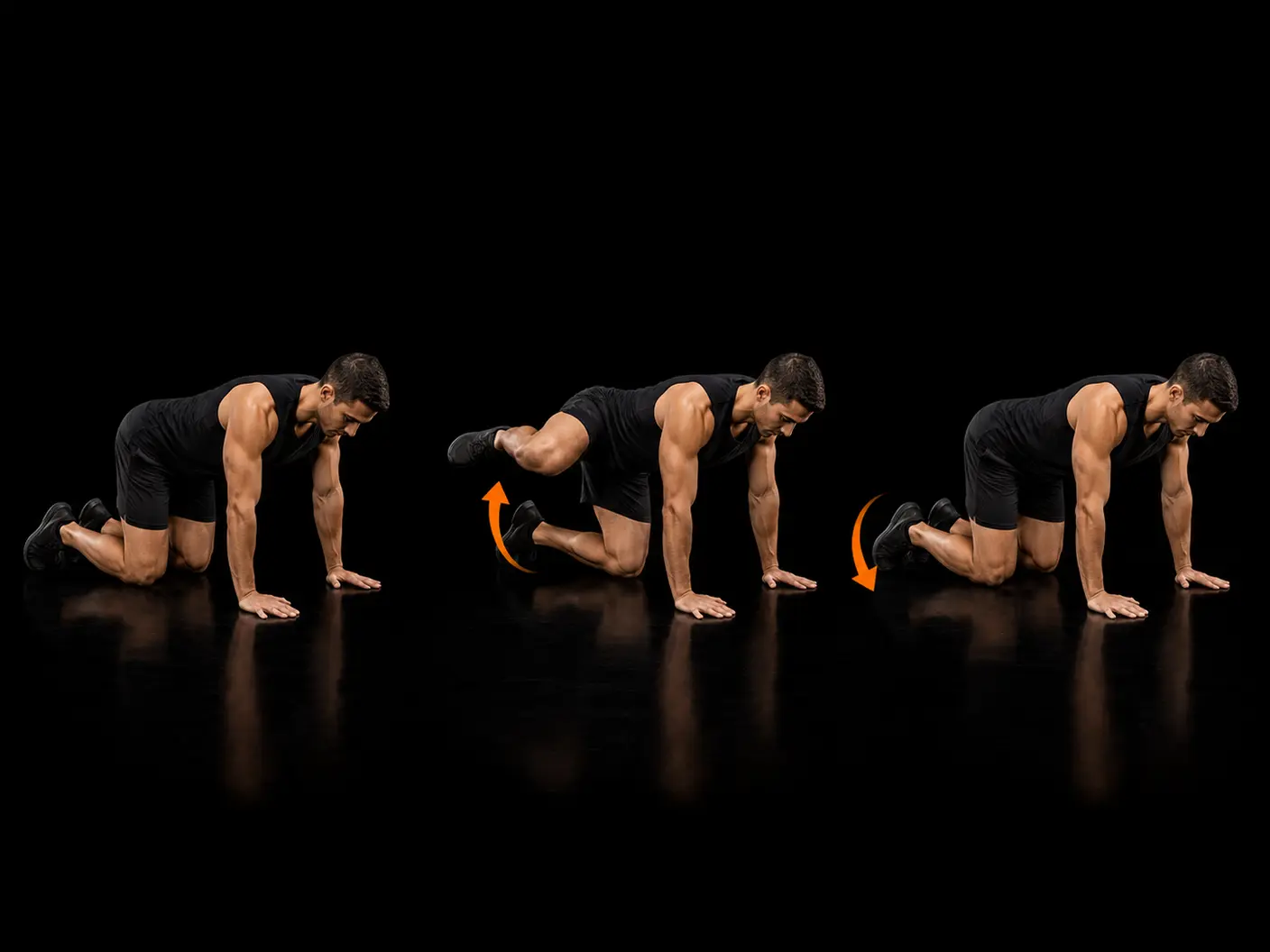
The fire hydrant is a bodyweight mobility drill performed on all fours, training hip abduction through a controlled range of motion. It targets the gluteus medius and gluteus minimus — two muscles that stabilise the pelvis during single-leg movement — making it a staple in both general fitness warm-ups and structured rehabilitation programmes. Its low technical demand makes it accessible to beginners while remaining a useful corrective tool for more experienced lifters with lateral hip weakness.
How to do it
Start on all fours with hands under shoulders and knees under hips, back flat. Keeping the knee bent at 90°, lift one leg out to the side until the thigh is parallel to the floor. Hold briefly at the top, squeezing the glute, then lower under control. Do not allow the spine to rotate or the hip to dip.
Coaching cues
- Thigh parallel to floor
- Squeeze the glute
- Spine stays still
- Slow and controlled
Why train it
- It directly loads the gluteus medius and gluteus minimus, which are frequently underactive in people who spend long periods seated.
- The quadruped position demands core engagement throughout, reinforcing the habit of maintaining a neutral spine under load.
- Because it requires no equipment, it integrates easily as a warm-up drill, a corrective exercise, or an accessory movement at the end of a session.
- Developing lateral hip strength through this pattern supports better pelvic stability in squats, lunges, and single-leg exercises.
Common mistakes
- Rotating the spine to gain range — keep the torso completely still and only lift as high as true hip abduction allows.
- Letting the hip on the working side hike upward — maintain level hips throughout the movement so the glute, not the lower back, does the work.
- Moving too quickly through the range — use a slow, deliberate tempo so the target muscles are loaded rather than momentum carrying the leg up.
- Allowing the knee angle to change during the lift — keep the knee bent at 90° from start to finish so the movement stays isolated to the hip.
Primary: Gluteus Medius.
Secondary: Gluteus Maximus, Rectus Abdominis.
Equipment
Good for
Easier variation
Side-lying hip abduction — removes the quadruped stability demand.
Similar movements
Frequently asked
- What muscles does the fire hydrant work?
- The primary muscles are the gluteus medius and gluteus minimus, which drive hip abduction. The gluteus maximus and core musculature act as secondary contributors, helping to stabilise the hip and maintain a neutral spine throughout the movement.
- How many sets and reps should I do for fire hydrants?
- For a warm-up or corrective context, 2–3 sets of 12–15 controlled repetitions per side is a practical starting point. If you are using it as a dedicated accessory exercise, 3 sets of 15–20 reps with a deliberate pause at the top of each rep will increase the stimulus to the lateral hip.
- Can fire hydrants help with hip mobility?
- Yes — performed consistently, the movement encourages active range of motion at the hip joint in the abduction and external rotation plane. Combining slow, controlled reps with a brief hold at the top position is more effective for developing usable mobility than rushing through the range.
- Are fire hydrants suitable for rehabilitation?
- They are widely used in rehabilitation contexts for lateral hip and glute work, and their low-load nature makes them appropriate early in a recovery programme. If you are working around a specific injury or post-surgical restriction, consult a qualified physiotherapist before adding them to your routine.
- What are good alternatives to the fire hydrant?
- Banded clamshells and side-lying hip abduction both train the gluteus medius and minimus through a similar plane of movement and can be used as direct substitutes. Standing cable hip abduction is a suitable progression once the foundational pattern is established.
Want this movement in a plan built for you?
Adaptiv programmes the right exercises for your goal, equipment and experience — then adapts them as you train.
Build my programme