Banded Hip Abduction
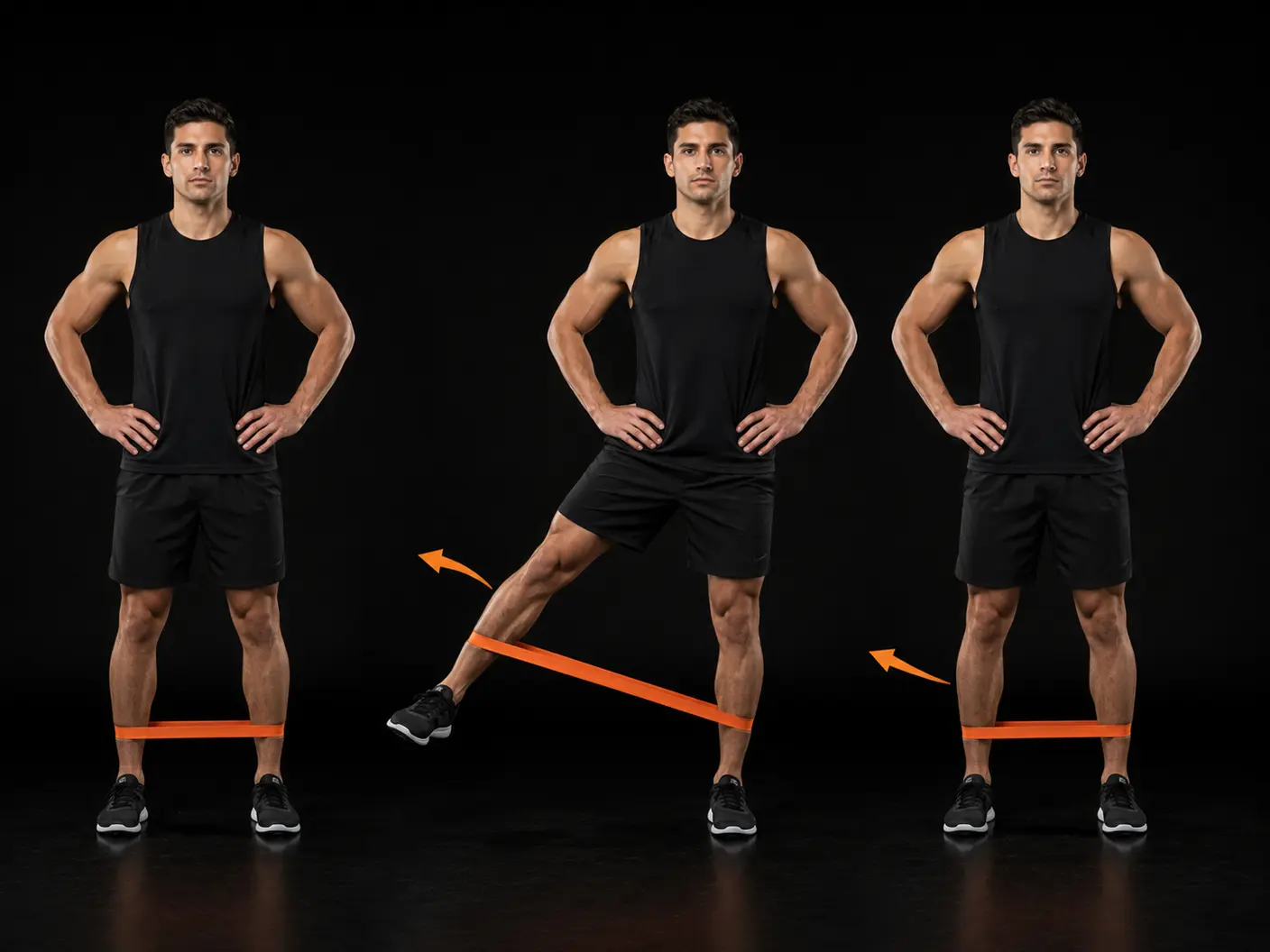
Banded hip abduction is a foundational isolation exercise that trains the lateral hip musculature — specifically the gluteus medius and gluteus minimus — by moving one leg out to the side against the resistance of a mini-band or resistance band. The band is positioned just above the knees or around the ankles, creating constant tension throughout the range of motion. It suits beginners establishing hip stability, athletes reinforcing lateral mechanics, and anyone looking to address weakness in the smaller glute muscles.
How to do it
Place a mini-band just above the knees or around the ankles. Stand with feet hip-width. Lift one leg directly out to the side against band resistance, leading with the heel. Keep the torso tall and do not hike the hip. Pause at peak abduction. Lower under control. Complete all reps on one side, then switch.
Coaching cues
- Lead with the heel
- Torso stays tall
- No hip hike
- Controlled pace
Why train it
- The gluteus medius and minimus are directly loaded throughout the movement, making this one of the most efficient ways to develop lateral hip strength without demanding high technical skill.
- Constant band tension encourages neuromuscular awareness of the hip abductors, which supports better movement quality in compound exercises such as squats and lunges.
- The standing position requires the stance leg to stabilise the pelvis, reinforcing single-leg balance and pelvic control simultaneously.
- Its foundational difficulty and minimal equipment requirement make it equally suitable as a warm-up activation drill or as a direct training stimulus within a lower-body programme.
Common mistakes
- Hiking the hip on the working side — maintain a level pelvis throughout the lift by resisting any upward shift of the hip as the leg travels out.
- Letting the torso lean away from the working leg — keep the torso tall and centred so the movement is driven by the hip rather than a compensatory side-bend.
- Using too fast a tempo on the return — lower the leg under control against the band rather than allowing it to snap back, as the eccentric phase contributes meaningfully to the training stimulus.
- Placing the band too low around the ankles before the requisite control is present — if pelvic stability is compromised, move the band just above the knees to reduce the moment arm and reinforce proper mechanics first.
Primary: Gluteus Medius.
Secondary: Gluteus Maximus, Tensor Fasciae Latae.
Equipment
Good for
Easier variation
Side-lying hip abduction — same target lying down, removing the balance demand.
Similar movements
Frequently asked
- What muscles does banded hip abduction work?
- The primary muscles are the gluteus medius and gluteus minimus, which sit on the lateral and posterior hip. The upper fibres of the gluteus maximus and the tensor fasciae latae (TFL) assist as secondary contributors throughout the movement.
- How many sets and reps should I do for banded hip abduction?
- For activation and warm-up purposes, two to three sets of 12 to 15 controlled reps per side is a practical starting point. When used as a direct training exercise within a programme, three to four sets of 15 to 20 reps with a pause at peak abduction will provide a more substantial stimulus to the lateral hip.
- Should the band go above the knees or around the ankles?
- Above the knees is the better starting position for most people because it reduces the moment arm and makes it easier to maintain pelvic control. Moving the band to the ankles increases the resistance arm and intensifies the demand on the hip abductors, but only makes sense once you can perform the movement with a stable pelvis and no hip hike.
- Is banded hip abduction useful for athletic performance?
- Yes — the gluteus medius plays a central role in controlling pelvic alignment during single-leg loading, which is present in virtually every athletic movement from sprinting to change of direction. Strengthening it in isolation gives athletes a targeted means of addressing lateral hip weakness that may not be adequately challenged in compound movements alone.
- What are good alternatives if I do not have a band?
- Without a band, the same muscles can be targeted through bodyweight side-lying hip abduction, which removes the standing balance demand and may suit those who are earlier in their training. Cable hip abduction is a logical progression that offers adjustable and more consistent resistance throughout the range of motion.
Want this movement in a plan built for you?
Adaptiv programmes the right exercises for your goal, equipment and experience — then adapts them as you train.
Build my programme