Farmer Walk on Toes
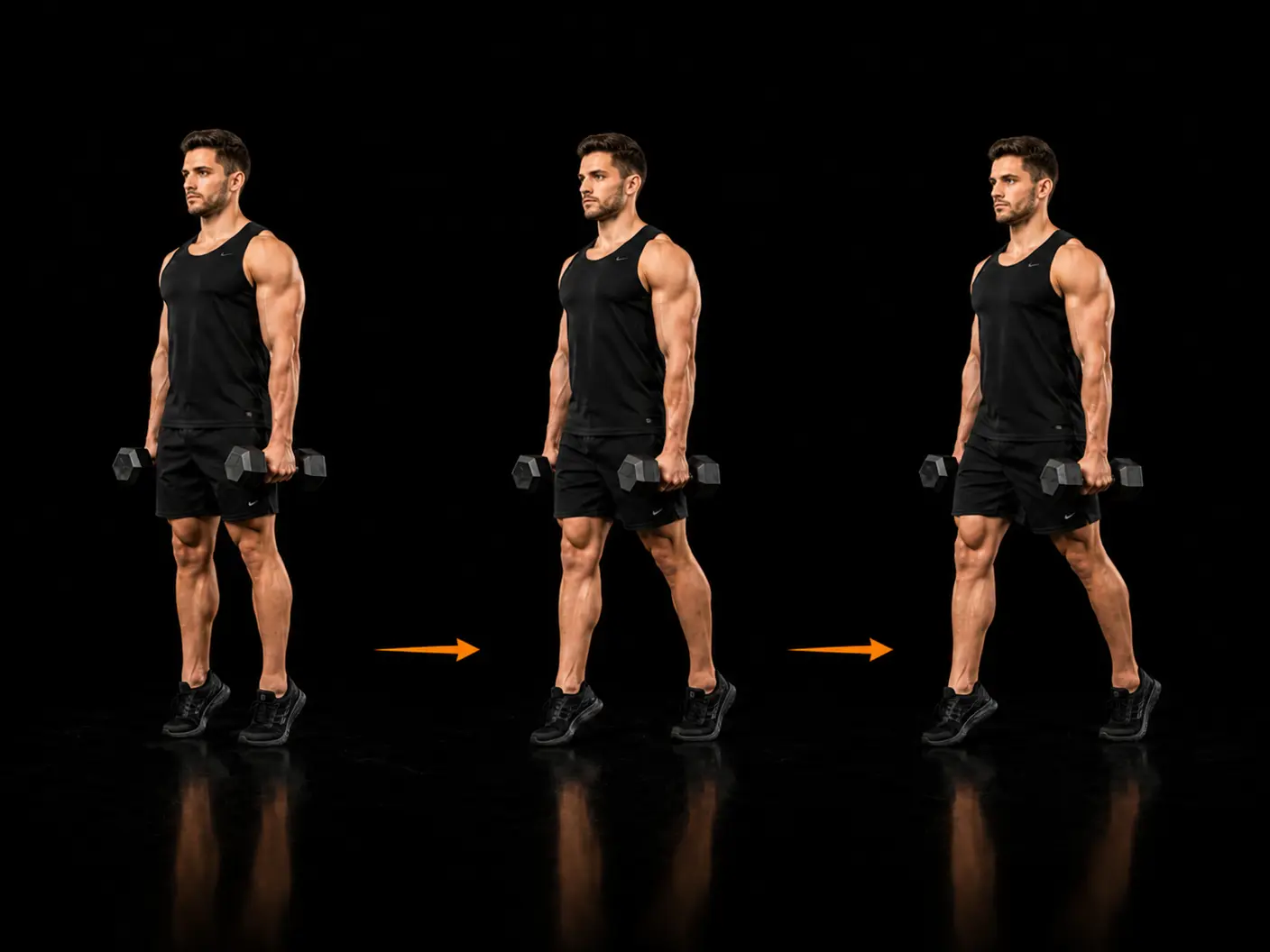
The farmer walk on toes is a loaded carry variation performed on the balls of the feet, combining calf musculature demand with the grip and postural challenge of a traditional farmer carry. It trains the gastrocnemius and soleus under prolonged tension across a full walking pattern, making it more specific to athletic movement than a static calf raise. It suits intermediate trainees who have established solid ankle stability and want to develop lower-leg strength and hypertrophy in a functional context.
How to do it
Hold heavy dumbbells at the sides. Rise onto the balls of the feet. Walk forward in small, controlled steps while keeping the heels elevated. Maintain tall posture and strong grip. Walk for a set distance or time.
Coaching cues
- Heels up
- Tall posture
- Small steps
- Strong grip
Why train it
- Sustained time under tension across the gastrocnemius and soleus promotes hypertrophy that static calf raises can struggle to replicate due to the added postural and locomotion demands.
- Maintaining heel elevation throughout the carry challenges ankle stability and proprioception, qualities that transfer directly to sprinting, jumping, and change-of-direction tasks.
- The loaded carry format simultaneously develops forearm and grip endurance, making it an efficient choice when training time is limited.
- Walking on the balls of the feet with a tall spine reinforces upright posture habits that carry over to general movement quality and sport.
Common mistakes
- Allowing the heels to drop mid-set — focus on keeping them elevated for the full duration of the carry rather than letting fatigue dictate your position.
- Shortening the carry distance or time prematurely rather than selecting an appropriate load — choose a weight that allows you to maintain heel elevation for the prescribed distance before increasing it.
- Hunching the shoulders forward under the load — pack the shoulders back and down, keep the chest tall, and let the arms hang straight.
- Taking excessively long strides — use small, controlled steps to keep the ankles stable and prevent the heels from touching down between steps.
Primary: Gastrocnemius, Soleus.
Secondary: Forearm Flexors, Rectus Abdominis.
Equipment
Good for
Easier variation
Standing calf raise — same target, easier load management.
Similar movements
Frequently asked
- What muscles does the farmer walk on toes work?
- The primary muscles are the gastrocnemius and soleus, both components of the calf complex. The forearms and core contribute as secondary stabilisers, working to maintain grip on the implements and keep the torso upright throughout the carry.
- How far or how long should I walk for?
- A practical starting point is carries of 20–40 metres or 20–30 seconds per set, with 3–4 sets. As grip and calf endurance improve, extend the distance or duration before adding load.
- What weight should I use for the farmer walk on toes?
- Begin lighter than you think necessary — sustaining heel elevation while walking is harder than it appears. A load that lets you maintain perfect posture and full heel elevation for the entire carry is the correct starting point; progress from there.
- Is the farmer walk on toes a good alternative to calf raises?
- It serves a different purpose rather than a direct replacement. Standard calf raises allow greater isolation and load, whereas the farmer walk on toes adds grip, postural, and locomotion demands that make it more specific to athletic performance. Both have a place in a well-rounded programme.
- Can I use kettlebells instead of dumbbells?
- Yes, the exercise is equally effective with kettlebells held at the sides. The implement choice is largely a matter of equipment availability and personal preference, as the mechanics and muscle demands remain the same.
Want this movement in a plan built for you?
Adaptiv programmes the right exercises for your goal, equipment and experience — then adapts them as you train.
Build my programme