EZ-Bar Reverse Curl
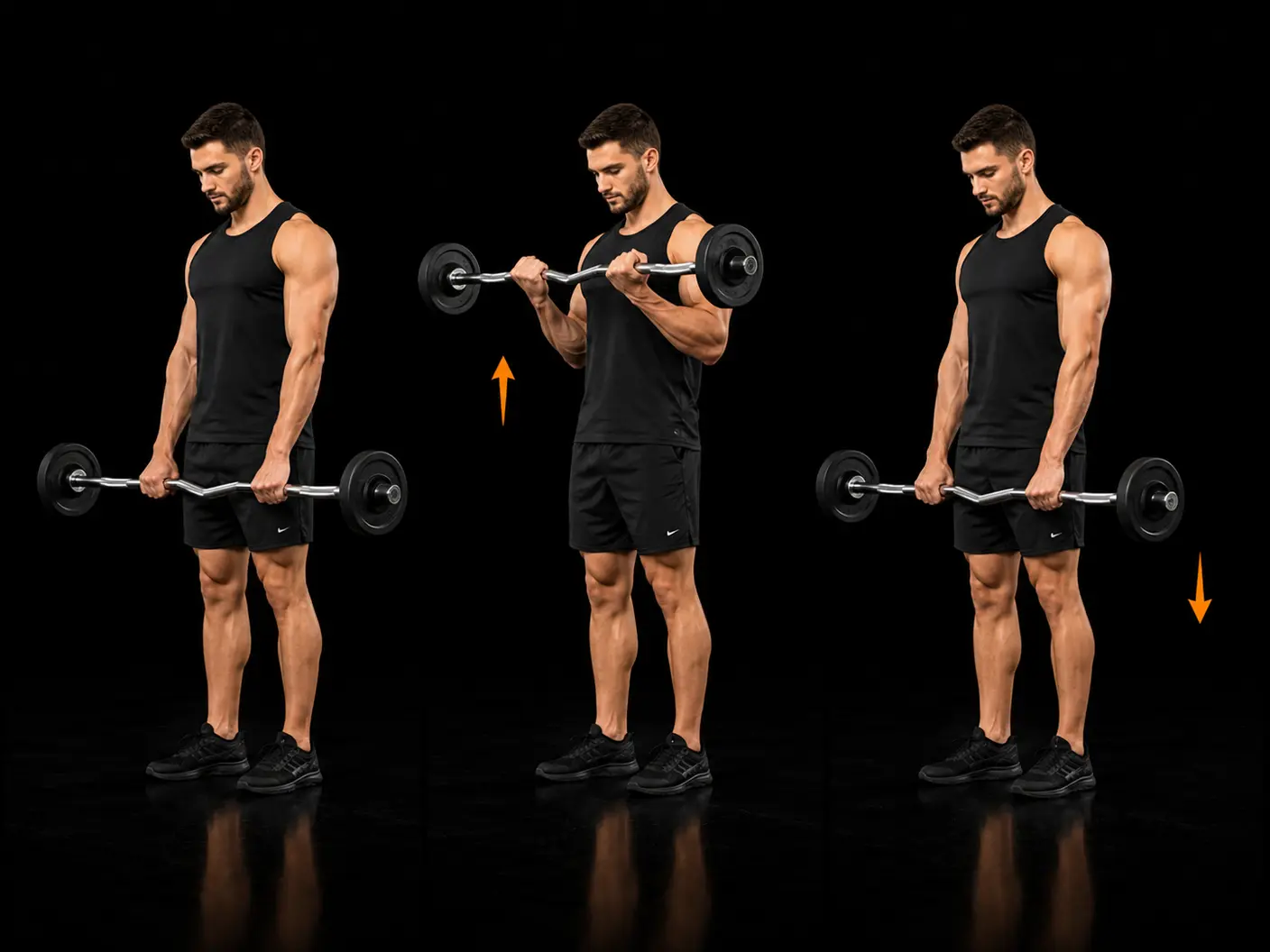
The EZ-bar reverse curl is an isolation movement for the elbow flexors and forearm extensors, performed with a pronated (overhand) grip on the angled grips of an EZ-curl bar. The pronated hand position shifts emphasis away from the biceps brachii and towards the brachioradialis and forearm extensors, making it a reliable tool for addressing the musculature that conventional curls tend to underload. It suits lifters at any level looking to develop balanced arm strength and forearm thickness.
How to do it
Grip an EZ bar with a pronated (overhand) grip at the angled points. Elbows tucked to the ribs. Curl the bar up by flexing the elbows; wrists remain firm and pronated throughout. Pause at peak. Lower under control to full extension.
Coaching cues
- Pronated grip throughout
- Wrists firm
- Elbows tucked
- Slow eccentric
Why train it
- Directly targets the brachioradialis and forearm extensors, muscle groups that are largely bypassed during standard supinated curls.
- The angled grip of an EZ-curl bar reduces wrist strain compared with a straight bar, making consistent training more comfortable over time.
- Developing the brachioradialis contributes to overall elbow flexion strength, which carries over to pulling movements and grip-intensive work.
- As a foundational isolation exercise, it is straightforward to load progressively, making it appropriate for both early-stage and experienced training programmes.
Common mistakes
- Allowing the wrists to extend or break during the curl — keep them firm and pronated throughout the entire range of motion so the forearm extensors remain under tension.
- Letting the elbows drift forward and away from the ribs — tuck them to the sides and hold that position to ensure the forearms, not momentum, are doing the work.
- Using excessive body swing to complete the rep — reduce the load and control the movement so each repetition is driven by elbow flexion rather than trunk momentum.
- Rushing the eccentric phase — lower the bar slowly to full extension on every rep, as the controlled descent is where much of the stimulus for the brachioradialis and forearm extensors is generated.
Primary: Brachioradialis, Forearm Extensors.
Secondary: Brachialis, Biceps Brachii.
Equipment
Good for
Easier variation
Reverse dumbbell curl — one arm at a time reduces grip demand.
Similar movements
Frequently asked
- What muscles does the EZ-bar reverse curl work?
- The primary muscles targeted are the brachioradialis and the forearm extensors. The brachialis and biceps brachii contribute as secondary movers during elbow flexion.
- How many sets and reps should I do for the EZ-bar reverse curl?
- For hypertrophy, 3–4 sets of 10–15 repetitions with a controlled tempo works well. Prioritise form and a slow eccentric over loading the bar heavily, as grip and wrist position become harder to maintain as fatigue accumulates.
- What is the difference between a reverse curl and a standard bicep curl?
- A standard curl typically uses a supinated (underhand) grip, which places the biceps brachii in a mechanically strong position. The reverse curl uses a pronated (overhand) grip, which reduces biceps involvement and shifts the load onto the brachioradialis and forearm extensors.
- Can I do reverse curls with a straight barbell instead of an EZ-curl bar?
- Yes, a straight barbell can be used, but the fixed pronated position places more rotational stress on the wrists and forearms. The EZ-curl bar's angled grip is generally more comfortable for most lifters and is the recommended option for sustained use.
- Where does the EZ-bar reverse curl fit in a training programme?
- It works well towards the end of an upper-body or arm-focused session, after compound pulling movements have been completed. It can be paired with standard curls or hammer curls to ensure the elbow flexors are trained through a variety of grip positions.
Want this movement in a plan built for you?
Adaptiv programmes the right exercises for your goal, equipment and experience — then adapts them as you train.
Build my programme