Dumbbell Wrist Curl
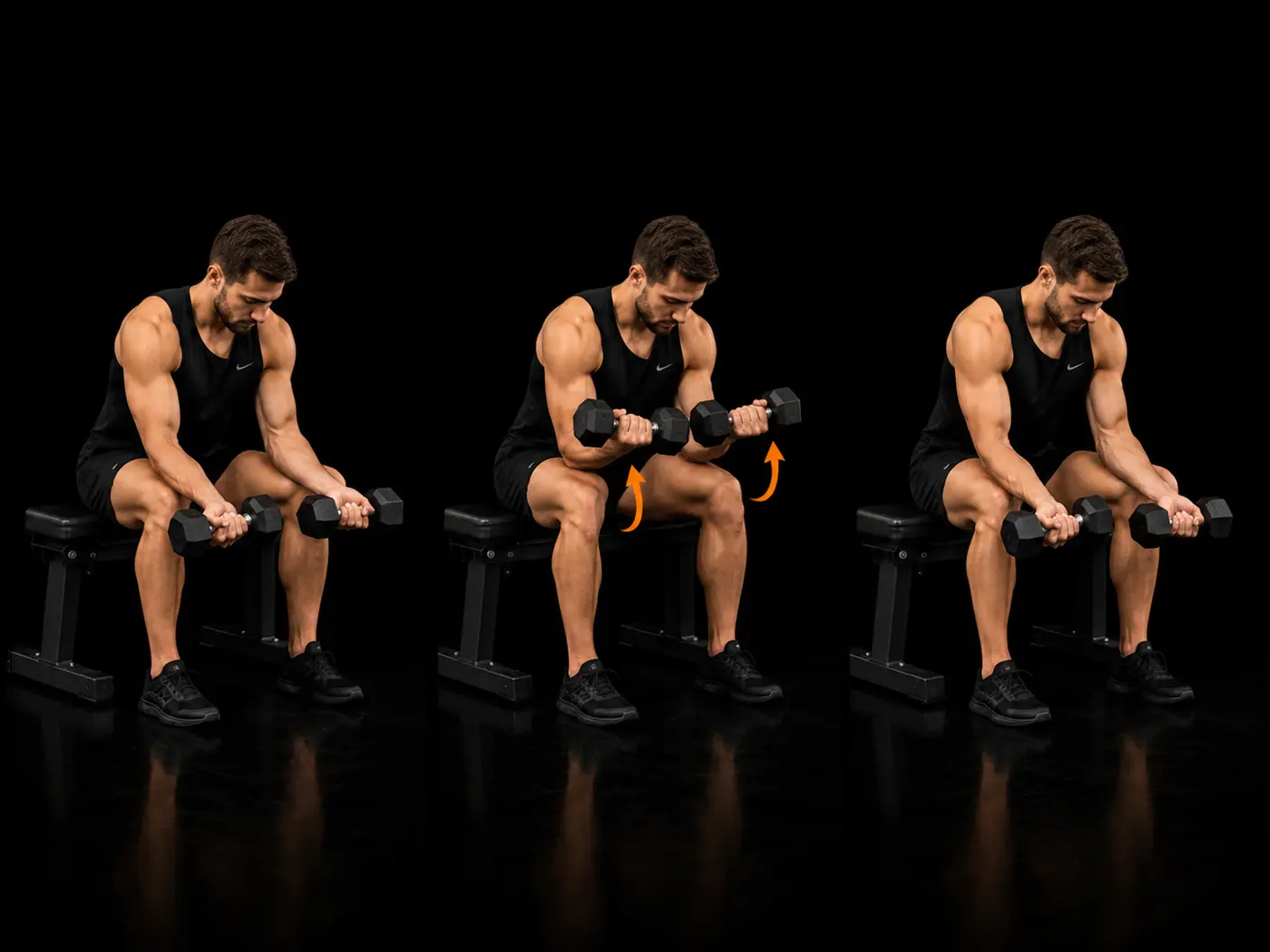
The dumbbell wrist curl is a foundational isolation exercise targeting the forearm flexors — specifically the flexor carpi radialis and flexor carpi ulnaris — through a strict, controlled wrist flexion pattern. Performed seated with the forearm braced flat on a bench and the hand hanging free over the edge, it removes any contribution from the upper arm and shoulder, placing the entire demand on the forearm musculature. It suits lifters of any level who want to develop forearm size, improve grip endurance, or address a weakness that is limiting performance in compound pulling movements.
How to do it
Sit with one forearm flat on a bench, palm up, hand hanging off the edge. Hold a dumbbell. Let the dumbbell roll to the fingertips at the bottom of the range. Curl the wrist back up, flexing the forearm. Pause at peak contraction. Lower under control. Complete all reps on one side before switching.
Coaching cues
- Forearm flat
- Let it roll to the fingers
- Strict wrist flexion
- Slow eccentric
Why train it
- Directly overloads the forearm flexors through a full range of motion, supporting hypertrophy in a muscle group that compound lifts rarely train in isolation.
- Allowing the dumbbell to roll to the fingertips at the bottom of each rep maximises the range of motion, ensuring the forearm flexors are loaded from a stretched position.
- Strengthening the wrist flexors contributes to overall grip capacity, which carries over to deadlifts, rows, and any pulling pattern where grip is a limiting factor.
- The unilateral format makes it straightforward to identify and address side-to-side imbalances in forearm development.
Common mistakes
- Lifting the forearm off the bench during the curl — keep the forearm flat and stationary throughout so the wrist, not the elbow, drives the movement.
- Rushing the eccentric — lower the dumbbell under deliberate control rather than letting it drop, as the lowering phase is where a significant portion of the muscular stimulus is generated.
- Using a weight that prevents full range of motion — choose a load that allows the dumbbell to roll to the fingertips at the bottom and achieve a complete curl at the top, rather than a heavier load that restricts movement to a short arc.
- Flexing at the elbow to assist the curl — the upper arm should remain passive; if the elbow is bending to help lift the weight, the load is too heavy.
Primary: Forearm Flexors.
Equipment
Good for
Easier variation
Barbell wrist curl — bilateral version; slightly easier to balance.
Similar movements
Frequently asked
- What muscles does the dumbbell wrist curl work?
- The primary muscles are the forearm flexors — the flexor carpi radialis and flexor carpi ulnaris. The grip muscles act as secondary contributors throughout the movement, particularly during the finger-roll portion at the bottom of each rep.
- How many sets and reps should I do for wrist curls?
- For hypertrophy, 3–4 sets of 12–20 reps per side works well, as the forearm flexors respond favourably to moderate-to-higher rep ranges. Keep rest periods short — around 60 seconds — and prioritise a slow eccentric and full range of motion over load.
- How often should I programme wrist curls?
- Two to three sessions per week is a practical frequency for most lifters. The forearms recover relatively quickly, but allow at least one rest day between sessions if you are also performing heavy pulling work that taxes the grip.
- What is a good alternative to the dumbbell wrist curl?
- The barbell wrist curl performs the same pattern bilaterally and can make it easier to load progressively. Cable wrist curls are another option, as the cable maintains tension throughout the range of motion rather than varying with the arc of the dumbbell.
- Will wrist curls help my grip strength for deadlifts and rows?
- Strengthening the forearm flexors contributes to grip endurance and the ability to sustain tension under load, which can support performance in pulling movements. However, grip for deadlifts also relies on finger flexor strength, so pairing wrist curls with specific grip work — such as holds or farmer's carries — will give a more complete result.
Want this movement in a plan built for you?
Adaptiv programmes the right exercises for your goal, equipment and experience — then adapts them as you train.
Build my programme