Dumbbell Romanian Deadlift
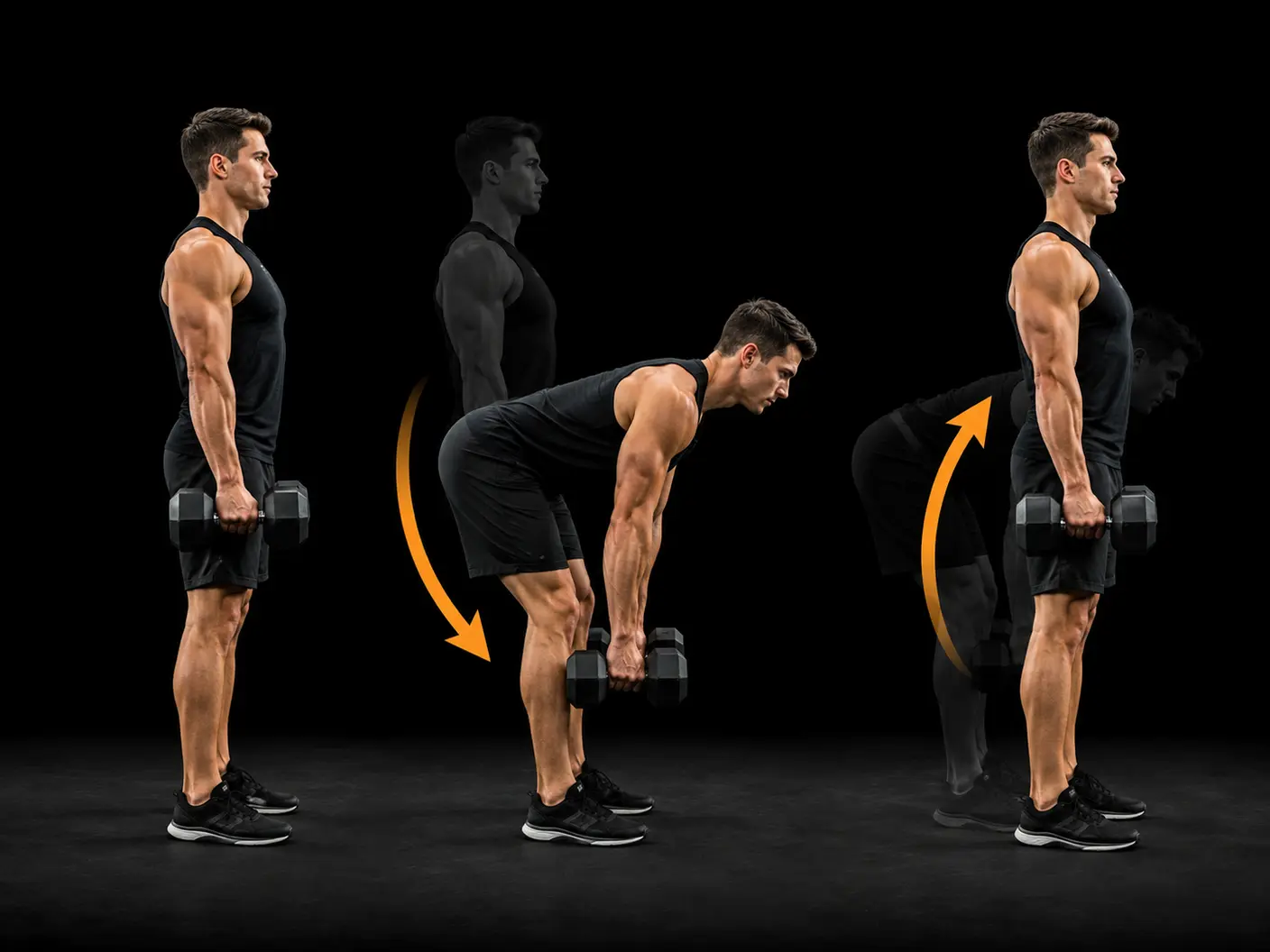
The dumbbell Romanian deadlift is a hip-hinge movement that loads the posterior chain through a controlled eccentric stretch and concentric drive. It targets the hamstrings and gluteus maximus as the primary movers, with supporting demand placed on the erector spinae, core, and grip. It suits intermediate trainees looking to develop posterior chain strength and size, and athletes who need to reinforce hip extension mechanics under load.
How to do it
Hold a dumbbell in each hand in front of the thighs, neutral or overhand grip. Stand with feet hip-width and a slight knee bend. Push the hips back while lowering the dumbbells along the front of the legs. Keep a flat back and keep the dumbbells close to the body. Descend until a strong hamstring stretch is felt, then drive the hips forward to return to standing — do not hyperextend at the top.
Coaching cues
- Hips back
- Dumbbells stay close
- Long spine
- Drive hips to stand
Why train it
- It places the hamstrings under a substantial stretch-under-tension stimulus, making it an effective choice for lower-body hypertrophy programmes.
- The hip-hinge pattern reinforces posterior chain mechanics that carry over directly to athletic movements such as sprinting, jumping, and conventional deadlift variations.
- Using dumbbells rather than a barbell allows each side to move independently, which can help identify and address asymmetries in strength or range of motion.
- The movement demands active trunk stiffness throughout the descent and ascent, providing meaningful stimulus for the erector spinae and core without isolating them.
Common mistakes
- Rounding the lower back — brace the core before the descent begins and maintain a flat spine throughout by thinking about keeping a long torso rather than simply hinging down.
- Letting the dumbbells drift away from the legs — keep them in contact with or very close to the thighs and shins throughout the movement to reduce shear load and maintain mechanical efficiency.
- Bending the knees excessively — this converts the pattern into a squat variation; maintain only a slight, fixed knee bend so the load stays on the hamstrings rather than the quadriceps.
- Hyperextending at the top of the rep — drive the hips forward to a tall, neutral standing position rather than forcing the lower back into extension, which shifts stress away from the target muscles.
Primary: Hamstrings, Gluteus Maximus.
Secondary: Erector Spinae, Rectus Abdominis, Forearm Flexors.
Equipment
Good for
Easier variation
Stiff-leg bodyweight hip hinge — practise the hinge pattern without load.
Similar movements
Frequently asked
- What muscles does the dumbbell Romanian deadlift work?
- The primary muscles are the hamstrings and gluteus maximus, which control the descent and drive the hip extension on the way up. The erector spinae and core work isometrically to maintain spinal position, and the grip muscles are loaded continuously throughout the set.
- How many sets and reps should I do for the dumbbell Romanian deadlift?
- For hypertrophy, three to four sets of eight to twelve reps at a controlled tempo works well, particularly with a deliberate pause or slow eccentric to maximise time under tension. For strength development, four to five sets of five to eight reps with heavier loading is a practical range, provided technique remains consistent.
- What is the difference between a Romanian deadlift and a stiff-leg deadlift?
- In the Romanian deadlift, a slight fixed knee bend is maintained throughout and the bar or dumbbells begin from a standing position, emphasising the hip hinge and hamstring stretch. The stiff-leg deadlift typically involves straighter knees and often starts from the floor, placing greater demand on the lower back and hip flexors alongside the hamstrings.
- Can I use the dumbbell Romanian deadlift to improve athletic performance?
- Yes — the movement trains the hip-hinge pattern under load, which is directly relevant to athletic tasks involving hip extension such as sprinting, change of direction, and jumping. Programming it consistently helps develop both the strength and the motor pattern needed to express force through the hips efficiently.
- What are good alternatives if I find the dumbbell Romanian deadlift too difficult?
- If the movement pattern is unfamiliar, bodyweight hip hinges or a kettlebell deadlift from the floor can help establish the mechanics before adding load through a range of motion. If hamstring flexibility limits range, elevating the heels slightly or reducing the depth of the descent until mobility improves is a practical short-term adjustment.
Want this movement in a plan built for you?
Adaptiv programmes the right exercises for your goal, equipment and experience — then adapts them as you train.
Build my programme