Single-Leg Romanian Deadlift
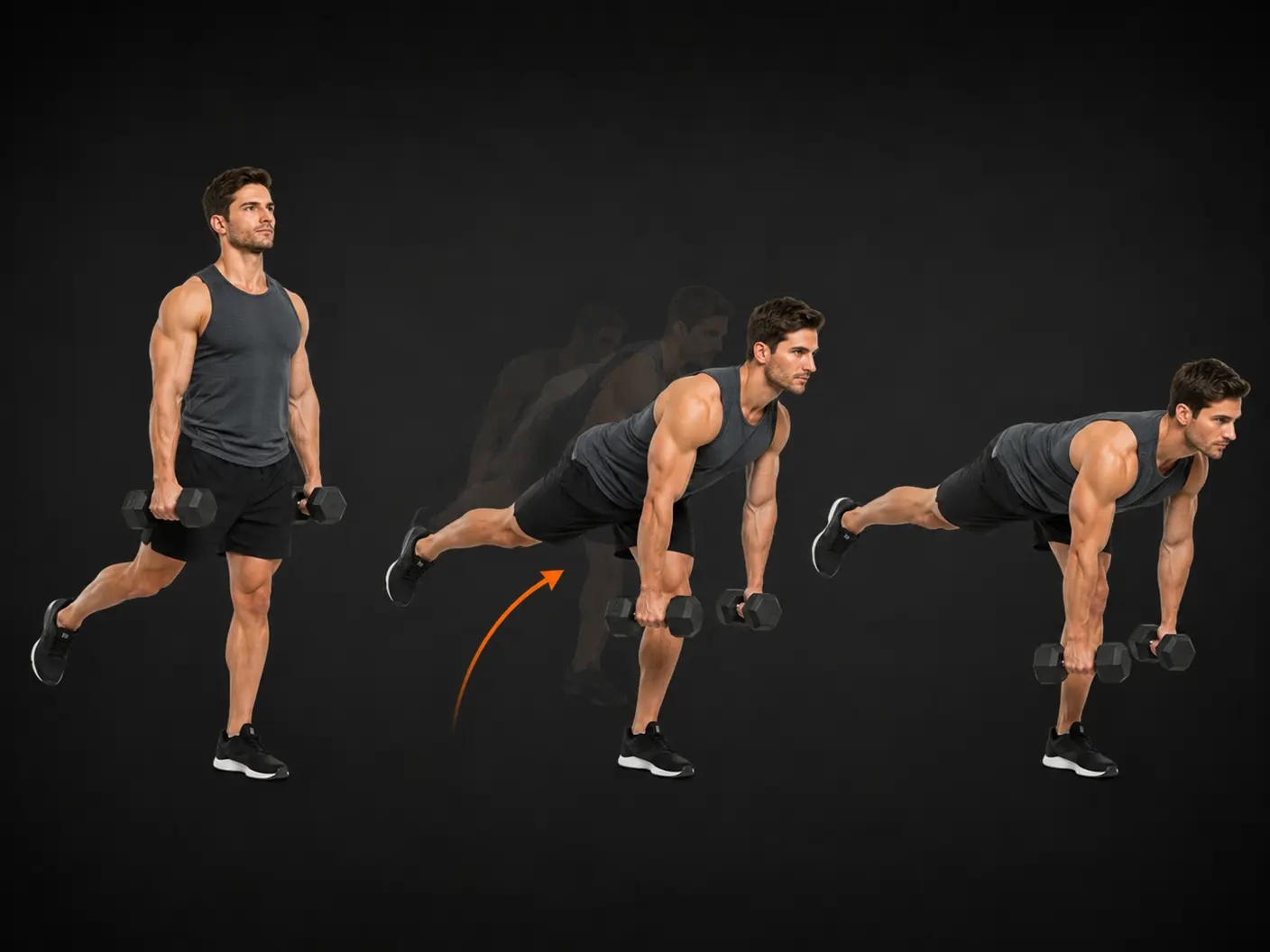
The single-leg Romanian deadlift is a unilateral hip-hinge movement performed on one leg, typically loaded with a dumbbell or kettlebell held in the opposite hand. It trains the posterior chain — primarily the hamstrings and gluteus medius — while simultaneously demanding significant balance and hip stability. It suits intermediate trainees looking to address side-to-side asymmetries, support athletic performance, or build posterior chain strength within a general fitness programme.
How to do it
Stand on one leg, a slight bend in the working knee. Hold a dumbbell in the opposite hand. Hinge at the hips, extending the free leg behind you as a counterbalance. Keep the hips square to the floor — do not open up. Lower until a hamstring stretch is felt; drive the hips forward to return.
Coaching cues
- Hips square
- Slight knee bend
- Long spine
- Squeeze the glute to return
Why train it
- Training each leg independently exposes and addresses strength imbalances between sides, which bilateral movements can mask.
- The demand on the ankle stabilisers, core, and gluteus medius makes this one of the more effective single-exercise options for developing the hip stability that underpins athletic movement.
- The long lever created by the extended rear leg places a substantial stretch on the working hamstring, supporting hypertrophy through a meaningful range of motion.
- Because load is introduced through a single dumbbell or kettlebell rather than a barbell, the exercise is accessible in almost any training environment without specialist equipment.
Common mistakes
- Rotating the hip of the free leg outward — keep both hips square to the floor throughout the entire range, as if headlights were fixed on each hip bone pointing straight down.
- Rounding the lower back during the descent — maintain a long, neutral spine from the top of the head to the tailbone and think about reaching the chest forward rather than the hands downward.
- Bending the standing knee excessively — allow only a slight, fixed bend; the movement should come from the hip hinge, not a squatting action in the working leg.
- Rushing the return to standing — squeeze the glute of the working leg deliberately to drive the hips forward, which keeps the correct muscles in control and reduces the risk of momentum taking over.
Primary: Hamstrings, Gluteus Medius.
Secondary: Erector Spinae, Rectus Abdominis.
Equipment
Good for
Easier variation
Staggered-stance RDL — rear foot lightly touches for balance.
Similar movements
Frequently asked
- What muscles does the single-leg Romanian deadlift work?
- The primary muscles are the hamstrings and gluteus medius of the working leg. The erectors, core, and ankle stabilisers contribute as secondary muscles to maintain a long spine and balance throughout the movement.
- How many sets and reps should I do?
- For hypertrophy, three to four sets of eight to twelve reps per side works well. For athletic performance or general fitness, three sets of six to ten reps per side with a focus on controlled tempo and balance quality is a practical starting point.
- What is the difference between a single-leg RDL and a regular Romanian deadlift?
- The conventional Romanian deadlift is a bilateral movement — both feet remain in contact with the floor — which allows heavier loading. The single-leg variation removes that base of support, reducing the load but adding unilateral stability demands that recruit the gluteus medius and ankle stabilisers far more directly.
- Should I hold the dumbbell on the same side as the working leg or the opposite side?
- The coaching convention is to hold the load in the opposite hand to the working leg — this is called the contralateral position. It creates a longer moment arm that challenges hip stability more effectively, though an ipsilateral or double-handed hold can also be used as a regression or variation.
- Is this exercise suitable for beginners?
- It is classified as an intermediate movement because it requires a baseline of hip-hinge mechanics, single-leg balance, and body awareness before the pattern can be performed safely with added load. Beginners are generally better served mastering the bilateral Romanian deadlift and single-leg balance drills first before progressing to this variation.
Want this movement in a plan built for you?
Adaptiv programmes the right exercises for your goal, equipment and experience — then adapts them as you train.
Build my programme