Dumbbell Renegade Row
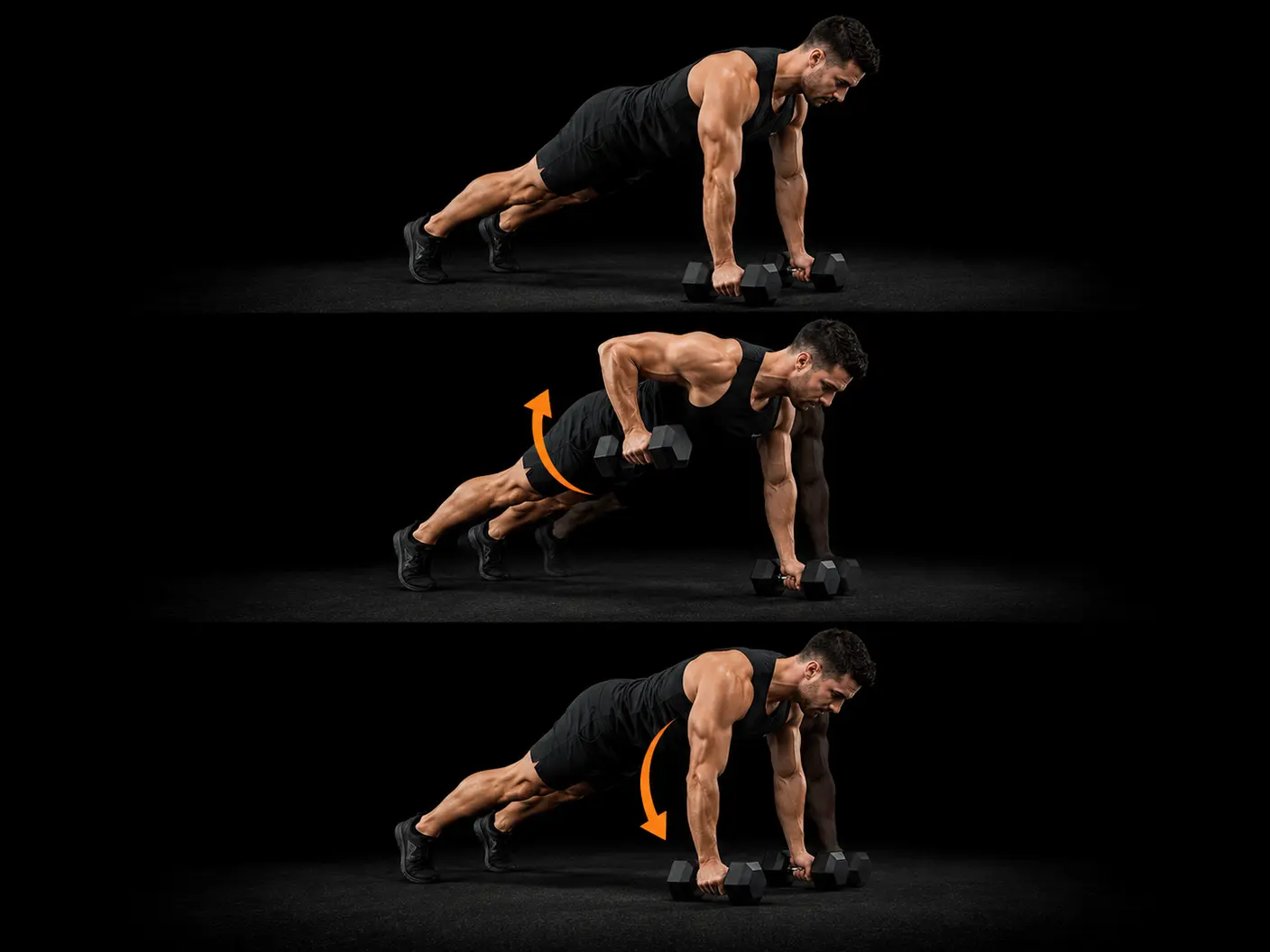
The dumbbell renegade row is a compound horizontal pull performed from a push-up position, requiring you to row one dumbbell to the hip while the opposite arm and both feet support your bodyweight on the floor. It trains the latissimus dorsi and rhomboids under a significant anti-rotation demand, meaning the core must work continuously to prevent the hips from twisting or sagging throughout each rep. The movement suits intermediate to advanced lifters who have already established a solid foundation in both rowing mechanics and plank stability.
How to do it
Hold two dumbbells in a push-up position, hands directly under shoulders. Row one dumbbell to the hip by driving the elbow back, keeping the hips level and resisting rotation. Return the dumbbell to the floor, then row the other side. Each single row counts as one rep.
Coaching cues
- Hips do not rotate
- Row to hip
- Brace the core hard
- Slow and controlled
Why train it
- It develops the latissimus dorsi and rhomboids through a full rowing pattern while simultaneously demanding high levels of core stability, making it an efficient choice when training time is limited.
- The anti-rotation requirement forces the obliques and deep stabilisers to work isometrically under load, which has direct carry-over to athletic movements that require resisting rotational forces.
- Because each side is trained independently, the renegade row helps identify and address left-to-right strength imbalances that a barbell or cable row might allow you to compensate around.
- The exercise can be scaled by adjusting dumbbell weight without changing the fundamental movement pattern, allowing progressive overload to continue across training blocks.
Common mistakes
- Rotating the hips as you row — brace the core hard before initiating each pull and focus on keeping both hips level throughout the entire movement.
- Rowing the dumbbell towards the shoulder rather than the hip — drive the elbow back and finish with the dumbbell beside the hip to correctly target the latissimus dorsi and rhomboids.
- Allowing the lower back to sag or the hips to pike — maintain a rigid plank position from head to heel before and during every rep, not just at the start of the set.
- Using momentum by dipping and jerking the torso — keep each row slow and controlled, which increases time under tension and reduces the risk of losing position mid-set.
Primary: Latissimus Dorsi, Rhomboids.
Secondary: Rectus Abdominis, Anterior Deltoid, Biceps Brachii, Triceps Brachii.
Equipment
Good for
Easier variation
Plank with dumbbell drag — slide the dumbbell across the floor instead of lifting it.
Similar movements
Frequently asked
- What muscles does the dumbbell renegade row work?
- The primary muscles are the latissimus dorsi and rhomboids. The deltoids, biceps, and triceps contribute to the rowing and support arm, while the core acts as a secondary stabiliser throughout each rep.
- How many sets and reps should I do for the renegade row?
- For strength, three to five sets of four to six reps per side with a heavier load works well. For hypertrophy, three to four sets of eight to ten reps per side at a controlled tempo is a common approach. Because the movement is classified as advanced, prioritise quality over volume, particularly when fatigued.
- Is the renegade row suitable for beginners?
- The movement is rated as advanced because it demands simultaneous competence in plank stability, anti-rotation bracing, and horizontal pulling mechanics. Beginners would typically benefit from building each of those qualities separately — through exercises such as the dumbbell bent-over row and forearm plank — before combining them in the renegade row.
- What are good alternatives to the dumbbell renegade row?
- If you want to keep the horizontal pull pattern but reduce the core demand, a dumbbell single-arm bent-over row is a practical alternative. If the anti-rotation component is the priority, a pallof press paired with a seated cable row addresses both qualities with more manageable loading for each.
- Should I use the renegade row for fat loss or hypertrophy?
- The exercise is listed as suitable for both hypertrophy and athletic performance, and it fits either goal depending on how it is programmed. For hypertrophy, a moderate load with a slow, controlled tempo maximises time under tension; for athletic performance, slightly heavier loading with a focus on positional stability is typically more appropriate.
Want this movement in a plan built for you?
Adaptiv programmes the right exercises for your goal, equipment and experience — then adapts them as you train.
Build my programme