Dumbbell Pullover (Serratus Emphasis)
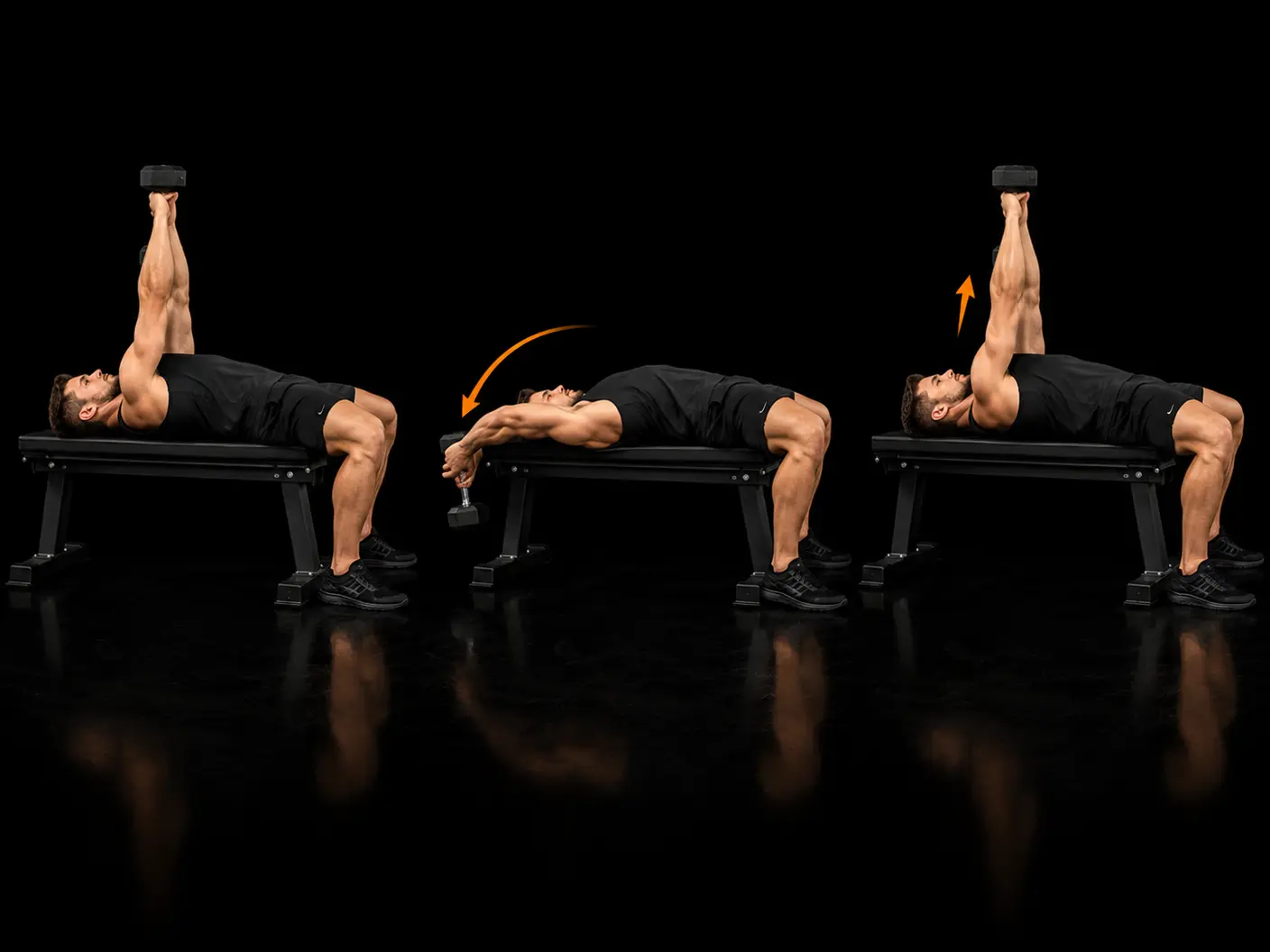
The dumbbell pullover performed with a serratus emphasis is an isolation movement that trains the shoulder girdle through a long arc, with particular attention given to the serratus anterior and latissimus dorsi. Lying across a bench with the hips dropped, the lifter sweeps a single dumbbell behind the head and drives it back overhead, finishing with a deliberate upward reach that maximises serratus engagement. It suits intermediate lifters looking to develop thoracic mobility, upper-back width, and the often-neglected serratus anterior.
How to do it
Lie across a bench with upper back supported and hips dropped. Hold one dumbbell with both hands over the chest, slight elbow bend. Lower the dumbbell behind the head in an arc until deep stretch. Pull back using the lats and serratus; emphasise the upward reach at the top.
Coaching cues
- Hips low
- Arc behind the head
- Reach up at the top
- Slight elbow bend
Why train it
- Directly targets the serratus anterior, a muscle that protracts and upwardly rotates the scapula and is frequently underdeveloped in standard pressing and pulling programmes.
- The long arc of motion places the latissimus dorsi under a substantial stretch, creating the mechanical tension associated with hypertrophic adaptation.
- Lying across the bench with hips lowered demands postural control through the trunk, adding a stabilisation demand without loading the spine axially.
- As an isolation movement it can be placed at the end of an upper-body session to accumulate volume for the lats and chest without further fatiguing the pressing muscles.
Common mistakes
- Keeping the hips raised level with the bench — allow the hips to drop toward the floor so the torso position encourages a fuller stretch and proper serratus recruitment.
- Bending the elbows too deeply during the arc — maintain only a slight, consistent elbow bend throughout; excess flexion shifts the load toward the triceps and reduces lat involvement.
- Stopping short of the full overhead stretch — lower the dumbbell until you feel a genuine stretch through the lats and chest wall, as a curtailed range limits the stimulus to the serratus anterior.
- Neglecting the upward reach at the top — at the end of the pull, consciously push the dumbbell toward the ceiling to fully protract the scapulae and complete the serratus contraction.
Primary: Serratus Anterior, Latissimus Dorsi.
Secondary: Pectoralis Major, Triceps Brachii.
Equipment
Good for
Easier variation
Cable pullover — constant tension.
Similar movements
Frequently asked
- What muscles does the dumbbell pullover with serratus emphasis work?
- The primary muscles are the serratus anterior and latissimus dorsi, with the pectoralis major and triceps contributing as secondary movers. The serratus anterior is particularly active during the upward reach at the top of the movement, where scapular protraction is greatest.
- How many sets and reps should I do for muscle growth?
- For hypertrophy, three to four sets of ten to fifteen repetitions works well for this movement. Because it is an isolation exercise, it is typically programmed toward the end of a session after compound pulling or pressing work.
- Why do I lie across the bench rather than along it?
- Lying across the bench with hips dropped frees the torso to move through a greater range and positions the upper back as the sole point of support, which encourages the thoracic extension and shoulder mobility needed to achieve a deep stretch behind the head.
- Is this exercise suitable for building a wider back?
- Yes, to a meaningful degree. The latissimus dorsi is loaded under a long stretch during the lowering phase, and consistent training in that stretched position is associated with hypertrophy that contributes to the appearance of back width.
- What is a good alternative if I do not have a bench?
- A stability ball can substitute for the bench, though it demands considerably more trunk stability; if neither is available, performing a lying pullover on the floor reduces the range of motion but still provides lat and serratus stimulus within the available arc.
Want this movement in a plan built for you?
Adaptiv programmes the right exercises for your goal, equipment and experience — then adapts them as you train.
Build my programme