Dumbbell Lateral Raise
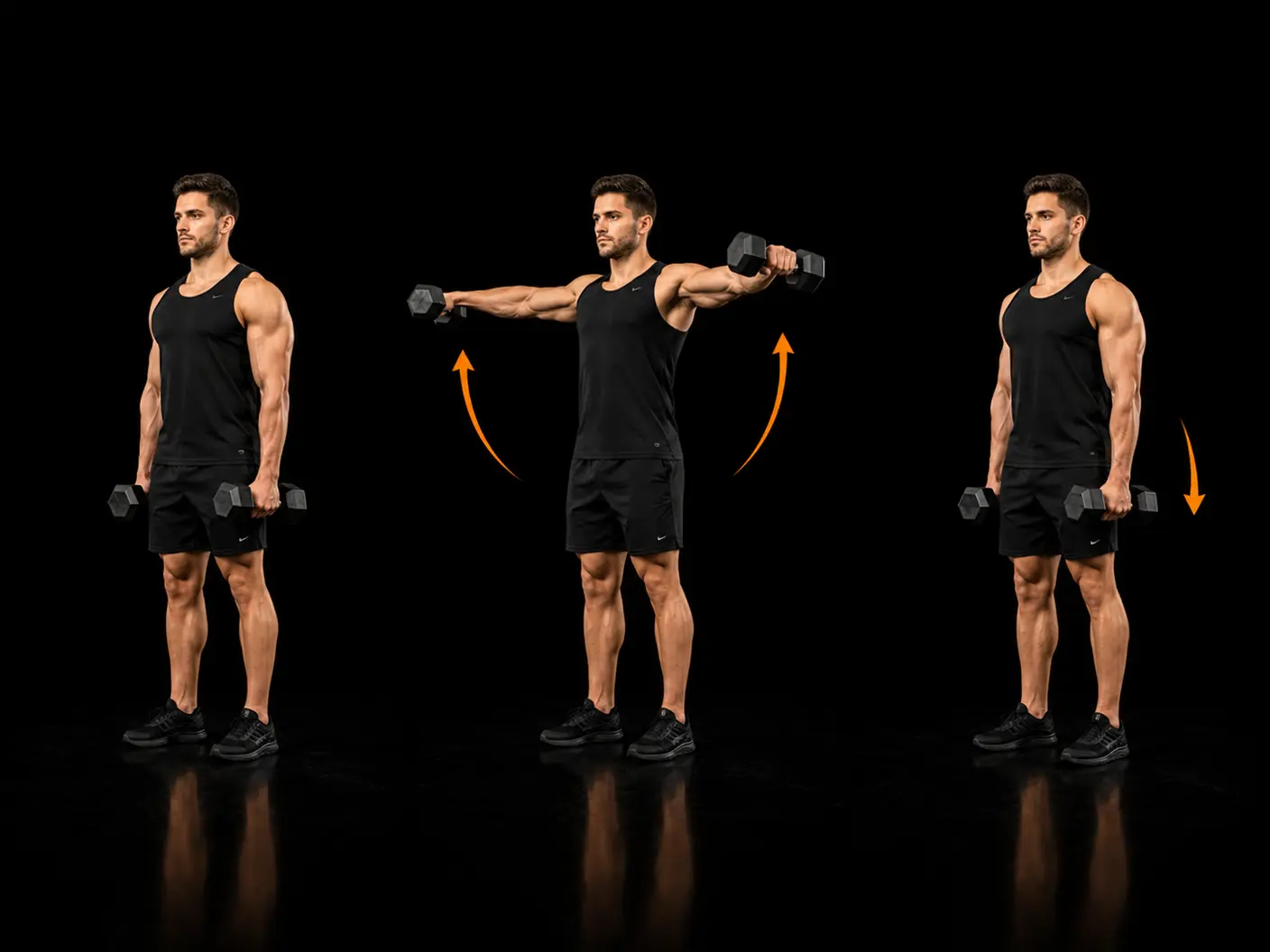
The dumbbell lateral raise is an isolation movement targeting the medial deltoid, the portion of the shoulder responsible for the characteristic width of the upper body. It trains pure shoulder abduction in the frontal plane, making it one of the few exercises that loads the lateral head of the deltoid directly. It suits lifters at any experience level who want to develop broader shoulders or address a weak point in their deltoid development.
How to do it
Stand tall, dumbbells at the sides, slight elbow bend locked in. Lead with the elbows as you raise the arms out to shoulder height. Thumbs level with or slightly below the little fingers at the top — as if pouring water from a jug. Pause briefly. Lower slowly to a full stretch.
Coaching cues
- Lead with the elbows
- Slight forward lean
- Pour the jug
- Slow eccentric
Why train it
- Direct loading of the medial deltoid makes this one of the most efficient exercises available for building shoulder width.
- As an isolation movement with a short learning curve, it can be programmed immediately after compound pressing work to accumulate targeted volume without significant systemic fatigue.
- The slow eccentric prescribed with this movement increases time under tension, which is a reliable driver of hypertrophic adaptation in the deltoids.
- Secondary involvement of the upper traps means the movement also contributes to upper back development and scapular stability as a by-product of consistent programming.
Common mistakes
- Using momentum to swing the dumbbells up — reduce the load and initiate every rep with a deliberate muscular contraction, keeping the torso still throughout.
- Leading with the thumbs rather than the elbows — internally rotate slightly so the thumbs are level with or just below the little fingers at the top, as if pouring from a jug, to keep tension on the medial deltoid.
- Raising the arms above shoulder height — stop at shoulder level, as lifting higher shifts the load onto the upper traps and reduces medial deltoid stimulus.
- Rushing the lowering phase — control the descent all the way to a full stretch at the bottom, as the eccentric portion is where a significant portion of the hypertrophic stimulus is generated.
Primary: Lateral Deltoid.
Secondary: Anterior Deltoid, Trapezius.
Equipment
Good for
Easier variation
Seated lateral raise — removes any body english and forces strict form.
Similar movements
Frequently asked
- What muscles does the dumbbell lateral raise work?
- The primary muscle is the medial (lateral) deltoid, which drives shoulder abduction in the frontal plane. The anterior deltoid and upper traps contribute as secondary muscles throughout the movement.
- How many sets and reps should I do for the dumbbell lateral raise?
- For hypertrophy, 3–4 sets of 12–20 reps works well for most lifters, as the deltoids respond effectively to moderate-to-high rep ranges with controlled tempo. Prioritise a weight that allows full range of motion and a genuine slow eccentric over simply lifting as heavy as possible.
- What weight should I start with for lateral raises?
- Most beginners find that very light dumbbells — often 4–8 kg — are sufficient to produce a meaningful challenge when the movement is performed with strict technique and a controlled lowering phase. The medial deltoid is a relatively small muscle, and form tends to break down quickly when the load is too heavy.
- Are dumbbell lateral raises a good alternative to overhead pressing for shoulder development?
- They serve a different purpose rather than acting as a direct replacement. Overhead pressing develops overall shoulder strength and mass across multiple heads, whereas the lateral raise isolates the medial deltoid specifically. The two movements complement each other well within the same programme.
- Can I do lateral raises if I have shoulder discomfort?
- If you are experiencing shoulder pain or discomfort, check with a qualified professional before programming this or any other shoulder movement, as they can assess what is appropriate for your specific situation.
Want this movement in a plan built for you?
Adaptiv programmes the right exercises for your goal, equipment and experience — then adapts them as you train.
Build my programme