Banded Lateral Raise
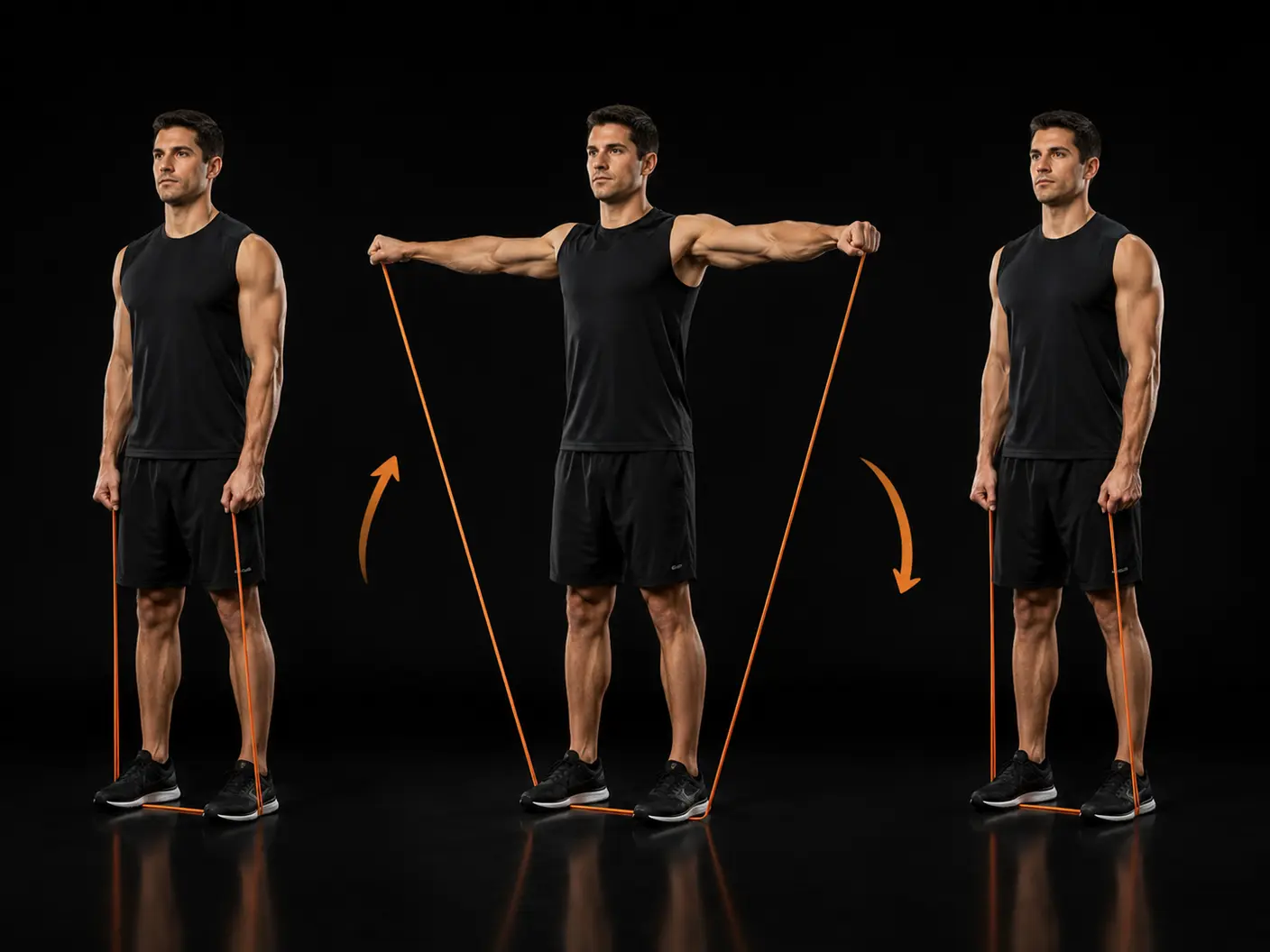
The banded lateral raise is an isolation movement targeting the medial deltoid through a side-elevation pattern against progressive band resistance. Standing on one end of the band and holding the other end in the opposite hand creates a cross-body pull that challenges the shoulder throughout the full arc of the lift. It suits beginners building foundational shoulder development and experienced trainees looking for a low-equipment option to finish a session.
How to do it
Stand on one end of a band; hold the other end in the opposite hand across the body. Raise the arm out to the side against the band's tension. Pause at shoulder height. Lower under control.
Coaching cues
- Cross-body setup
- Full range
- Slow eccentric
- Elbow leads
Why train it
- The cross-body band setup places meaningful tension on the medial deltoid at the bottom of the range where a dumbbell offers little resistance, improving stimulus across the full movement.
- The slow eccentric phase demanded by band tension accumulates time under tension effectively, supporting hypertrophy without requiring heavy loads.
- Performing the exercise unilaterally allows each shoulder to work independently, making it straightforward to identify and address left-to-right strength differences.
- The resistance band format makes this movement accessible at home or when travelling, fitting it into general fitness programmes without dedicated gym access.
Common mistakes
- Using momentum to swing the arm up — initiate the movement deliberately from the shoulder and keep the torso still throughout.
- Letting the elbow drop behind the wrist — lead with the elbow so the joint tracks above the hand as the arm rises, keeping tension in the medial deltoid rather than shifting it to the forearm.
- Cutting the range short — raise until the arm reaches shoulder height to complete the intended range and maximise the training stimulus.
- Rushing the lowering phase — resist the band on the way down with a controlled eccentric rather than allowing the arm to snap back, as this is where significant muscular work occurs.
Primary: Lateral Deltoid.
Secondary: Anterior Deltoid.
Equipment
Good for
Easier variation
Dumbbell lateral raise — fixed load vs variable band tension.
Similar movements
Frequently asked
- What muscles does the banded lateral raise work?
- The primary muscle trained is the medial deltoid, which drives arm elevation to the side. The anterior deltoid contributes as a secondary mover throughout the range.
- How many sets and reps should I do?
- For hypertrophy, three to four sets of twelve to twenty reps works well, given that bands suit slightly higher rep ranges. Rest sixty to ninety seconds between sets to maintain quality of movement.
- What is the cross-body band setup and why does it matter?
- Standing on one end of the band and holding the other end in the opposite hand means the band pulls the arm diagonally across the body rather than straight down. This angle increases tension at the start of the rep where shoulder abduction is weakest, providing a more consistent stimulus than a straight pull.
- Is the banded lateral raise a good alternative to dumbbell lateral raises?
- It is a practical alternative when dumbbells are unavailable and offers a different resistance curve, with greater tension at the bottom of the range rather than the top. Both variations target the medial deltoid effectively and can be rotated within a programme.
- How difficult is this exercise for beginners?
- It is classified as a foundational movement, meaning most beginners can learn it quickly with attention to the coaching cues. The main focus early on should be controlling the eccentric and ensuring the elbow leads, rather than prioritising load or rep volume.
Want this movement in a plan built for you?
Adaptiv programmes the right exercises for your goal, equipment and experience — then adapts them as you train.
Build my programme