Cable Lateral Raise
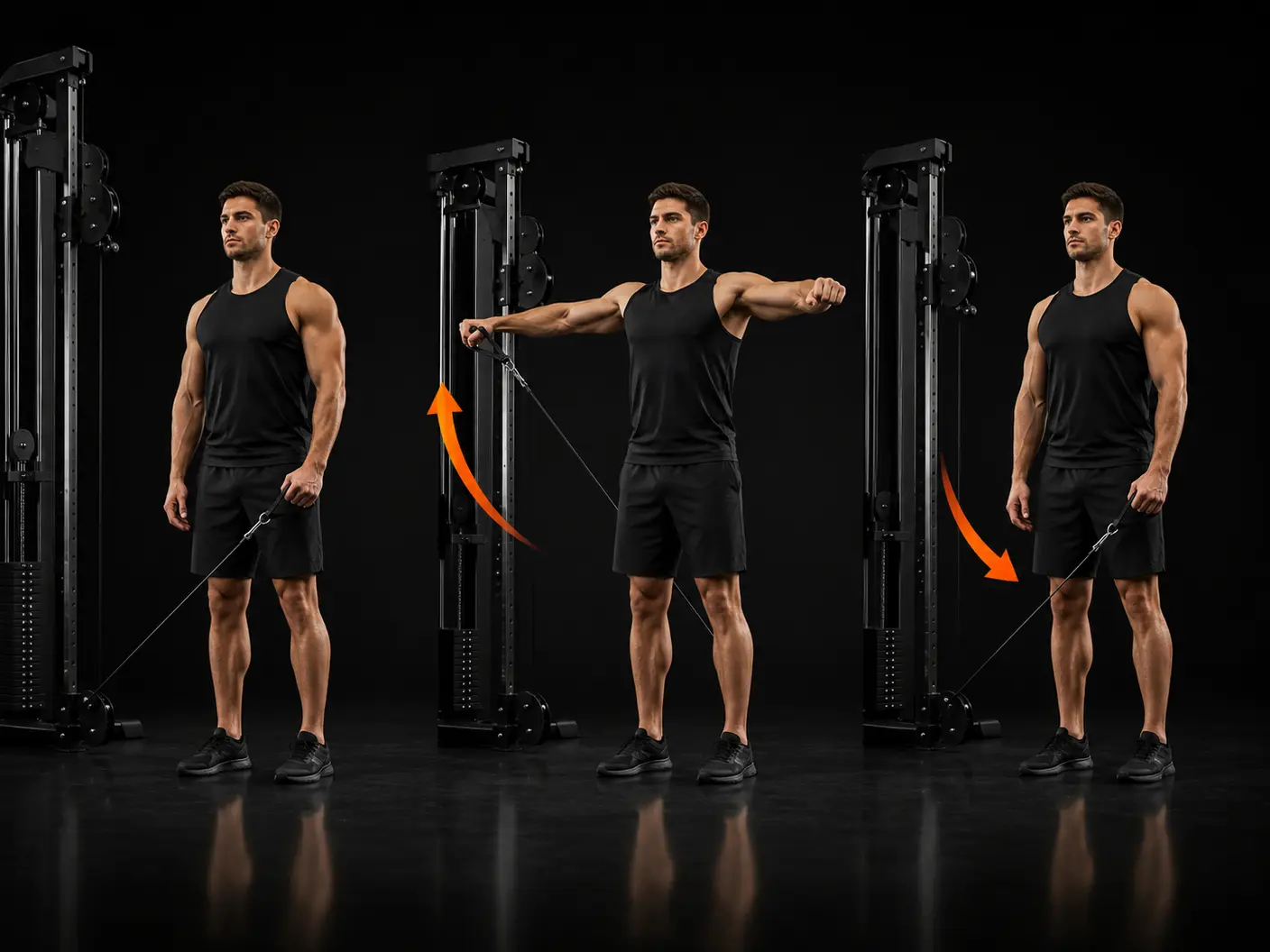
The cable lateral raise is an isolation movement that targets the medial deltoid by raising the arm out to the side against continuous cable resistance. Unlike the dumbbell equivalent, the cable maintains meaningful tension throughout the full range of motion — including at the bottom, where a dumbbell offers almost none. It suits anyone looking to develop shoulder width, from beginners learning the pattern to experienced lifters refining deltoid hypertrophy work.
How to do it
Set a cable low. Stand side-on to the stack; grip the handle with the far hand, cable crossing in front of the body. Slight elbow bend. Raise the arm out to the side to shoulder height. Pause. Lower under control to a full stretch.
Coaching cues
- Lead with the elbow
- Constant tension
- Pause at shoulder height
- Slow descent
Why train it
- The cable provides constant tension across the entire range of motion, including the stretched position at the bottom, making it more mechanically demanding than a dumbbell for the same load.
- The unilateral setup allows each shoulder to be trained independently, which helps address side-to-side imbalances in deltoid development.
- Pausing at shoulder height increases time under tension at the point of peak contraction, a useful stimulus for hypertrophy-focused programming.
- The fixed cable path encourages a cleaner movement arc than free weights, making it a reliable option for lifters still grooving the lateral raise pattern.
Common mistakes
- Using momentum from the torso — keep the trunk still and initiate the movement from the shoulder, not a lateral body lean.
- Raising the arm too high above shoulder height — stop at shoulder level to keep tension on the medial deltoid rather than transferring load to the upper trapezius.
- Letting the elbow drop so the forearm leads the movement — lead with the elbow to keep the medial deltoid as the primary driver throughout the lift.
- Rushing the descent — lower the arm slowly and with full control to a genuine stretch at the bottom, rather than letting the cable pull the arm back passively.
Primary: Lateral Deltoid.
Secondary: Anterior Deltoid.
Equipment
Good for
Easier variation
Dumbbell lateral raise — easier setup, similar target.
Similar movements
Frequently asked
- What muscles does the cable lateral raise work?
- The primary muscle trained is the medial deltoid, which is responsible for shoulder width and the lateral silhouette of the upper arm. The anterior deltoid acts as a secondary contributor throughout the movement.
- How many sets and reps should I do for cable lateral raises?
- For hypertrophy, three to four sets of 12 to 20 reps with a controlled tempo works well. The lighter loads and constant cable tension make higher rep ranges practical and effective here.
- Why use a cable instead of a dumbbell for lateral raises?
- A dumbbell provides very little resistance at the bottom of the movement where the arm hangs by the side. The cable maintains meaningful tension throughout, including in the stretched position, which increases the total mechanical stimulus across the set.
- Which hand should grip the handle?
- Grip the handle with the hand furthest from the cable stack — the far hand — so the cable crosses in front of the body. This positioning allows a natural arc and keeps the cable from interfering with the movement path.
- Is the cable lateral raise suitable for beginners?
- Yes. It is classified as a foundational movement and the cable provides a guided resistance path that can help beginners learn the correct arc and feel the target muscle working. Starting with a light load and focusing on the coaching cues — particularly leading with the elbow and pausing at shoulder height — will build good habits early.
Want this movement in a plan built for you?
Adaptiv programmes the right exercises for your goal, equipment and experience — then adapts them as you train.
Build my programme