Dumbbell Hip Thrust
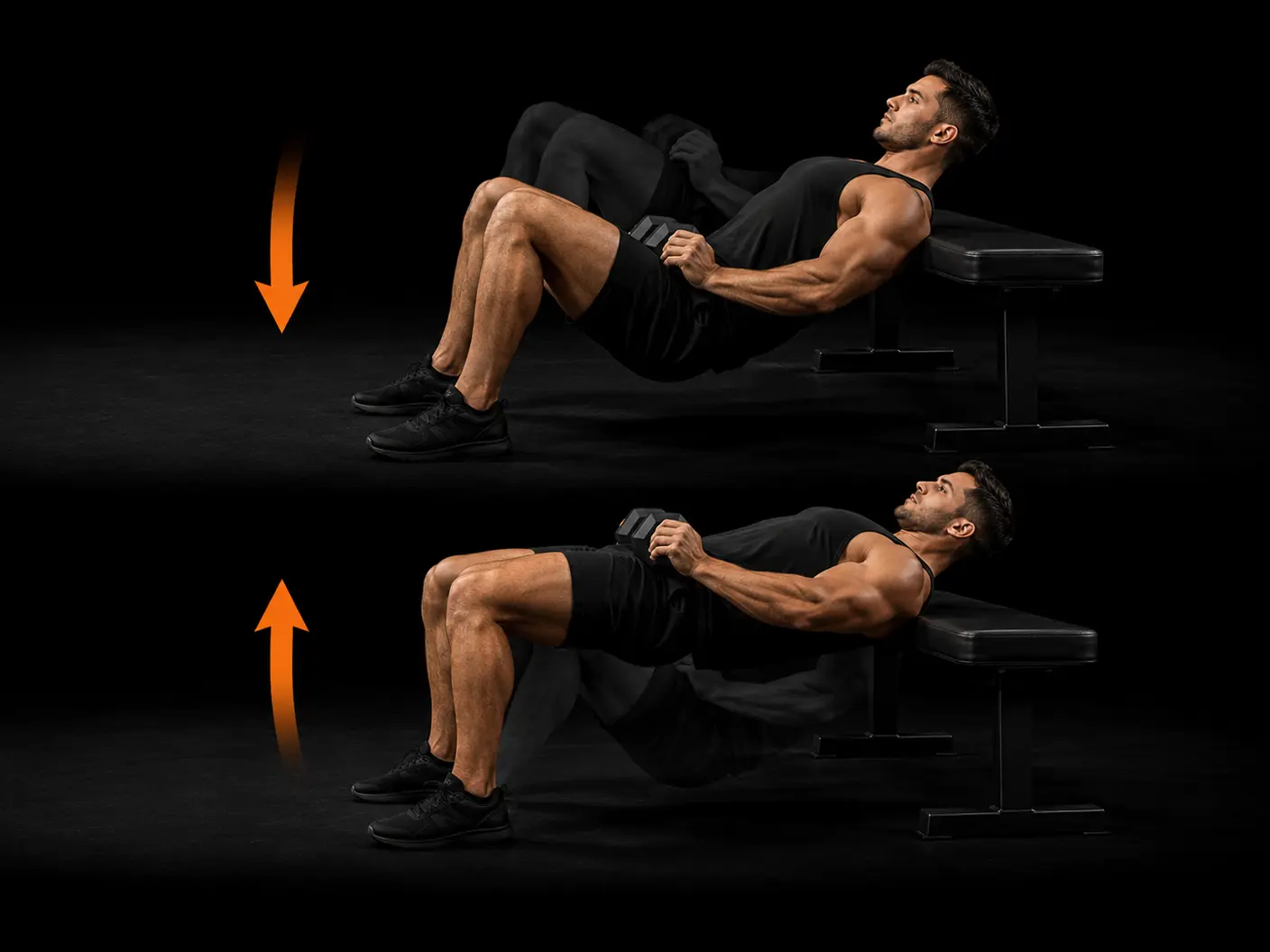
The dumbbell hip thrust is a compound hinge movement that loads the gluteus maximus through a powerful hip extension, with the upper back braced against a bench and one or two dumbbells positioned across the hip crease. It differs from deadlift-pattern hinges by keeping the torso elevated throughout, which places a sustained mechanical demand on the glutes across the full range of motion. It suits intermediate lifters pursuing glute hypertrophy, lower-body strength, or athletic performance who have access to dumbbells and a bench.
How to do it
Set the upper back against a bench, knees bent, feet flat on the floor. Rest one or two dumbbells horizontally across the hip crease — pad them for comfort if necessary. Drive through both heels to lift the hips until the body forms a straight line from shoulder to knee. Squeeze the glutes hard at the top; keep the ribs down and avoid hyperextending the lower back. Lower the hips under control.
Coaching cues
- Drive through heels
- Ribs down
- Squeeze hard at top
- Chin tucked
Why train it
- The elevated torso position keeps the gluteus maximus under meaningful load at both the stretched and shortened positions, making it a highly effective choice for hypertrophy-focused programming.
- Driving through the heels reinforces posterior-chain recruitment patterns that carry over to sprinting, jumping, and other athletic movements requiring powerful hip extension.
- The dumbbell variation allows load to be adjusted incrementally without requiring a barbell set-up, making it practical for home gyms, commercial gym floors, and circuit-style sessions.
- Secondary involvement of the hamstrings, adductors, and core means the movement builds broader lower-body stability alongside its primary glute stimulus.
Common mistakes
- Hyperextending the lower back at the top — keep the ribs down and think of posteriorly tilting the pelvis slightly so the spine stays neutral at lockout.
- Pushing through the toes rather than the heels — actively drive the heels into the floor to shift load away from the quads and onto the glutes and hamstrings.
- Allowing the chin to rise and the head to jut forward — tuck the chin throughout the movement to maintain a neutral cervical spine and avoid excessive lumbar extension.
- Rushing the descent — lower the hips under deliberate control to maintain tension through the glutes and reduce the risk of the dumbbells shifting out of position.
Primary: Gluteus Maximus.
Secondary: Hamstrings, Adductors, Rectus Abdominis.
Equipment
Good for
Easier variation
Bodyweight glute bridge — same movement pattern without load.
Similar movements
Frequently asked
- What muscles does the dumbbell hip thrust work?
- The primary muscle trained is the gluteus maximus. The hamstrings, adductors, and core act as secondary contributors to stabilise and assist the movement throughout the range of motion.
- How many sets and reps should I do for the dumbbell hip thrust?
- For hypertrophy, three to four sets of eight to fifteen reps with a controlled tempo works well. For strength-focused sessions, four to five sets of five to eight reps with heavier loading is more appropriate — ensure technique remains clean before adding weight.
- How do I stop the dumbbell digging into my hips?
- Fold a gym towel or use a dedicated barbell pad across the hip crease before resting the dumbbell on top. This distributes the load more evenly and allows you to focus on the movement rather than discomfort.
- What are good alternatives if I do not have a bench?
- A sofa, plyo box, or any stable elevated surface of similar height can substitute for the bench. Alternatively, a glute bridge performed flat on the floor removes the bench entirely, though it reduces the range of hip extension available.
- Is the dumbbell hip thrust suitable for building athletic performance?
- Yes — powerful hip extension underpins sprinting speed, jumping height, and change-of-direction ability, and the hip thrust trains this pattern with direct glute loading. It is commonly included in athletic strength programmes as an accessory to compound lifts such as squats and deadlifts.
Want this movement in a plan built for you?
Adaptiv programmes the right exercises for your goal, equipment and experience — then adapts them as you train.
Build my programme