Dumbbell Floor Press
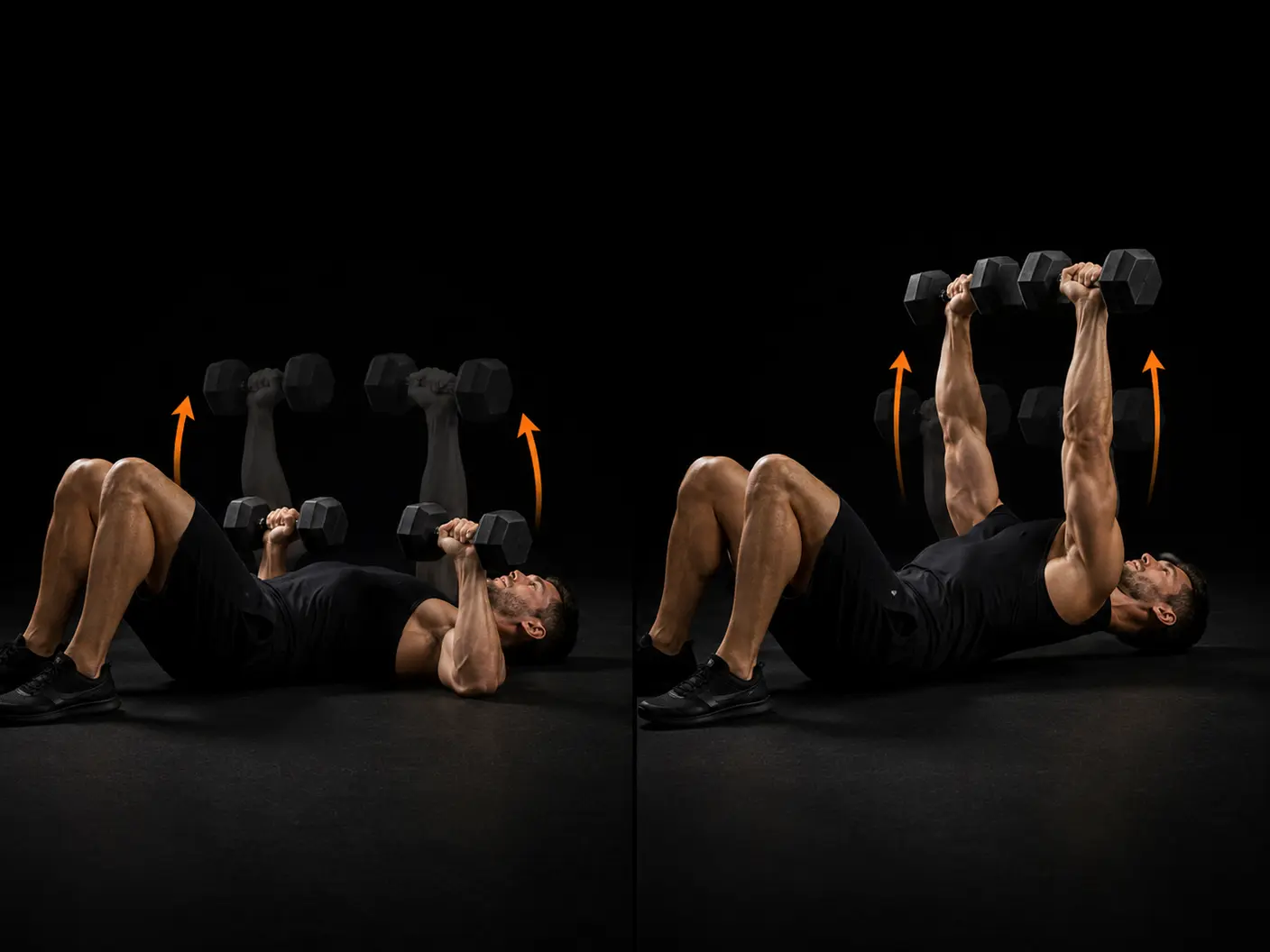
The dumbbell floor press is a horizontal pushing movement performed lying on the floor, which uses the ground itself to limit how far the elbows descend and naturally reduces the range of motion at the shoulder. It trains the pectorals and triceps as primary movers, with the anterior deltoids contributing as a secondary muscle group. The restricted range of motion makes it a practical option for lifters managing shoulder discomfort or those looking to build pressing strength without the full demand of a bench press.
How to do it
Lie on the floor with knees bent and feet flat. Hold dumbbells at chest height with a neutral or slight overhand grip. Press the dumbbells upward and slightly inward until the arms are extended. Lower until the elbows contact the floor — this naturally limits the range of motion and shoulder stress. Press again immediately.
Coaching cues
- Elbows touch the floor
- Press in an arc
- Neutral wrists
- Drive through the palms
Why train it
- The floor acts as a built-in range-of-motion limiter, reducing stress at the bottom of the press and allowing consistent, controlled repetitions.
- Training with dumbbells rather than a barbell means each side works independently, helping to identify and address strength imbalances between left and right.
- The movement builds meaningful pectoral and triceps hypertrophy within a shorter arc, making it a useful accessory lift alongside compound pressing work.
- Its minimal equipment requirement — only dumbbells and floor space — makes it straightforward to programme in home, garage, or commercial gym settings.
Common mistakes
- Letting the wrists bend back under load — maintain a neutral wrist position throughout so the force travels directly through the palms and into the dumbbells.
- Bouncing the elbows off the floor at the bottom — allow the elbows to touch and briefly pause rather than using the rebound, which removes tension from the working muscles.
- Pressing straight up rather than in a slight arc — guide the dumbbells inward as they rise to follow the natural pressing path and keep the pectorals under load throughout the movement.
- Flaring the elbows excessively wide — keep them at a moderate angle from the torso to protect the shoulder joint and maintain effective muscle recruitment.
Primary: Pectoralis Major, Triceps Brachii.
Secondary: Anterior Deltoid.
Equipment
Good for
Easier variation
Standard push-up — equivalent upper body push pattern requiring no equipment.
Similar movements
Frequently asked
- What muscles does the dumbbell floor press work?
- The primary muscles are the pectorals and triceps, with the anterior deltoids contributing as a secondary mover. The floor position limits how far the shoulder extends, so the emphasis shifts slightly more toward the triceps compared with a full-range bench press.
- How many sets and reps should I do for the dumbbell floor press?
- For hypertrophy, three to four sets of eight to twelve repetitions at a moderate load works well. For strength, three to five sets of four to six repetitions with heavier dumbbells is appropriate. General fitness programmes typically sit in the middle range of three sets of ten.
- Is the dumbbell floor press a good alternative to the bench press?
- It is a practical alternative when a bench is unavailable or when shoulder discomfort discourages the full range of a bench press. The shorter range of motion does mean less pectoral stretch at the bottom, so it is worth treating it as a complement or substitute rather than a direct replacement if your goal is maximum pectoral development.
- Can beginners use the dumbbell floor press?
- Yes — it is classified as a foundational movement, and the floor provides a stable base that simplifies setup compared with a bench. Starting with lighter dumbbells to groove the pressing arc and wrist position before adding load is advisable.
- What is the difference between a dumbbell floor press and a barbell floor press?
- Both movements share the same range-of-motion limit imposed by the floor, but dumbbells allow each arm to travel independently and let you use a neutral or slight overhand grip, which many lifters find more comfortable. A barbell locks both arms into a fixed path and typically allows heavier loading once technique is established.
Want this movement in a plan built for you?
Adaptiv programmes the right exercises for your goal, equipment and experience — then adapts them as you train.
Build my programme