Barbell Floor Press
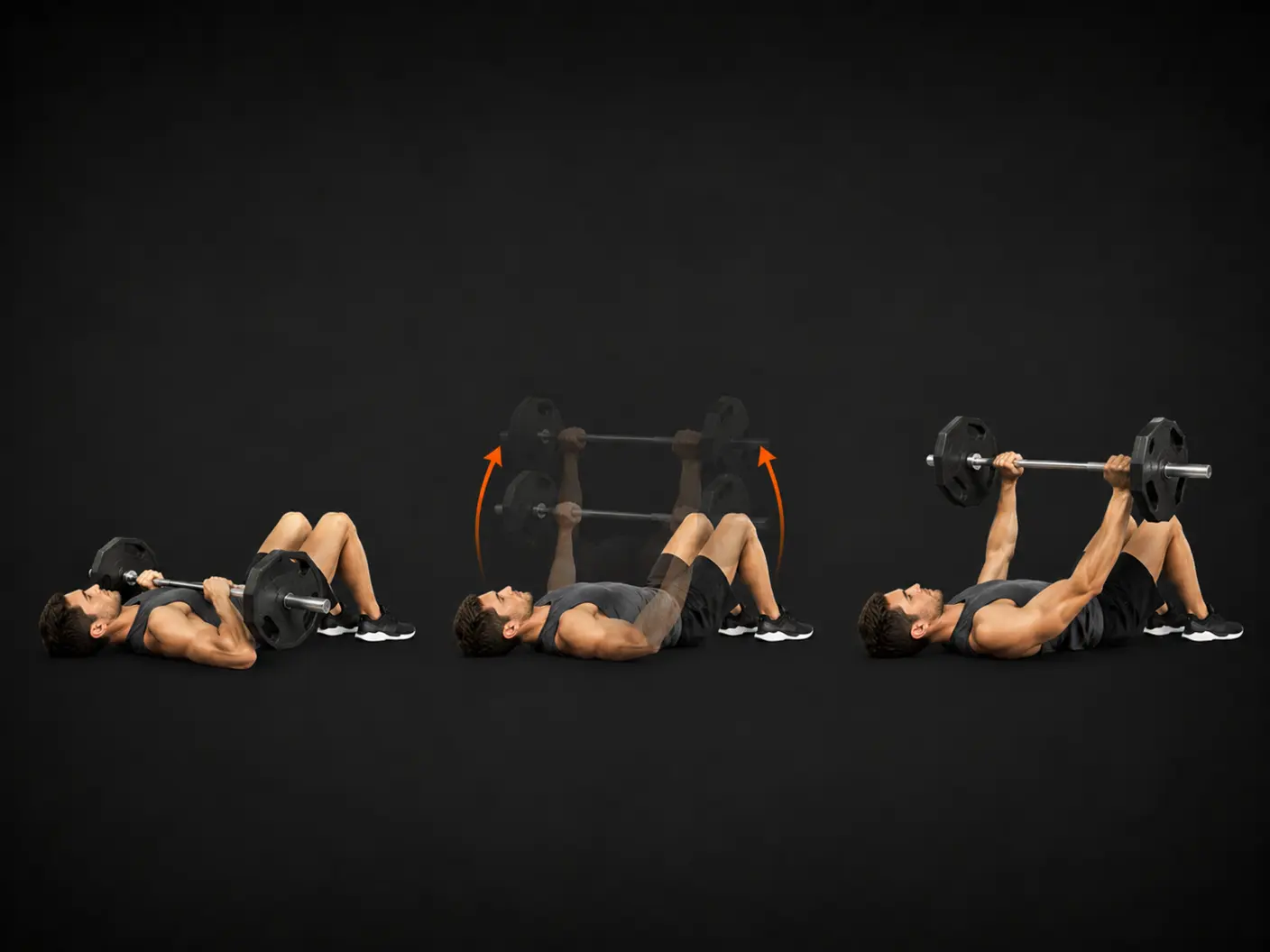
The barbell floor press is a compound horizontal pushing movement performed lying on the floor beneath a rack-held barbell. By limiting the range of motion at the bottom, the floor removes leg drive and the stretch reflex, placing the work squarely on the chest, triceps, and anterior deltoid. It suits intermediate lifters looking to build upper-body pressing strength or address a sticking point in the mid-to-upper range of the bench press.
How to do it
Lie on the floor under a rack-held barbell. Grip slightly wider than shoulder-width. Unrack. Lower the bar to the chest; when the upper arms rest on the floor, pause briefly. Press back up to lockout. The floor limits ROM, eliminating leg drive and the bottom stretch reflex.
Coaching cues
- Elbows pause on the floor
- Pause tight
- Press with intent
- Wrists stacked over elbows
Why train it
- The restricted range of motion isolates the mid-to-lockout portion of the press, making it an effective tool for developing triceps strength and overcoming sticking points in heavier lifts.
- Without the option to use leg drive or a pronounced arch, the floor press demands honest upper-body output, which can expose and correct weaknesses in raw pressing strength.
- The hard pause when the upper arms contact the floor eliminates momentum, requiring the musculature to generate force from a dead stop and reinforcing controlled, intentional pressing mechanics.
- Its straightforward setup with a rack or safeties makes it a reliable accessory movement within a strength or hypertrophy programme when a full bench is unavailable or undesirable.
Common mistakes
- Letting the elbows bounce off the floor — control the descent and pause under tension rather than using the ground as a springboard.
- Allowing the wrists to drift behind the elbows — keep the wrists stacked directly over the elbows throughout the lift to maintain efficient force transfer.
- Cutting the pause short when the upper arms touch the floor — hold the position briefly and with full control before pressing, as this is where the movement's training stimulus is concentrated.
- Gripping too narrow or too wide — a grip slightly wider than shoulder-width positions the wrists over the elbows and distributes load effectively across the pectorals and triceps.
Primary: Pectoralis Major, Triceps Brachii.
Secondary: Anterior Deltoid.
Equipment
Good for
Easier variation
Dumbbell floor press — same floor-limited ROM with lighter load.
Similar movements
Frequently asked
- What muscles does the barbell floor press work?
- The primary muscles trained are the pectoralis major and triceps brachii, with the anterior deltoid contributing as a secondary mover. The floor press places particular emphasis on the triceps relative to a full-range bench press, as the shortened range of motion reduces the loading demand on the lower chest.
- How many sets and reps should I do for the barbell floor press?
- For strength, three to five sets of three to six reps at a challenging load works well. For hypertrophy, three to four sets of eight to twelve reps with controlled tempo and a consistent pause is a practical starting point.
- Is the barbell floor press a good alternative to the bench press?
- It serves as a useful complement rather than a direct substitute, as the reduced range of motion means the lower chest receives less stimulus than in a full bench press. It is particularly effective as an accessory movement for lifters targeting triceps development or lockout strength.
- Do I need a rack to perform the barbell floor press?
- A rack with j-hooks or adjustable safeties set at an appropriate height is the recommended setup, as it allows safe unracking and re-racking without assistance. Performing it without any rack support significantly increases the risk of being unable to safely terminate the set.
- Can the floor press help with my bench press sticking point?
- Because it trains the mid-to-lockout range from a dead stop, it is well suited to addressing sticking points in the upper third of the bench press where triceps strength is often the limiting factor. Programme it as an accessory lift after your primary bench work.
Want this movement in a plan built for you?
Adaptiv programmes the right exercises for your goal, equipment and experience — then adapts them as you train.
Build my programme