Close-Grip Push-Up
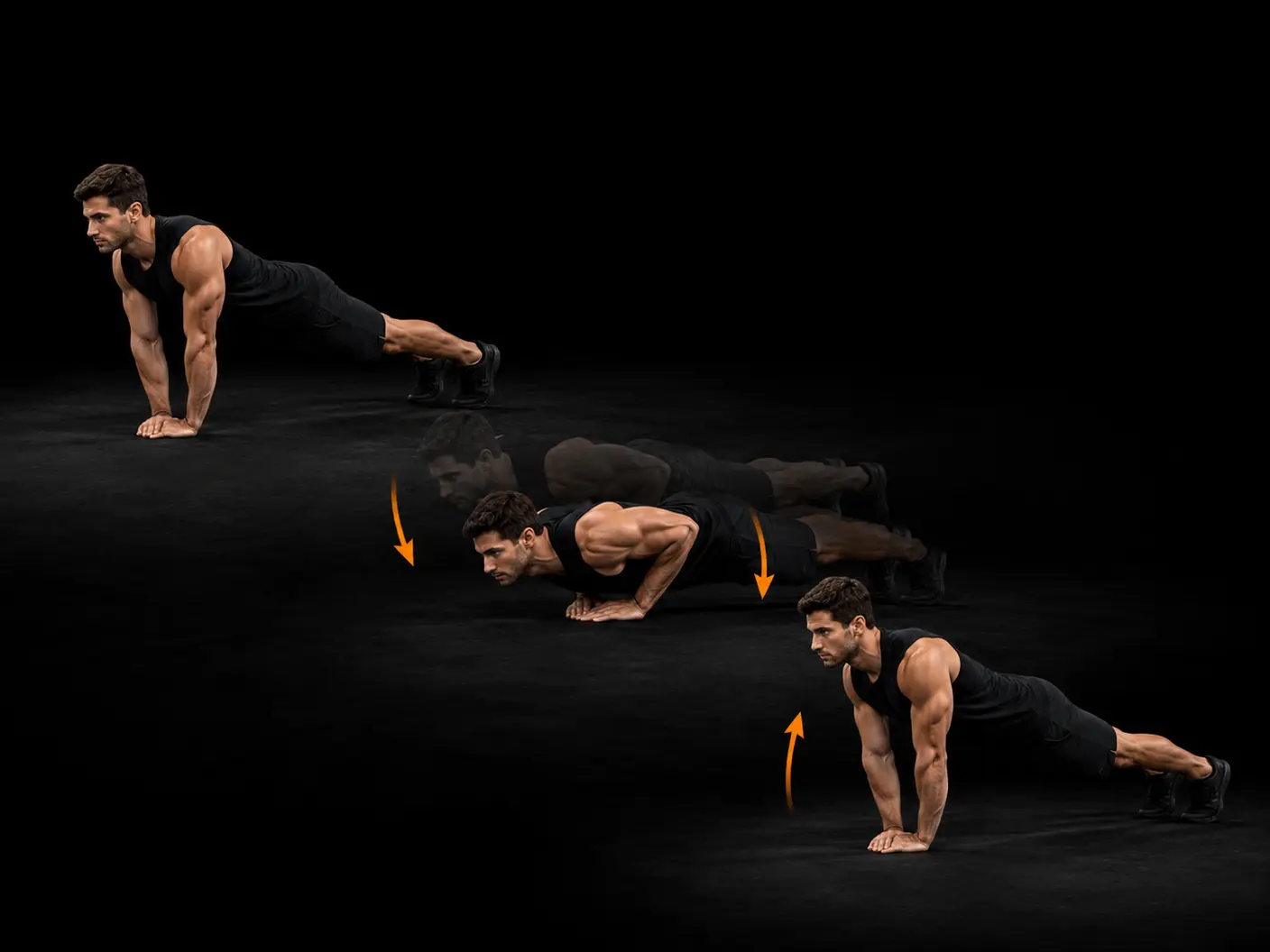
The close-grip push-up is a bodyweight horizontal pressing movement that shifts emphasis from the chest toward the triceps brachii by positioning the hands at shoulder-width or narrower and keeping the elbows close to the ribs throughout the rep. It trains the same fundamental push pattern as a standard push-up but demands greater elbow extension strength, making it a practical progression for lifters who want to develop the back of the upper arm without loading a barbell. It suits intermediate trainees who have already established solid push-up mechanics and are looking to vary stimulus or address triceps development.
How to do it
Set hands at shoulder-width or narrower. Plank from head to heels. Lower the chest to the hands with elbows close to the ribs. Press back up to lockout. Keep the body in a straight line.
Coaching cues
- Hands shoulder-width
- Elbows tight
- Plank position
- Full lockout
Why train it
- Directly overloads the triceps brachii as a primary mover, making it a useful accessory choice for anyone whose pressing strength is limited by elbow extension.
- Requires no equipment, so it can be programmed into home, travel, or gym sessions without any change to logistics.
- Reinforces whole-body tension by demanding a rigid plank position from head to heels, developing core bracing as a byproduct of correct technique.
- Pairs well with horizontal and vertical pressing compounds as a lower-fatigue finishing exercise that accumulates volume for the triceps and chest.
Common mistakes
- Flaring the elbows out to the sides — keep them tracking close to the ribs throughout the descent and press to maintain the close-grip stimulus and reduce unnecessary shoulder stress.
- Allowing the hips to sag or pike — brace the glutes and abdomen before the first rep and hold that plank alignment for the entire set.
- Cutting the range of motion short at the bottom — lower the chest all the way to the hands on each rep to ensure full muscle lengthening before the press.
- Failing to reach full lockout at the top — extend the elbows completely at the top of each rep, as this is where the triceps complete their primary function.
Primary: Triceps Brachii, Pectoralis Major.
Secondary: Anterior Deltoid.
Equipment
Good for
Easier variation
Incline close-grip push-up — reduces bodyweight load.
Similar movements
Frequently asked
- What muscles does the close-grip push-up work?
- The primary muscles are the triceps brachii and pectoralis major, with the anterior deltoid contributing as a secondary mover. The core musculature is also engaged isometrically to maintain the plank position.
- How is the close-grip push-up different from a standard push-up?
- The main distinction is hand placement and elbow path — narrower hands with elbows tucked to the ribs transfers a greater share of the work to the triceps compared with the wider, more chest-dominant standard push-up. Both movements are compound horizontal pressing patterns.
- How many sets and reps should I do?
- For hypertrophy, three to four sets of eight to fifteen reps with controlled tempo works well. For general fitness, two to three sets taken close to but not to failure is a sensible starting point. Rest ninety seconds to two minutes between sets.
- Is the close-grip push-up suitable for building bigger triceps?
- Yes, it is a reasonable hypertrophy option for the triceps, particularly when performed with a full range of motion and progressive overload applied over time through added reps, slower tempo, or elevated feet. It is most effective when combined with other pressing volume.
- What are some alternatives if I find this movement too difficult?
- A standard push-up with a slightly wider hand position reduces the triceps demand and is a sensible regression. Incline close-grip push-ups — hands on a bench or box — further reduce the load and allow the same elbow mechanics to be practised before progressing to the floor.
Want this movement in a plan built for you?
Adaptiv programmes the right exercises for your goal, equipment and experience — then adapts them as you train.
Build my programme