Dumbbell Conventional Deadlift
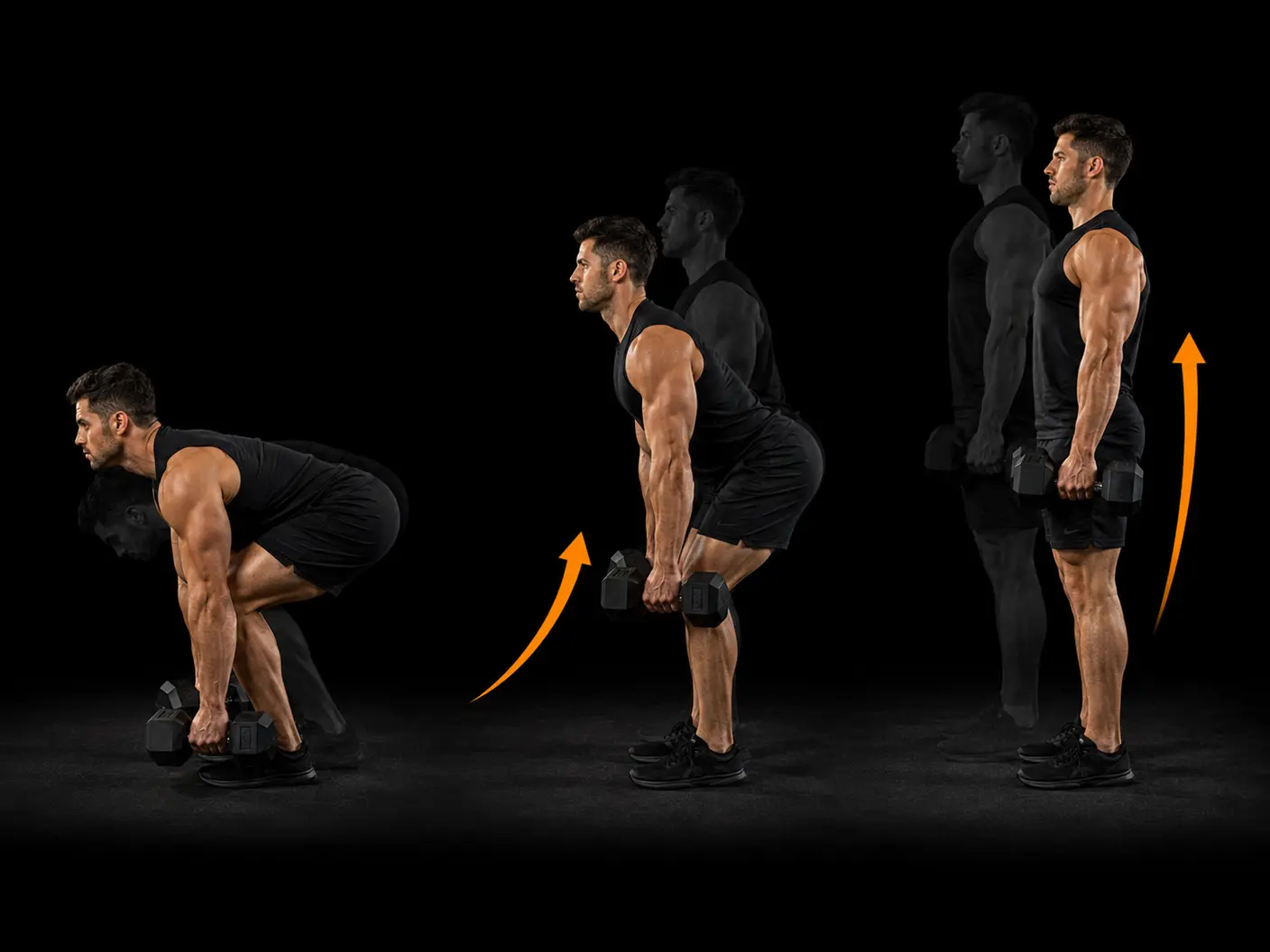
The dumbbell conventional deadlift is a hip-hinge movement that trains the posterior chain — primarily the glutes, hamstrings, and erector spinae — through a full range of pull from the floor to lockout. Holding a dumbbell in each hand rather than a barbell allows for a more natural hand position and makes the movement accessible without a loaded bar. It suits intermediate lifters developing posterior chain strength, as well as those training in settings where a barbell is unavailable.
How to do it
Place dumbbells at your sides or just outside the feet. Push the floor away from you while keeping the chest tall, back flat, and hips and shoulders rising at the same rate. As the dumbbells pass the knees, drive the hips through to lockout — squeeze the glutes and stand tall. Lower the dumbbells under control by hinging back at the hips.
Coaching cues
- Push the floor away
- Chest tall
- Hips and shoulders rise together
- Squeeze at lockout
Why train it
- It directly develops strength and size in the gluteus maximus, hamstrings, and erector spinae — the key muscles responsible for hip extension and upright posture.
- The dumbbell format allows each hand to track a natural path, reducing rotational stress at the wrist and forearm compared with a fixed barbell grip.
- The movement also places meaningful demand on the lats, trapezius, and grip, making it an efficient compound option that trains multiple muscle groups in a single pattern.
- It transfers well to general fitness goals, reinforcing the mechanics of safe lifting from the floor — a pattern that carries over directly to everyday tasks.
Common mistakes
- Letting the hips rise faster than the shoulders — focus on driving the hips and shoulders upward at the same rate so the torso angle stays consistent through the pull.
- Rounding the upper back as the dumbbells leave the floor — set the chest tall before initiating the pull and maintain that position throughout.
- Allowing the dumbbells to drift forward away from the body — keep them close to the legs throughout the lift to reduce the moment arm on the lower back.
- Cutting the lockout short at the top — drive the hips fully through and squeeze the glutes to achieve a complete standing position before beginning the descent.
Primary: Gluteus Maximus, Hamstrings, Erector Spinae.
Secondary: Quadriceps, Latissimus Dorsi, Rectus Abdominis, Trapezius, Forearm Flexors.
Equipment
Good for
Easier variation
Goblet squat — teaches the hip-knee loading pattern with a lighter, more manageable load.
Similar movements
Frequently asked
- What muscles does the dumbbell conventional deadlift work?
- The primary muscles are the gluteus maximus, hamstrings, and erector spinae. The quadriceps, latissimus dorsi, trapezius, core, and grip musculature all contribute as secondary movers and stabilisers.
- How many sets and reps should I do for the dumbbell conventional deadlift?
- For strength, three to five sets of three to six reps with heavier dumbbells works well. For hypertrophy, three to four sets of eight to twelve reps at a moderate load is a common and effective range. General fitness goals are typically well served by two to four sets of ten to fifteen reps.
- Is the dumbbell deadlift as effective as a barbell deadlift?
- The dumbbell version trains the same movement pattern and primary muscles, making it a genuinely useful alternative when a barbell is unavailable or when a lifter is building familiarity with the hinge. Load capacity is the main limitation, as you will likely reach the ceiling of available dumbbell weight before you would with a barbell.
- What is the difference between placing the dumbbells at my sides versus just outside my feet?
- Positioning the dumbbells just outside the feet can allow a more upright torso and a path that clears the legs more easily, which some lifters find more comfortable. Holding them directly at the sides is a closer analogue to a barbell grip. Experiment with both positions to find what allows you to maintain a flat back and consistent hinge mechanic.
- Can beginners use this exercise?
- The exercise is classified as intermediate, largely because controlling two independent implements while maintaining a flat back and co-ordinated hip hinge requires a reasonable degree of body awareness. Beginners who have not yet established a reliable hinge pattern are generally better served by learning the Romanian deadlift or a kettlebell deadlift first before progressing to this variation.
Want this movement in a plan built for you?
Adaptiv programmes the right exercises for your goal, equipment and experience — then adapts them as you train.
Build my programme