Deficit Reverse Lunge
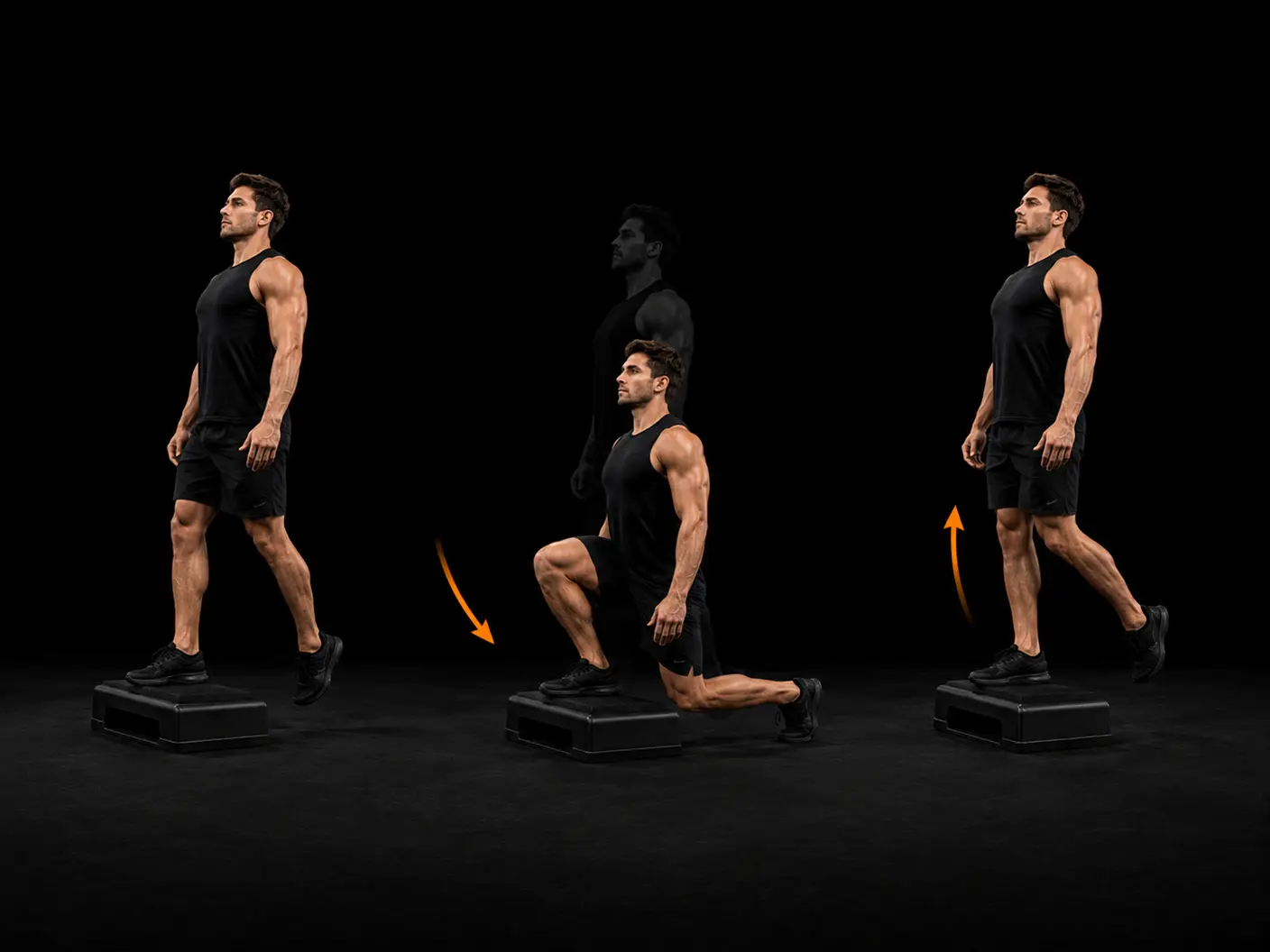
The deficit reverse lunge is a compound lower-body exercise performed standing on a raised surface — typically a weight plate or low step — with dumbbells held at the sides. Stepping one foot back and down below the level of the front foot creates a greater range of motion than a conventional reverse lunge, increasing the demand on the quadriceps, glutes, and hamstrings through a deeper stretch. It suits intermediate lifters looking to build single-leg strength, address bilateral imbalances, or add specificity to athletic development programmes.
How to do it
Stand on a plate or a low step, dumbbells at the sides. Step one leg back and down — the back knee drops below the level of the front foot. Front shin vertical. Drive through the front mid-foot to return. Alternate or complete all reps on one side.
Coaching cues
- Drop the back knee low
- Front shin vertical
- Deficit increases stretch
- Drive through mid-foot
Why train it
- The elevated stance increases the depth of the hip and knee flexion, placing the primary muscles under load through a longer range of motion and creating a stronger stimulus for hypertrophy.
- As a unilateral movement, it exposes and addresses strength asymmetries between limbs that bilateral exercises tend to mask.
- The stepping-back mechanics reduce shear force at the front knee compared with a forward lunge, making it a useful option for building quad and glute volume with a more controlled loading pattern.
- Carrying dumbbells at the sides requires the core to resist rotation and lateral lean throughout each repetition, adding meaningful stabilisation work without a dedicated accessory exercise.
Common mistakes
- Allowing the front shin to drift forward past vertical — keep the front shin upright and position the foot far enough from the step so the knee stays stacked over the ankle at the bottom.
- Touching the back knee down lightly without controlling the descent — lower the rear knee deliberately below the level of the front foot to earn the range the deficit provides.
- Shifting weight onto the front toes on the drive up — press firmly through the mid-foot of the front foot so force transfers efficiently through the hip and knee rather than loading the forefoot.
- Leaning excessively through the torso as fatigue builds — keep the chest tall and brace the core to prevent the upper body compensating for reduced leg drive.
Primary: Quadriceps, Gluteus Maximus, Hamstrings.
Secondary: Rectus Abdominis.
Equipment
Good for
Easier variation
Reverse lunge — remove the deficit.
Similar movements
Frequently asked
- What muscles does the deficit reverse lunge work?
- The primary muscles are the quadriceps, glutes, and hamstrings of the front leg, which work through an extended range of motion due to the raised surface. The core acts as a secondary stabiliser throughout the movement to control rotation and lateral lean.
- How many sets and reps should I do for hypertrophy?
- For muscle building, three to four sets of eight to twelve repetitions per leg is a reliable starting point. Rest ninety seconds to two minutes between sets, and prioritise controlling the descent before adding dumbbell load.
- What is the difference between a deficit reverse lunge and a standard reverse lunge?
- The deficit version elevates the front foot, which allows the rear knee to drop below the level of the front foot — something a flat surface prevents. This increases the stretch on the hip flexors, glutes, and quadriceps, raising the range of motion and the potential hypertrophic stimulus.
- What are good alternatives if I do not have a step or plate?
- A standard reverse lunge performed from the floor trains the same movement pattern with a reduced range of motion and suits those building towards the deficit variation. Bulgarian split squats, also performed with dumbbells, offer a comparable unilateral and range-of-motion challenge if a step is available but a stepping movement is preferred.
- Is the deficit reverse lunge suitable for athletic performance training?
- Yes — the exercise is listed with athletic performance as a primary goal because unilateral strength, hip extension power, and deceleration control are all relevant to sport. The single-leg loading pattern and the demand to drive through the front foot translate well to running, cutting, and jumping mechanics.
Want this movement in a plan built for you?
Adaptiv programmes the right exercises for your goal, equipment and experience — then adapts them as you train.
Build my programme