Decline Barbell Bench Press
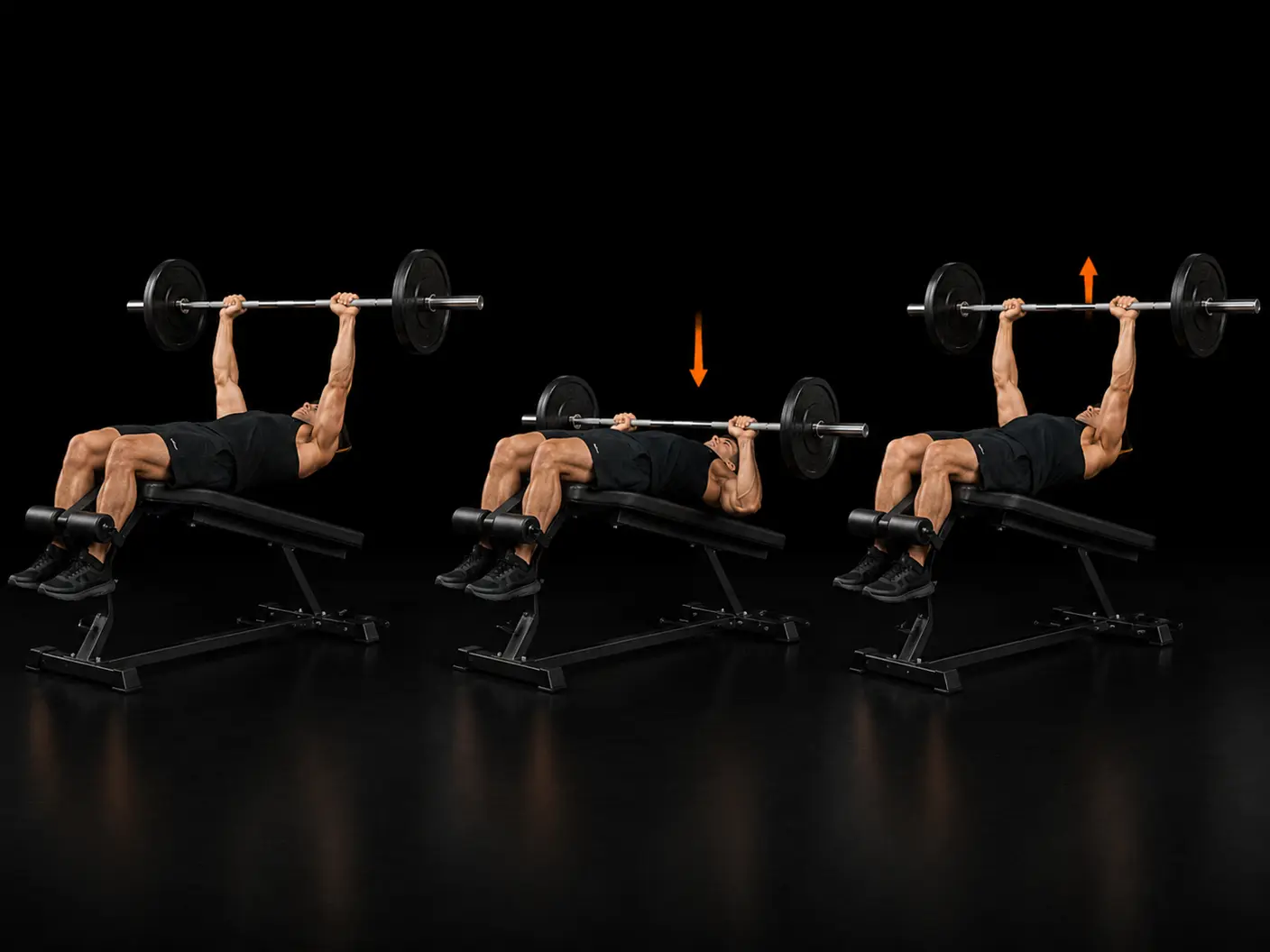
The decline barbell bench press is a compound horizontal push performed on a decline bench, targeting the lower portion of the pectoralis major — the costal fibres that attach along the lower ribs and sternum. The angled position shifts the line of force relative to the flat or incline variants, placing the lower chest under greater mechanical demand throughout the movement. It suits intermediate lifters who have a solid foundation in bench pressing mechanics and are looking to develop more complete pectoral mass and pressing strength.
How to do it
Lock the feet into the decline bench. Lie back, eyes under the bar. Set the shoulder blades. Grip slightly wider than shoulder-width. Unrack. Lower the bar to the lower chest / upper abs. Press up and slightly back over the shoulders.
Coaching cues
- Bar to lower chest
- Elbows tucked
- Shoulder blades set
- Control the eccentric
Why train it
- The declined angle places direct emphasis on the lower and costal fibres of the pectoralis major, making it a useful complement to flat and incline pressing in a well-rounded chest programme.
- As a compound barbell movement, it allows for progressive overload across both hypertrophy and strength rep ranges, supporting long-term development of pressing capacity.
- The triceps and anterior deltoid contribute meaningfully as secondary movers, meaning the movement builds upper-body pushing strength across multiple muscle groups simultaneously.
- The barbell variant provides a stable, bilateral loading option that makes load management and incremental progression straightforward to track over time.
Common mistakes
- Failing to set the shoulder blades before unracking — retract and depress the scapulae firmly against the bench and maintain that position throughout the set to protect the shoulder joint and improve force transfer.
- Letting the elbows flare excessively — keep the elbows tucked at a moderate angle relative to the torso so the load is distributed efficiently between the chest, triceps, and anterior deltoid.
- Lowering the bar too high up the chest — the bar should descend to the lower chest or upper abdominal region, not the mid or upper sternum, to match the mechanics of the decline angle.
- Rushing the eccentric phase — control the descent deliberately rather than dropping the bar, as a slow lowering phase increases time under tension and reduces the risk of losing positional integrity at the bottom.
Primary: Pectoralis Major.
Secondary: Triceps Brachii, Anterior Deltoid.
Equipment
Good for
Easier variation
Flat bench press — more common setup with comparable lower-pec involvement.
Similar movements
Frequently asked
- What muscles does the decline barbell bench press work?
- The primary muscle is the pectoralis major, specifically its lower and costal fibres. The triceps and anterior deltoid work as secondary contributors throughout the pressing movement.
- How does the decline bench press differ from the flat bench press?
- The decline angle shifts the emphasis away from the mid and upper chest toward the lower and costal portion of the pectoralis major. Many lifters also find they can handle slightly more load on the decline due to the reduced range of motion and advantageous pressing angle.
- What sets and reps should I use for the decline barbell bench press?
- For hypertrophy, three to four sets of eight to twelve reps at a controlled tempo works well. For strength development, working in the three to six rep range with heavier loads and longer rest periods between sets is more appropriate.
- Is the decline bench press suitable for beginners?
- This movement is classified as intermediate difficulty, largely because it requires confident racking and unracking mechanics on an angled bench, as well as solid shoulder blade positioning under load. Beginners are better served building competency on the flat bench press first before progressing to the decline variant.
- Are there alternatives if I do not have access to a decline bench?
- A decline dumbbell press or weighted dips can target similar lower chest musculature if a decline bench is unavailable. The barbell flat bench press remains a valuable alternative for overall pectoral development, though the emphasis on the costal fibres will be less pronounced.
Want this movement in a plan built for you?
Adaptiv programmes the right exercises for your goal, equipment and experience — then adapts them as you train.
Build my programme