Concentration Curl
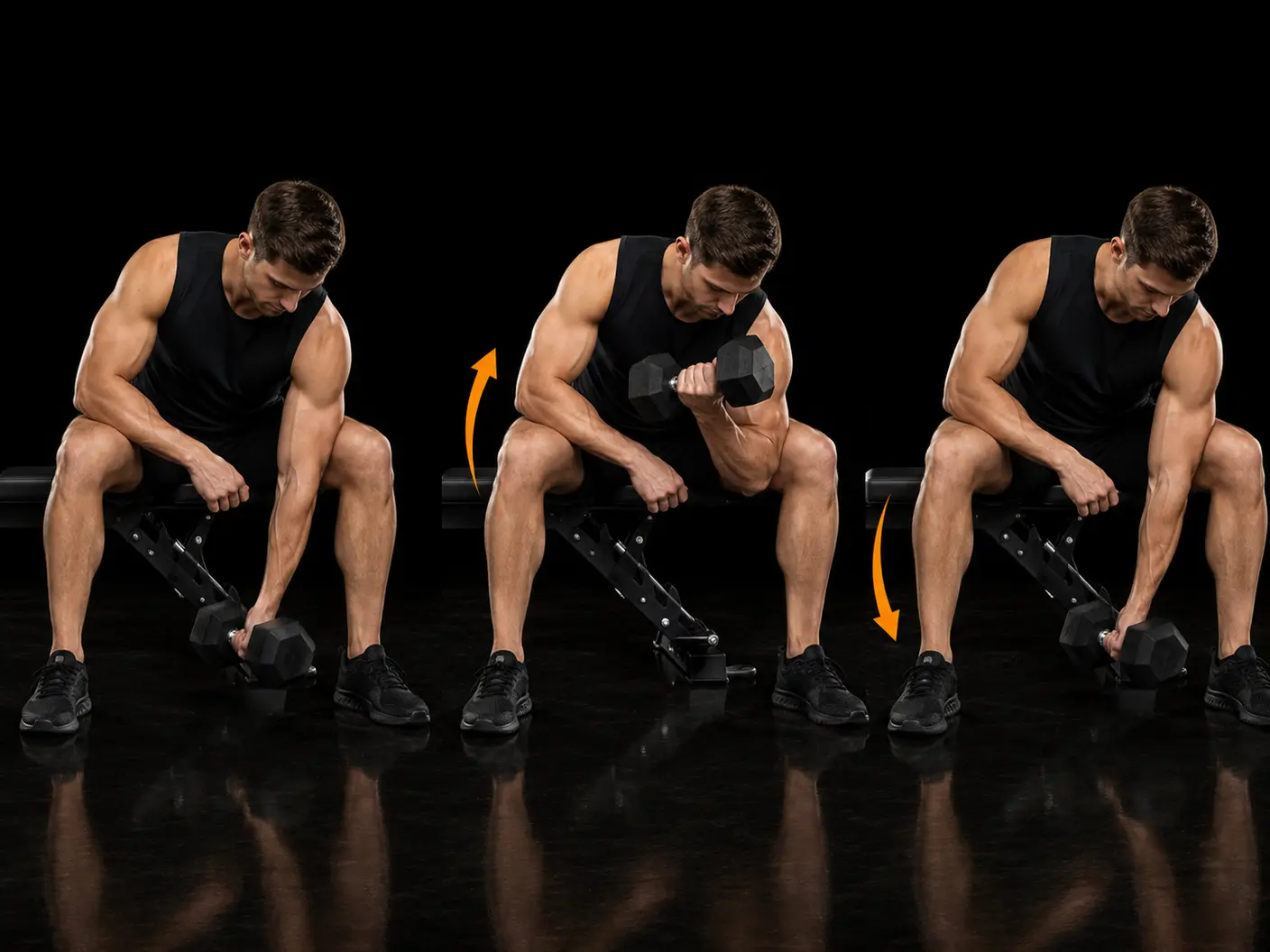
The concentration curl is a seated, single-arm dumbbell exercise that isolates the biceps brachii by bracing the working elbow against the inner thigh, eliminating momentum and shoulder involvement. This constrained position directs the load almost exclusively through elbow flexion, making it one of the more targeted upper-arm movements available. It suits lifters at any stage who want to address biceps development with strict, controlled technique.
How to do it
Sit on a bench, one hand holding a dumbbell between the knees. Brace the elbow on the inside of the thigh. Curl the dumbbell up toward the shoulder. Pause at peak. Lower under control.
Coaching cues
- Elbow braced on thigh
- Curl to the shoulder
- Pause at peak
- Strict form
Why train it
- Bracing the elbow against the thigh removes compensatory shoulder movement, ensuring the biceps brachii does the majority of the work throughout each repetition.
- The unilateral nature of the exercise allows you to identify and address strength or size differences between arms, which bilateral curls can mask.
- The paused peak contraction emphasises the shortened position of the biceps brachii, providing a training stimulus that is difficult to replicate with free-standing curl variations.
- The foundational difficulty level and fixed elbow position make it an accessible starting point for lifters learning to establish a genuine mind-muscle connection with the biceps.
Common mistakes
- Using the free hand to assist the lift — keep the non-working hand resting lightly on the knee and allow the working arm to complete each repetition independently.
- Allowing the elbow to slide forward off the thigh during the curl — press the elbow firmly into the inner thigh before initiating the movement and hold that contact throughout.
- Rushing the lowering phase — control the dumbbell back to the start position over at least two counts to maintain tension through the full range of motion.
- Choosing a load that forces the torso to rock for assistance — select a weight that allows strict form for every repetition, as momentum defeats the purpose of the exercise.
Primary: Biceps Brachii.
Secondary: Brachialis.
Equipment
Good for
Easier variation
Seated DB curl — same principle without the brace.
Similar movements
Frequently asked
- What muscles does the concentration curl work?
- The primary muscle trained is the biceps brachii, with the brachialis acting as a secondary contributor during elbow flexion. The fixed elbow position limits the involvement of the anterior deltoid, keeping the emphasis on the upper arm.
- How many sets and reps should I do for the concentration curl?
- For hypertrophy, a typical prescription is 3–4 sets of 10–15 repetitions per arm, with 60–90 seconds of rest between sets. Prioritise a controlled tempo and a genuine pause at the top over simply accumulating repetitions.
- What is the difference between a concentration curl and a standard dumbbell curl?
- The key distinction is elbow position — bracing against the thigh in the concentration curl prevents any shoulder flexion from contributing to the lift, whereas a standing or seated dumbbell curl allows some degree of upper-arm movement. This makes the concentration curl a stricter isolation exercise.
- Can the concentration curl replace barbell or EZ-bar curls in a programme?
- The concentration curl serves a different purpose from barbell variations; it prioritises isolation and strict form rather than total load. Most programmes benefit from including both a compound-style curl for heavier loading and an isolation movement such as this one, rather than substituting one for the other entirely.
- Is the concentration curl suitable for beginners?
- Yes — it is classified as a foundational movement, and the supported elbow position can actually help beginners learn what isolated elbow flexion feels like before progressing to standing variations. Start with a conservative load and focus on the pause at the top of each repetition.
Want this movement in a plan built for you?
Adaptiv programmes the right exercises for your goal, equipment and experience — then adapts them as you train.
Build my programme