Bodyweight Squat (Air Squat)
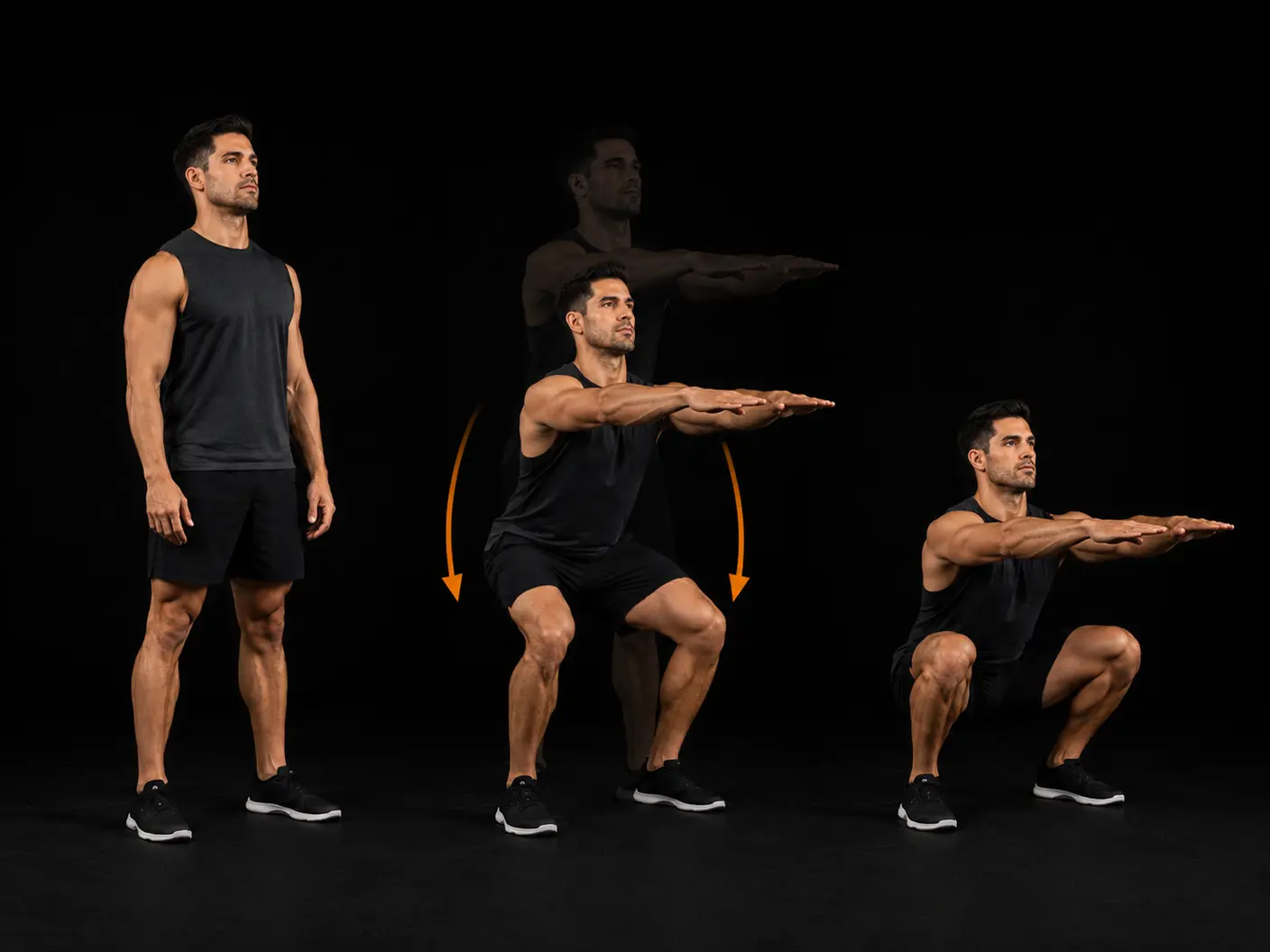
The bodyweight squat — often called the air squat — is a foundational compound movement that trains the squat pattern using only the load of your own body. It develops strength and coordination through the quadriceps, glutes, hamstrings, and core simultaneously, making it one of the most complete lower-body exercises available without equipment. It suits beginners learning the squat pattern for the first time, as well as more experienced trainees using it for warm-up, active recovery, or high-volume conditioning work.
How to do it
Stand feet shoulder-width, toes slightly out, arms forward for counterbalance. Inhale, brace, and sit back and down between the hips. Descend until hip crease drops below the knee, knees tracking over toes. Drive through the whole foot to stand; squeeze glutes at the top. Keep the spine long throughout.
Coaching cues
- Sit between the hips
- Knees track toes
- Tall spine
- Drive through mid-foot
Why train it
- Develops functional lower-body strength through the quadriceps and glutes without requiring any equipment, making it accessible in any setting.
- Training the squat pattern regularly improves hip and ankle mobility, as the movement demands a full range of motion through both joints.
- The braced descent and drive phase engage the core as a stabilising structure, reinforcing trunk control that carries over to loaded squat variations.
- As a foundational movement, it builds the motor pattern and positional awareness needed to progress safely to barbell, goblet, and split squat variations.
Common mistakes
- Letting the heels rise off the floor — drive through the whole foot and consider elevating the heels temporarily if ankle mobility is limiting depth.
- Allowing the knees to cave inward — actively track the knees over the toes throughout the descent and ascent to maintain correct alignment.
- Rounding the upper back — maintain a tall spine from set-up to lockout, keeping the chest up and the gaze forward rather than down.
- Cutting the depth short — descend until the hip crease drops below the knee, as stopping above parallel reduces the stimulus to the glutes and limits the movement's training value.
Primary: Quadriceps, Gluteus Maximus.
Secondary: Hamstrings, Rectus Abdominis, Gastrocnemius.
Equipment
Good for
Easier variation
Box squat to a knee-height surface — provides depth feedback and reduces eccentric control demand.
Similar movements
Frequently asked
- What muscles does the bodyweight squat work?
- The primary muscles trained are the quadriceps and glutes. The hamstrings, calves, and core work as secondary contributors throughout the movement.
- How many sets and reps should I do for the air squat?
- For general fitness, three to four sets of 15 to 25 repetitions is a practical starting point. If you are using the air squat as a warm-up, one to two sets of 10 to 15 repetitions at a controlled tempo is usually sufficient.
- Is the bodyweight squat suitable for complete beginners?
- Yes — it is classified as a foundational movement precisely because it introduces the squat pattern without the complexity of external load. Focus on depth, knee tracking, and a tall spine before progressing to weighted variations.
- What are good alternatives or progressions from the air squat?
- The goblet squat is a natural progression, as the counterbalance of a dumbbell or kettlebell encourages an upright torso and adds load progressively. For those who find the full squat difficult initially, a box squat to a controlled depth is a useful regression.
- Can I use the bodyweight squat if I have knee or hip discomfort?
- If you experience pain during the movement, stop and consult a qualified professional rather than attempting to train through it. Discomfort during a bodyweight squat warrants assessment before progressing.
Want this movement in a plan built for you?
Adaptiv programmes the right exercises for your goal, equipment and experience — then adapts them as you train.
Build my programme