Bodyweight Calf Raise
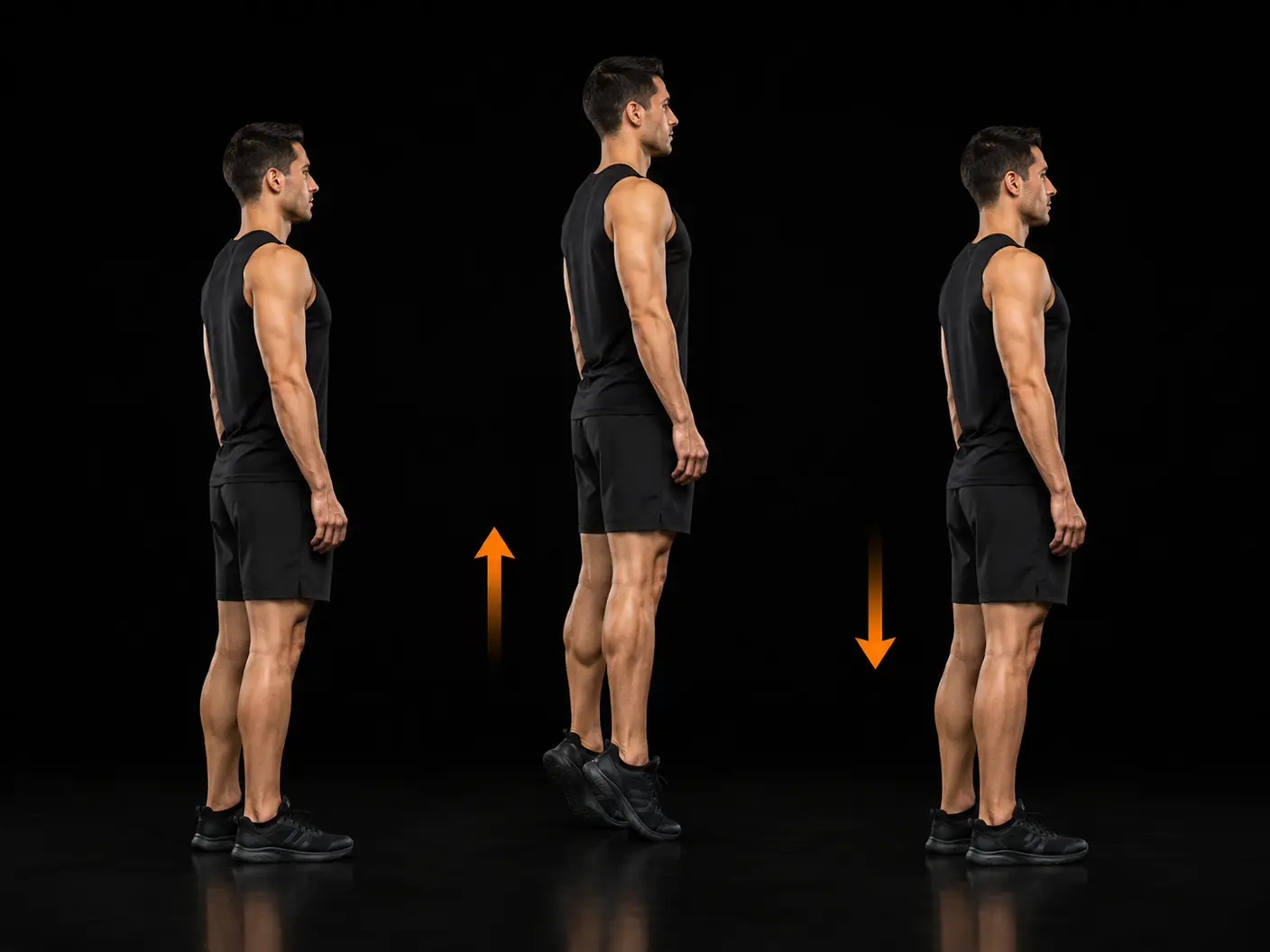
The bodyweight calf raise is a foundational isolation exercise targeting the gastrocnemius, the large two-headed muscle that gives the calf its visible shape. Performed either flat on the floor or with enhanced range of motion on a step, it trains the ankle plantar-flexion pattern through a controlled raise and lower. It suits beginners building lower-leg strength, as well as more experienced trainees looking to add volume without loading the spine.
How to do it
Stand with feet hip-width. For a flat-floor version, rise onto the balls of both feet to peak contraction and lower. For full range, place the balls of the feet on a step edge, heels hanging off. Lower the heels below the step for a full stretch, then press to peak contraction. Pause briefly. Lower under control.
Coaching cues
- Full stretch at the bottom
- Peak contraction at the top
- Slow eccentric
- No bouncing
Why train it
- Training through a full range of motion on a step edge maximises mechanical tension on the gastrocnemius, which supports long-term calf development.
- The slow eccentric phase develops strength at the bottom of the movement where the muscle is most lengthened, a position often neglected with bouncy or partial repetitions.
- Because no external load is required, the exercise can be performed anywhere and slotted into a programme as accessory work without taxing recovery significantly.
- The ankle stabilisers work throughout each repetition, making this a practical choice for building the joint integrity that underpins running, jumping, and single-leg movements.
Common mistakes
- Bouncing at the bottom of the rep — pause briefly in the stretched position and initiate each rep under muscular control rather than using momentum.
- Cutting the range of motion short at the top — press to a genuine peak contraction, pausing long enough to feel the gastrocnemius fully engaged before lowering.
- Rushing the descent — take at least two to three seconds to lower the heel, as the eccentric phase is where much of the training stimulus is generated.
- Allowing the feet to turn out excessively — keep the feet close to hip-width with toes pointing forward or only slightly out, so the load stays distributed evenly across the calf musculature.
Primary: Gastrocnemius.
Secondary: Soleus.
Equipment
Good for
Easier variation
Seated calf raise — reduces balance demand.
Similar movements
Frequently asked
- What muscles does the bodyweight calf raise work?
- The primary muscle is the gastrocnemius, the prominent muscle at the back of the lower leg. The soleus, which sits beneath the gastrocnemius, and the ankle stabilisers contribute as secondary muscles throughout the movement.
- How many sets and reps should I do for the bodyweight calf raise?
- For general fitness, three to four sets of 15 to 25 repetitions works well, given the muscle's capacity for higher volumes. Prioritise a slow eccentric and a genuine pause at the top over chasing a specific rep count.
- Is there a difference between doing calf raises on a step versus on flat ground?
- Yes — using a step allows the heels to drop below the level of the toes, which increases the stretch on the gastrocnemius and trains a greater range of motion. The flat-floor version is a useful starting point, but progressing to a step will typically produce a more complete stimulus.
- Can the bodyweight calf raise replace weighted calf work?
- For beginners or those new to direct calf training, bodyweight is sufficient to stimulate adaptation. Over time, the muscle will respond better to progressive overload, so adding a dumbbell or moving to a single-leg variation is a logical next step when the movement feels straightforward.
- How often should I train calf raises each week?
- The calves recover relatively quickly and can tolerate higher training frequencies. Two to three sessions per week with adequate rest between allows sufficient volume without accumulating unnecessary fatigue in the lower leg.
Want this movement in a plan built for you?
Adaptiv programmes the right exercises for your goal, equipment and experience — then adapts them as you train.
Build my programme