Block Pull
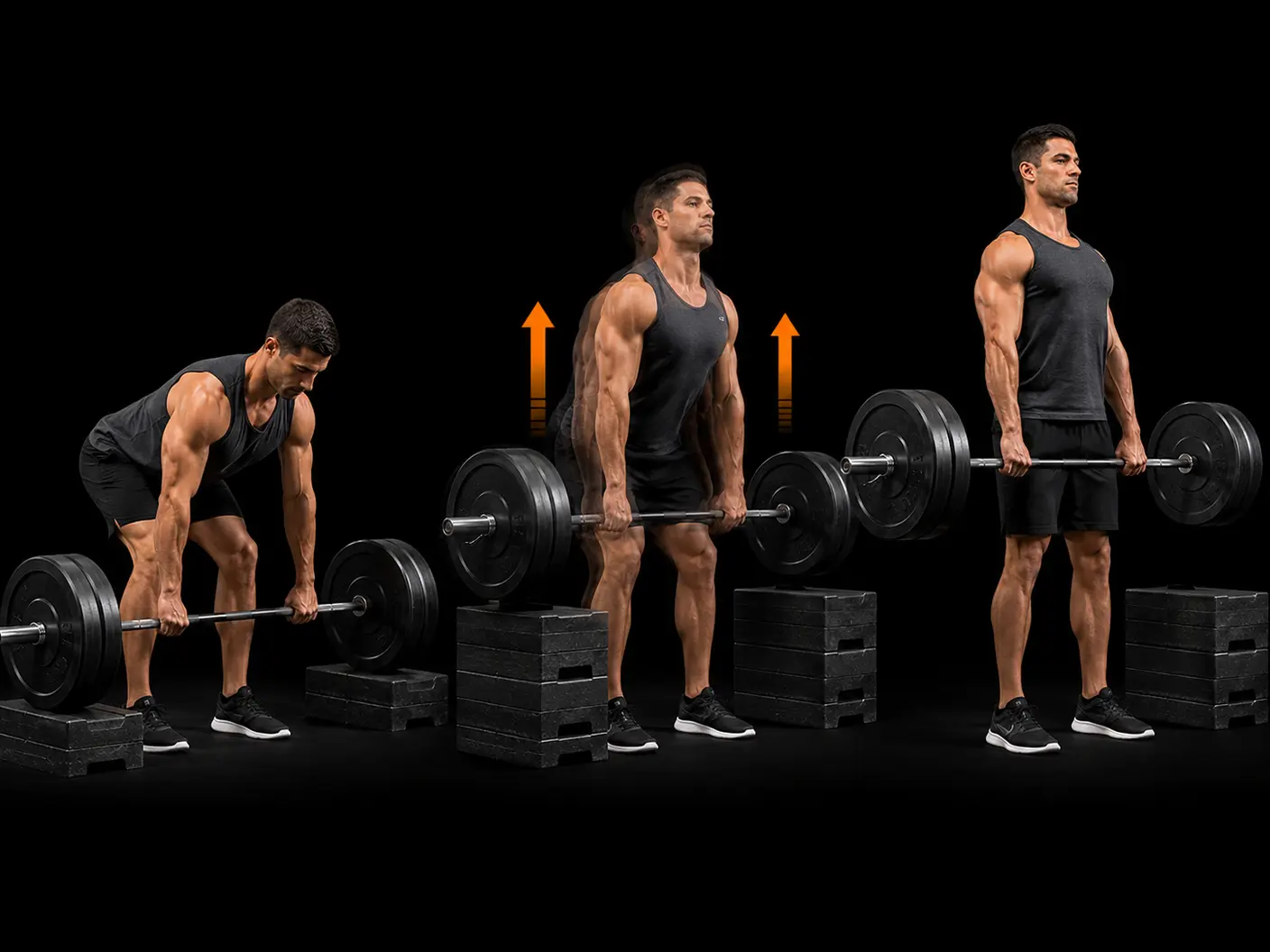
The block pull is a partial-range deadlift performed from an elevated starting position — typically with the bar set at or just below knee height on blocks or plyo boxes. It trains the hip hinge pattern through the upper portion of the pull, placing high demand on the glutes, hamstrings, erectors, upper back, and traps. It suits intermediate to advanced lifters looking to overload the lockout phase or address weaknesses in the top half of the conventional deadlift.
How to do it
Set a barbell on blocks, typically at knee height or just below. Set up and execute as a conventional deadlift from this elevated starting position. Pack the lats, brace 360°. Drive through the floor, maintaining a vertical bar path. Lock out tall with full hip extension.
Coaching cues
- Lats packed
- Push the floor
- Bar against legs
- Tall lockout
Why train it
- The elevated start allows you to load the bar heavier than a conventional deadlift, exposing the posterior chain and upper back to greater absolute force through the lockout range.
- By beginning closer to lockout, the block pull isolates the portion of the pull where erector and trap engagement is highest, making it a precise tool for targeting those muscles.
- It is an effective way to accumulate pulling volume without the same systemic fatigue as a full deadlift from the floor, supporting recovery management in a well-structured programme.
- The shortened range of motion makes it accessible for lifters who struggle with floor-pull mechanics, allowing them to practise and reinforce a strong bar path and tall lockout under load.
Common mistakes
- Setting the blocks too high — position the bar at knee height or just below so the movement still challenges the posterior chain meaningfully rather than becoming a near-lockout shrug.
- Losing lat tension at the start — pack the lats firmly before initiating the pull to stabilise the shoulder girdle and maintain a vertical bar path throughout.
- Letting the bar drift away from the body — keep the bar in contact with the legs from the moment it breaks the blocks to preserve mechanical efficiency and reduce lower-back strain.
- Hyperextending at lockout — finish the rep with full hip extension and a neutral spine rather than leaning back excessively, which shifts stress onto the lumbar vertebrae.
Primary: Gluteus Maximus, Hamstrings, Erector Spinae, Rhomboids, Trapezius.
Secondary: Latissimus Dorsi, Forearm Flexors, Quadriceps.
Equipment
Good for
Easier variation
Rack pull — same shortened range from a rack instead of blocks.
Similar movements
Frequently asked
- What muscles does the block pull work?
- The primary muscles are the glutes, hamstrings, spinal erectors, upper back, and traps. The lats, forearms, and quadriceps contribute as secondary muscles, with the lats playing a key role in keeping the bar close to the body.
- How does a block pull differ from a rack pull?
- Both are partial-range deadlifts, but block pulls use plyo boxes or blocks under the plates, which allows the bar to behave more like a conventional deadlift in terms of flex and feel. Rack pulls use the safeties of a power rack, which some lifters find alters bar position and setup mechanics.
- What sets and reps work best for block pulls?
- For strength, work in the 3–5 rep range at high relative intensity, typically 3–5 sets. For hypertrophy, sets of 6–10 reps with controlled execution are effective. Because the range of motion is shorter, many coaches programme slightly higher loads than they would use for a conventional deadlift at the same rep target.
- Can the block pull replace the conventional deadlift?
- It is best used as an accessory or variation rather than a full replacement, since it does not train the initial drive from the floor or the same degree of hip flexion at the start position. Used alongside conventional deadlifts, it is a highly effective tool for reinforcing lockout strength and upper-back positioning.
- Is the block pull suitable for beginners?
- This movement is classified as advanced and assumes a well-established hip hinge pattern and familiarity with conventional deadlift mechanics. Beginners are better served building those foundations first before introducing partial-range pulling variations.
Want this movement in a plan built for you?
Adaptiv programmes the right exercises for your goal, equipment and experience — then adapts them as you train.
Build my programme