Barbell Walking Lunge
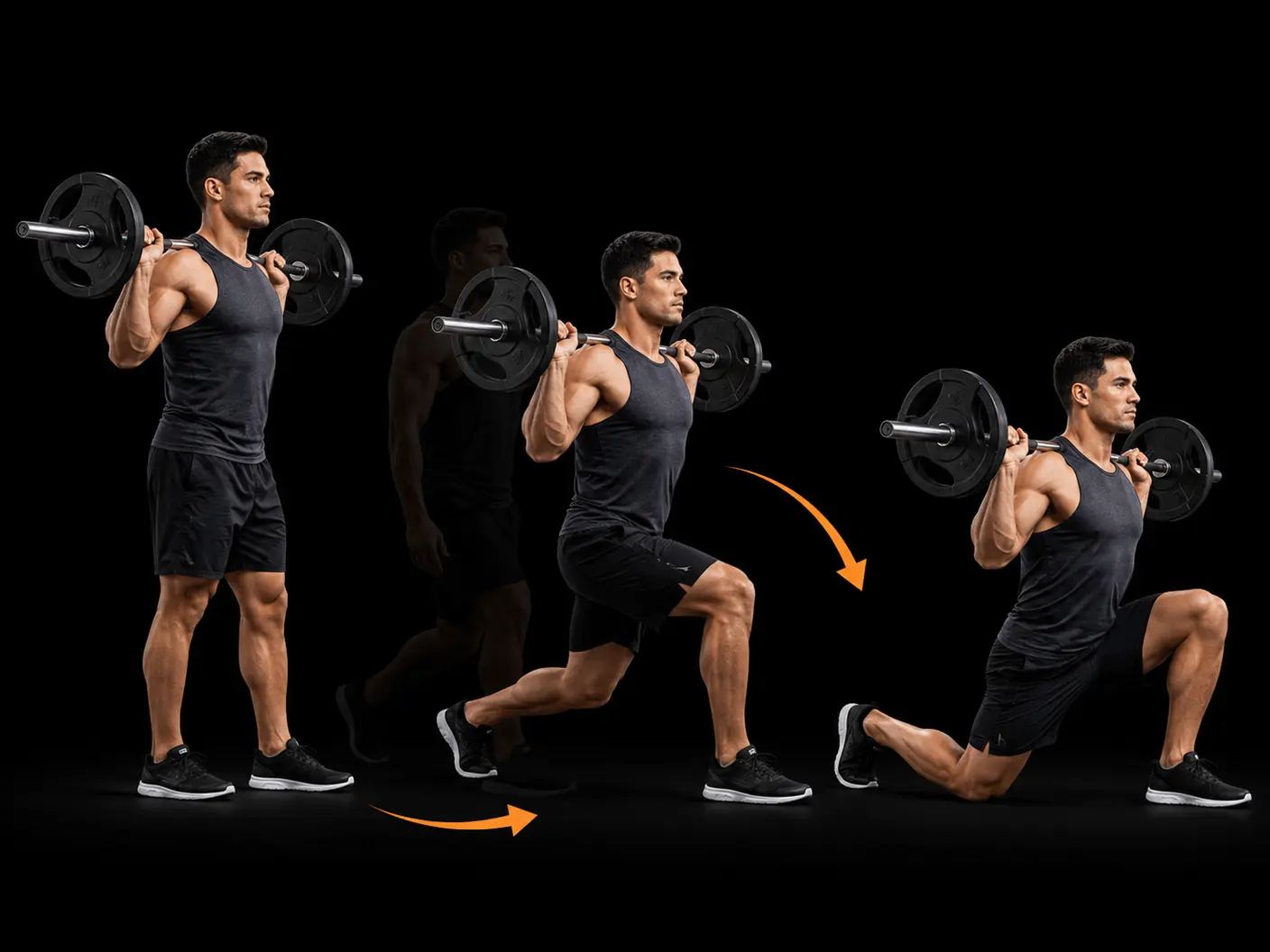
The barbell walking lunge is a loaded unilateral compound movement that trains the lunge and split pattern under significant mechanical demand. Placing a barbell across the upper back increases loading compared to dumbbell or bodyweight variants, challenging the quadriceps and glutes through a full range of motion while requiring the core and stabilising muscles to manage each successive step. It suits intermediate to advanced trainees who have already developed confidence in the unloaded or dumbbell lunge pattern and want to drive hypertrophy, strength, or athletic transfer.
How to do it
Rack a barbell on the upper back as a back squat. Step forward into a long lunge; back knee toward the floor. Drive through the front foot to bring the back leg through into the next lunge. Continue in a straight line.
Coaching cues
- Long stride
- Tall torso
- Drive the floor
- Brace hard
Why train it
- The unilateral nature of the movement addresses left-to-right strength imbalances that bilateral exercises such as the squat can mask over time.
- Driving through the front foot on each stride places a high eccentric and concentric demand on the quadriceps and glutes, making it an efficient choice for lower-body hypertrophy programmes.
- The continuous stepping pattern closely mirrors athletic locomotion, making the exercise a practical tool for sports conditioning where single-leg force production matters.
- Maintaining a tall torso and braced trunk under a barbell across consecutive repetitions builds meaningful anti-flexion core strength without a dedicated isolation exercise.
Common mistakes
- Taking too short a stride — a longer step is required to allow the back knee to travel close to the floor and achieve full range through the hip and knee.
- Allowing the torso to lean forward — keep the chest tall and the spine neutral throughout each stride so the hips and quads do the work rather than the lower back.
- Letting the front knee drift inward at the point of drive — focus on pressing the floor away so the knee tracks in line with the toes as you propel into the next step.
- Failing to brace the trunk before each step — re-engage the core actively at the start of every repetition rather than relying on passive posture to manage the barbell load.
Primary: Quadriceps, Gluteus Maximus.
Secondary: Hamstrings, Rectus Abdominis.
Equipment
Good for
Easier variation
Dumbbell walking lunge — lower axial load.
Similar movements
Frequently asked
- What muscles does the barbell walking lunge work?
- The primary muscles are the quadriceps and glutes, which drive the stepping and standing phases of each repetition. The hamstrings contribute as hip extensors and knee stabilisers, while the core works continuously to keep the torso upright under the barbell.
- How many sets and reps should I do for the barbell walking lunge?
- For hypertrophy, three to four sets of eight to twelve repetitions per leg works well, using a load that challenges you in the final few steps without compromising torso position. For strength or athletic performance, lower rep ranges of five to eight per leg with heavier loading are appropriate, provided your technique is solid.
- What is a good alternative to the barbell walking lunge?
- The dumbbell walking lunge is the most direct alternative and reduces the stability demand on the upper back, making it a useful regression. The barbell reverse lunge is another option if you want to keep the barbell but remove the continuous stepping element while still training the same pattern.
- Is the barbell walking lunge suitable for building athletic performance?
- Yes — the movement replicates the single-leg force production and stride mechanics that underpin many sport activities, making it a common inclusion in athletic performance programmes. It is classified as an intermediate exercise, so athletes should be competent in the lunge pattern under lighter loads before adding barbell loading.
- How do I set up the barbell for a walking lunge?
- Rack and brace the barbell across the upper back in the same position used for a back squat, ensuring it sits on the shelf of the upper traps rather than the neck. Before stepping out, take a full breath, brace the core firmly, and confirm you have clear, unobstructed space ahead for the full set.
Want this movement in a plan built for you?
Adaptiv programmes the right exercises for your goal, equipment and experience — then adapts them as you train.
Build my programme