Barbell Hip Thrust March
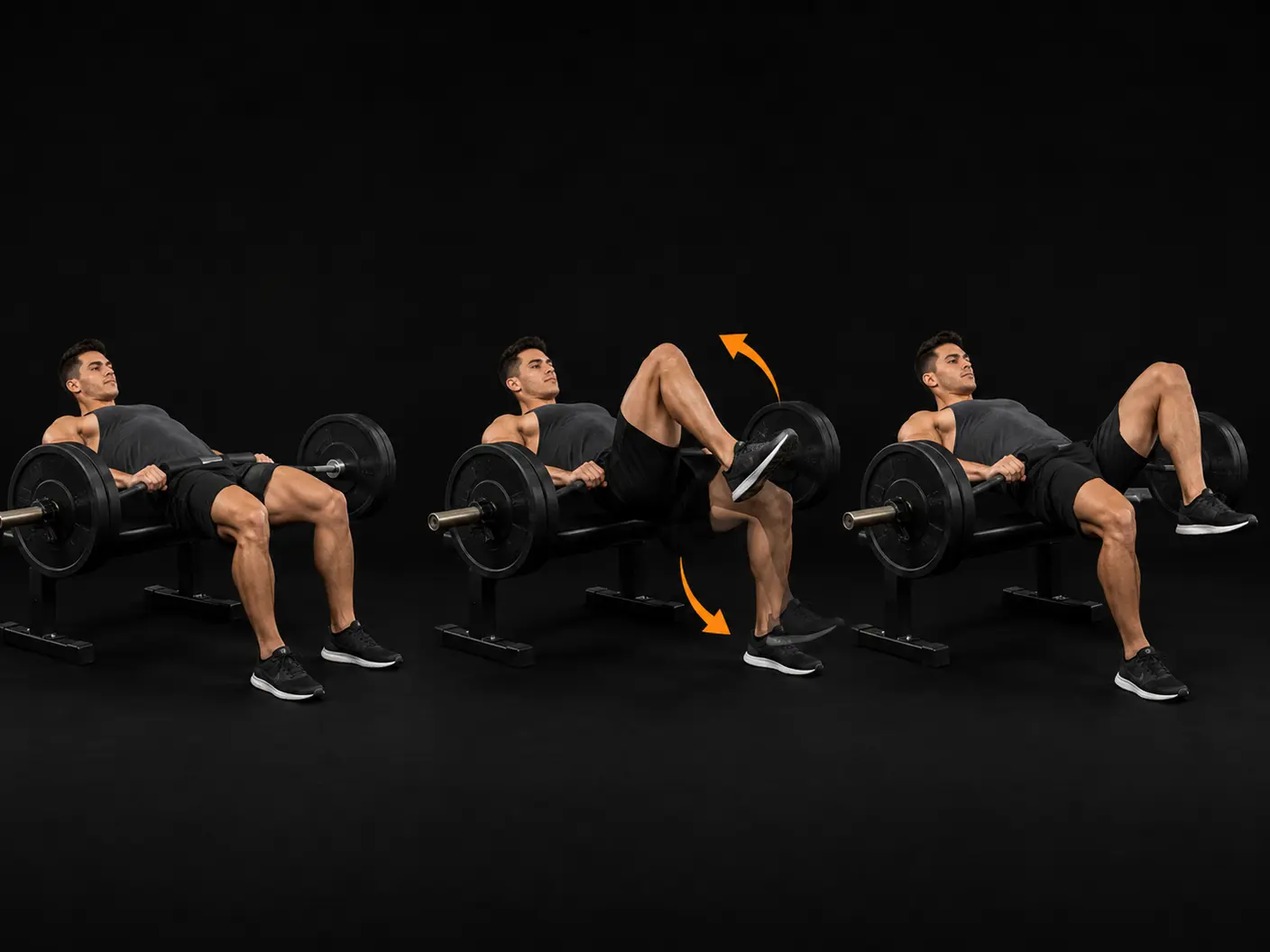
The barbell hip thrust march is a compound hinge variation that challenges you to maintain a loaded hip lockout while alternating knee drives against the barbell's resistance. It combines the glute and hamstring demand of a conventional hip thrust with the anti-rotation and anti-lateral-flexion challenge of single-leg stability, making it significantly more demanding than the static version. It suits intermediate lifters who have already built a solid hip thrust foundation and want to develop the hip control required for athletic movement.
How to do it
Set up and lift into a barbell hip thrust position, locked out at the top. Hold the lockout. March by alternating knee drives — lift one knee to 90° while keeping the hips level; lower; alternate. Do not let the hips drop or rotate.
Coaching cues
- Hips stay level
- Squeeze the down-leg glute
- Control the march
- Tall hip lockout
Why train it
- Develops unilateral glute stability under load, reinforcing the strength and positional awareness needed to keep the hips level during single-leg athletic tasks.
- Training the down-leg glute isometrically while the opposite knee drives creates a strong neuromuscular demand that carries over to sprinting, change of direction, and similar patterns.
- The marching tempo forces deliberate, controlled movement rather than momentum, increasing time under tension through the glutes and core simultaneously.
- Because it requires no additional equipment beyond a standard hip thrust set-up, it is a practical progression for any programme already using the barbell hip thrust.
Common mistakes
- Allowing the hips to drop on the marching side — actively squeeze the down-leg glute throughout the knee drive to keep both hip bones at the same height.
- Letting the hips rotate as the knee lifts — brace the core and keep the pelvis square to the ceiling so the movement is pure hip flexion, not a twist.
- Losing the lockout by sagging at the hips between marches — re-establish full hip extension before each repetition rather than rushing the alternating pattern.
- Driving the knee too aggressively and sacrificing pelvic position — control the tempo of the march so height and stability are maintained at every stage of the movement.
Primary: Gluteus Maximus, Rectus Abdominis.
Secondary: Hamstrings, Hip Flexors.
Equipment
Good for
Easier variation
Glute bridge march — easier bodyweight version.
Similar movements
Frequently asked
- What muscles does the barbell hip thrust march work?
- The primary muscles are the glutes and core, with the hamstrings and hip flexors contributing as secondary movers. The down-leg glute works isometrically to hold the lockout and prevent hip drop, while the hip flexor of the marching leg drives the knee to 90°.
- How many sets and reps should I do?
- Given the stability demand, three to four sets of six to ten marches per leg works well for most intermediate lifters. Keep the load moderate — the priority is maintaining a level, locked-out hip position throughout, so reduce the weight if form deteriorates before the set is complete.
- What is the difference between this and a standard barbell hip thrust?
- A standard hip thrust trains bilateral hip extension through a full range of motion. The march variation keeps you at the top of that range and adds a unilateral stability challenge, so it functions more as an isometric endurance and anti-rotation exercise than a primary strength movement.
- Is this exercise suitable for beginners?
- It is classified as intermediate because it requires both the positional awareness to hold a barbell hip thrust lockout and the hip control to march without compensation. Beginners are better served by establishing consistent technique on the standard barbell hip thrust before progressing to this variation.
- What are good alternatives if I find it too difficult?
- A bodyweight or resistance-band hip thrust march removes the barbell load and allows you to focus on pelvic control first. Alternatively, a single-leg hip thrust performed through a full range of motion builds similar unilateral glute strength with a more familiar movement pattern.
Want this movement in a plan built for you?
Adaptiv programmes the right exercises for your goal, equipment and experience — then adapts them as you train.
Build my programme