Banded Clamshell Activation
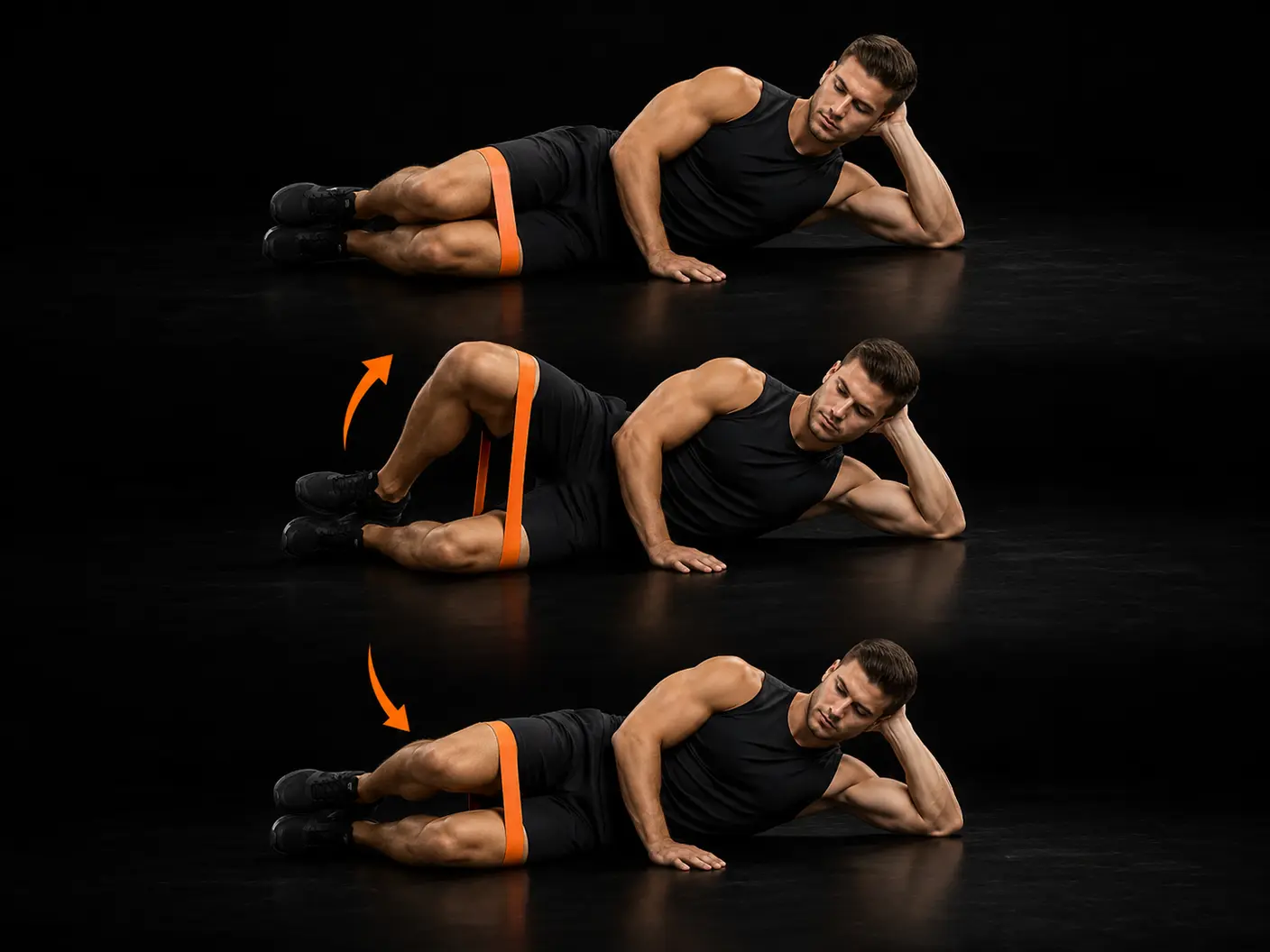
The banded clamshell is a foundational side-lying mobility drill that targets the gluteus medius and external rotators by opening the top knee against the resistance of a mini-band whilst keeping the feet together. It trains hip abduction and external rotation in a controlled, low-load environment, making it an effective activation or warm-up movement. It suits beginners, athletes preparing for lower-body training, and anyone looking to reinforce hip stability before more demanding work.
How to do it
Lie on your side, knees bent, mini-band above the knees. Hips stacked. Open the top knee against the band's resistance; keep the feet together. Pause at peak. Lower under control. Perform 10–20 reps per side.
Coaching cues
- Hips stacked
- Squeeze the glute
- Pause at peak
- Feet stay together
Why train it
- Directly activates the gluteus medius, a muscle frequently underused in daily movement and often neglected in standard lower-body training.
- The mini-band adds targeted resistance through the range of motion, increasing neuromuscular demand without loading the spine or joints.
- Reinforcing external rotation control here carries over to squats, lunges, and single-leg movements where hip stability is essential for sound mechanics.
- Its low-load, side-lying position makes it accessible at any stage of a session — equally useful as a warm-up drill or a corrective exercise within a programme.
Common mistakes
- Letting the hips roll back as the knee rises — keep the hips stacked directly on top of one another throughout the full range of motion.
- Rushing through the repetitions — pause briefly at peak opening to ensure the glute is working, rather than relying on momentum to drive the movement.
- Lifting the feet apart as the knee opens — the feet must stay in contact with each other, as separating them removes the rotational challenge the exercise is designed to create.
- Failing to lower under control — resist the band on the way down rather than letting it snap the knee closed, as the eccentric phase contributes meaningfully to the training stimulus.
Primary: Gluteus Medius, Hip External Rotators.
Secondary: Gluteus Maximus.
Equipment
Good for
Easier variation
Clamshell without band — lower intensity.
Similar movements
Frequently asked
- What muscles does the banded clamshell work?
- The primary muscles are the gluteus medius and the external rotators of the hip. The upper fibres of gluteus maximus provide secondary contribution, particularly at peak opening.
- How many sets and reps should I do for the banded clamshell?
- The movement is typically performed for 2–3 sets of 10–20 repetitions per side, as indicated by the exercise parameters. Rest briefly between sides rather than taking long recovery periods, since the load is low.
- When in a session should I include the banded clamshell?
- It is most commonly used as an activation drill in the warm-up before lower-body or athletic training sessions. It can also be placed between heavier sets as a corrective filler to maintain hip recruitment.
- What can I use if I do not have a mini-band?
- A mini-band is the intended equipment for this variation and provides the specific resistance pattern the exercise relies on. If one is unavailable, a standard looped resistance band tied to a shorter length is a reasonable substitute, though it may be less comfortable.
- Is the banded clamshell suitable for improving athletic performance?
- Yes — the exercise is listed under athletic performance as a primary goal. Hip abduction and external rotation strength are foundational to running mechanics, change-of-direction ability, and stable landing patterns, so it is a practical inclusion in an athlete's preparation work.
Want this movement in a plan built for you?
Adaptiv programmes the right exercises for your goal, equipment and experience — then adapts them as you train.
Build my programme