Band Resisted Hip Thrust
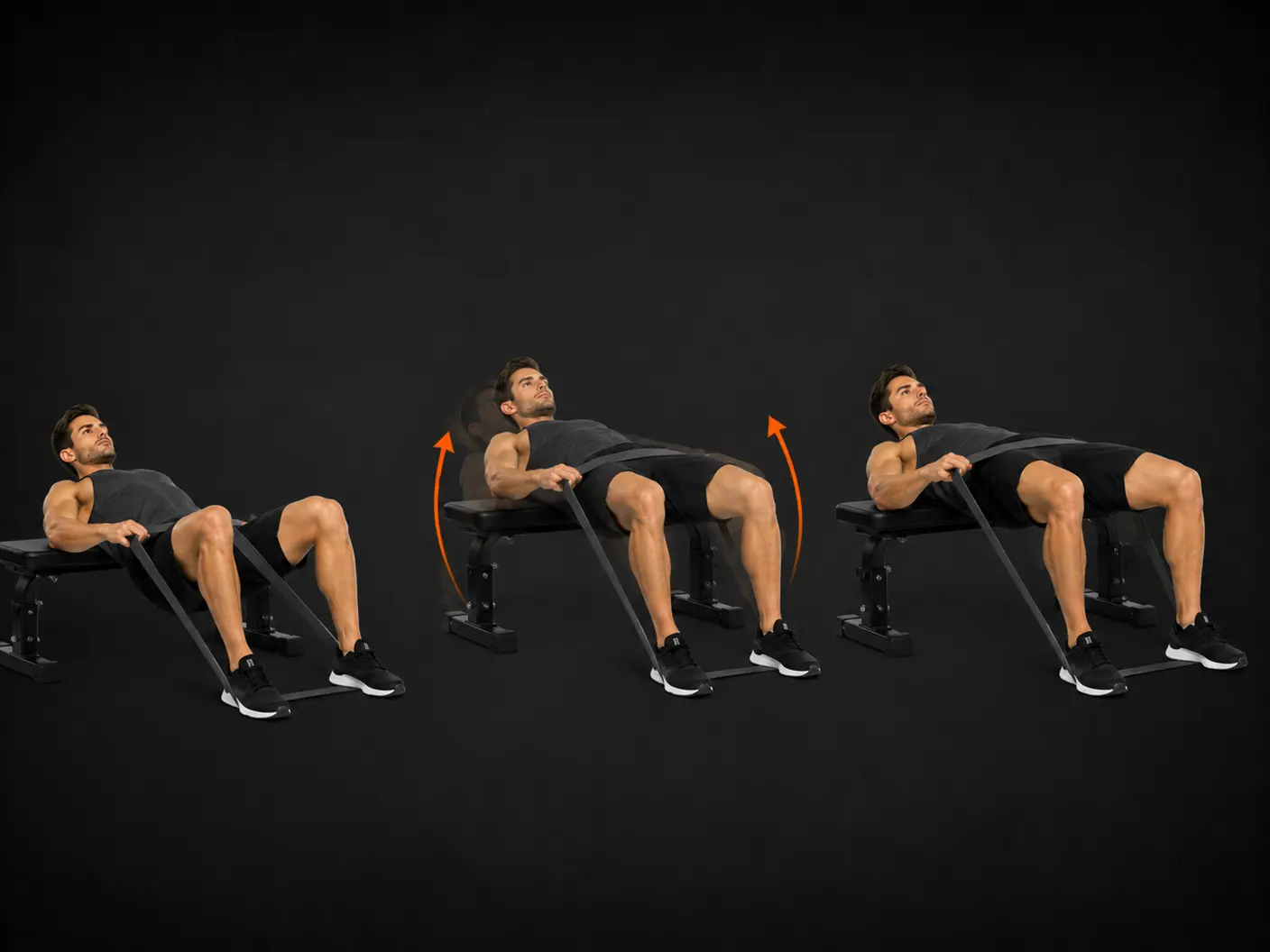
The band resisted hip thrust is a barbell hip thrust variation that adds accommodating resistance through a looped band anchored under the feet or at a low fixed point. The band creates minimal load at the bottom of the movement and peak tension at lockout, directly overloading the glutes at their point of greatest mechanical advantage. It suits intermediate lifters who have already established solid barbell hip thrust mechanics and are looking to push further adaptation in the posterior chain.
How to do it
Set up a barbell hip thrust. Loop a resistance band over the bar and under the feet (or anchor low). The band tension is lowest at the bottom and highest at the top of the lift. Drive through full range; the band punishes lockout.
Coaching cues
- Constant tension
- Max tension at the top
- Squeeze hard at lockout
- Control the descent
Why train it
- The ascending band tension matches the glute's strength curve, ensuring maximal challenge at lockout rather than allowing the lift to feel easiest where the muscle is strongest.
- Combining barbell load with band resistance creates a dual stimulus that promotes both mechanical tension and metabolic stress in the glutes, supporting hypertrophy outcomes.
- The requirement to resist the band pulling the bar back down reinforces deliberate, controlled eccentric technique, improving motor control through the full range.
- The added instability introduced by the band encourages greater core bracing throughout the set, developing trunk stability as a secondary training effect.
Common mistakes
- Losing tension at the top by not fully extending the hips — drive to complete lockout and squeeze the glutes hard before beginning the descent, as this is precisely where the band demands the most effort.
- Allowing the hips to hike and the lower back to hyperextend at lockout — keep the ribcage down and think about posteriorly tilting the pelvis as you reach the top position.
- Letting the band pull the bar down too quickly on the descent — maintain deliberate control of the lowering phase rather than allowing the combined weight and band to dictate the speed.
- Positioning the bench too far from the band anchor — check that the band stays taut throughout the full range so resistance is present from the moment the lift begins.
Primary: Gluteus Maximus.
Secondary: Hamstrings, Rectus Abdominis.
Equipment
Good for
Easier variation
Standard hip thrust — no band.
Similar movements
Frequently asked
- What muscles does the band resisted hip thrust work?
- The primary muscle targeted is the glutes, with the hamstrings and core working as secondary contributors. The band's peak tension at lockout specifically emphasises the glutes in their shortened position, which is a key driver of posterior chain development.
- How many sets and reps should I do for the band resisted hip thrust?
- For hypertrophy, three to four sets of eight to twelve repetitions with a load that makes the final two reps genuinely challenging works well. For strength, lower the rep range to four to six per set and ensure the combined barbell and band tension is appropriately heavy at lockout.
- How do I set up the band correctly?
- Loop the resistance band over the barbell and anchor it under both feet or to a low fixed point directly beneath the bar. The anchor should be positioned so the band is already under slight tension at the bottom of the lift, ensuring resistance is present throughout the entire range of motion.
- Is the band resisted hip thrust suitable for beginners?
- This variation is rated intermediate because it requires the lifter to manage barbell load, band tension, and bench positioning simultaneously. Beginners would be better served by establishing consistent mechanics with a standard barbell hip thrust before introducing accommodating resistance.
- What are good alternatives if I do not have a band?
- A standard barbell hip thrust or a dumbbell hip thrust will train the same hinge pattern and primary muscles without accommodating resistance. If the goal is to increase peak contraction difficulty specifically, a hip thrust performed on a machine with a cam-based resistance profile can serve a similar purpose.
Want this movement in a plan built for you?
Adaptiv programmes the right exercises for your goal, equipment and experience — then adapts them as you train.
Build my programme