Half-Kneeling Single-Arm Landmine Press
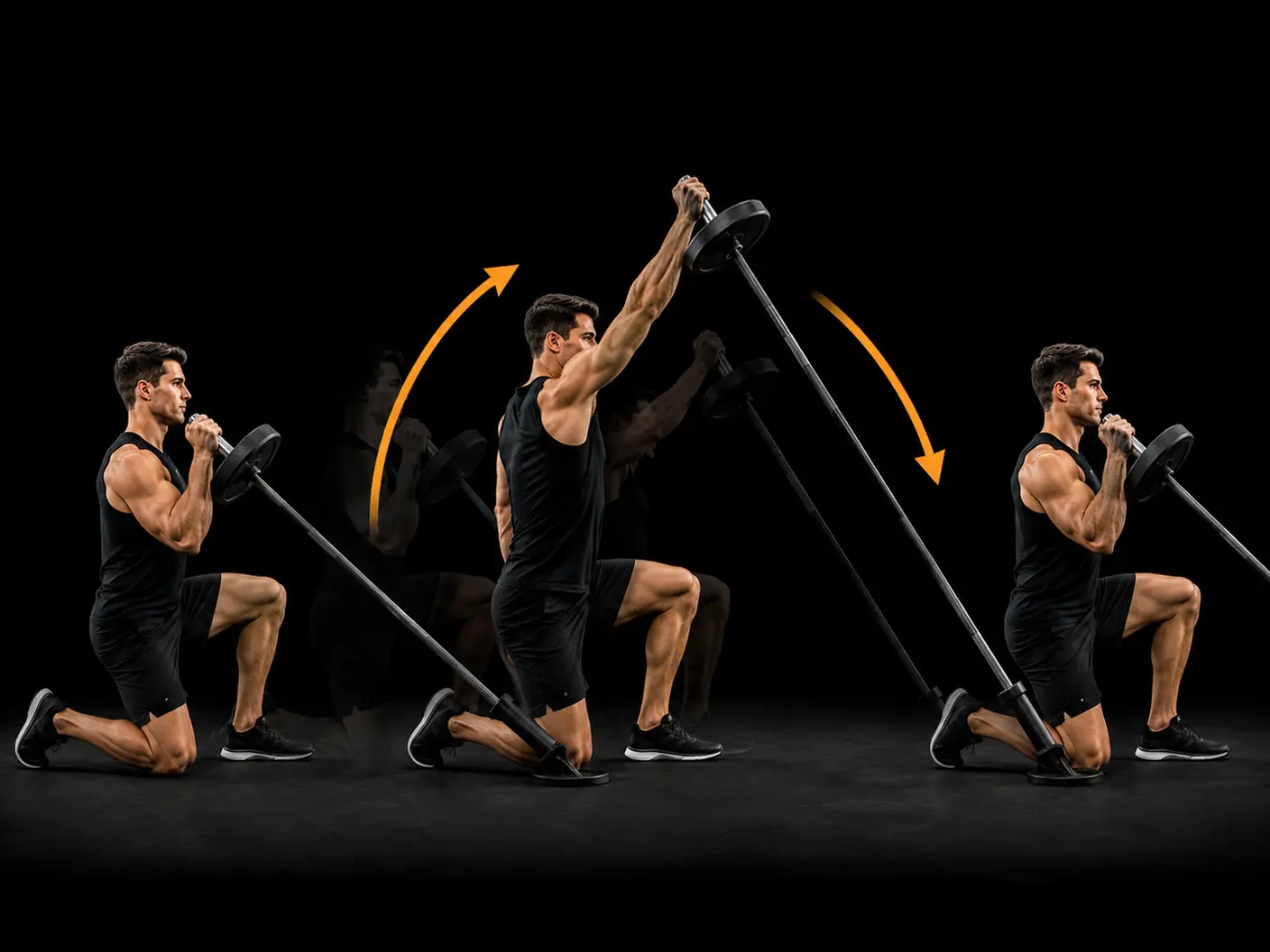
The half-kneeling single-arm landmine press is a compound vertical push movement performed from a staggered kneeling stance, using a barbell loaded into a landmine attachment. The angled pressing path trains the anterior deltoid as the primary mover, with meaningful contribution from the upper pec, triceps, serratus, and the core's anti-rotation capacity. It suits intermediate lifters who want to develop pressing strength and shoulder stability while simultaneously challenging trunk control in a unilateral, grounded position.
How to do it
Kneel on one knee, opposite foot forward. Hold the landmine end in the hand opposite the down knee. Brace hard. Press the bar up and forward, resisting rotation through the torso. Lower under control.
Coaching cues
- Half-kneeling tall
- Resist rotation
- Full ROM
- Brace the core
Why train it
- The half-kneeling position removes the lower body from the equation, isolating pressing output and exposing any asymmetry between sides.
- The angled bar path of the landmine places the anterior deltoid under load through a pressing arc that tends to feel more comfortable at the shoulder joint than a strict overhead press.
- Resisting rotation through the torso during a single-arm effort directly develops core anti-rotation strength, which transfers well to athletic performance and compound lifting.
- Programming this movement supports hypertrophy in the deltoids and triceps while reinforcing serratus activation, which plays an important role in healthy scapular mechanics.
Common mistakes
- Allowing the torso to rotate toward the pressing arm — brace the core hard before initiating the press and maintain a square position through the full range of motion.
- Sinking into the hips rather than kneeling tall — keep the hips extended and the trunk upright throughout so the movement stays a pressing challenge rather than a balance compensation.
- Using too much weight and abbreviating the range of motion — use a load that allows the bar to travel through its full arc from the shoulder to full extension and back under control.
- Neglecting the lowering phase — control the descent deliberately rather than letting the bar drop, as the eccentric portion contributes meaningfully to both strength and muscle development.
Primary: Anterior Deltoid.
Secondary: Pectoralis Major, Triceps Brachii, Serratus Anterior, Obliques.
Equipment
Good for
Easier variation
Tall-kneeling or standing variant — reduces rotational challenge.
Similar movements
Frequently asked
- What muscles does the half-kneeling single-arm landmine press work?
- The anterior deltoid is the primary muscle targeted. The upper pec, triceps, and serratus anterior provide secondary assistance, while the core works throughout to resist the rotational forces created by pressing with one arm.
- What sets and reps work best for this exercise?
- For hypertrophy, three to four sets of eight to twelve reps per side works well. For athletic performance and strength, four sets of five to eight reps with a heavier load and longer rest periods is a practical starting point.
- Which hand holds the bar and which knee is down?
- The hand holding the bar should be opposite the down knee — so if the right knee is on the floor, the right hand presses. This contralateral set-up creates greater rotational demand on the core and reflects the movement's anti-rotation intent.
- Is this exercise suitable for beginners?
- It is rated intermediate because it requires the lifter to manage shoulder stability, core anti-rotation, and hip positioning simultaneously. Beginners would benefit from building familiarity with the standard landmine press and basic core bracing before progressing to this variation.
- What are good alternatives if I don't have a landmine attachment?
- A half-kneeling single-arm dumbbell press trains a similar pattern and muscle group and requires only a dumbbell. If developing the anti-rotation core demand is the priority, a Pallof press can complement a standard pressing alternative in the same session.
Want this movement in a plan built for you?
Adaptiv programmes the right exercises for your goal, equipment and experience — then adapts them as you train.
Build my programme