Front Raise (Dumbbell or Plate)
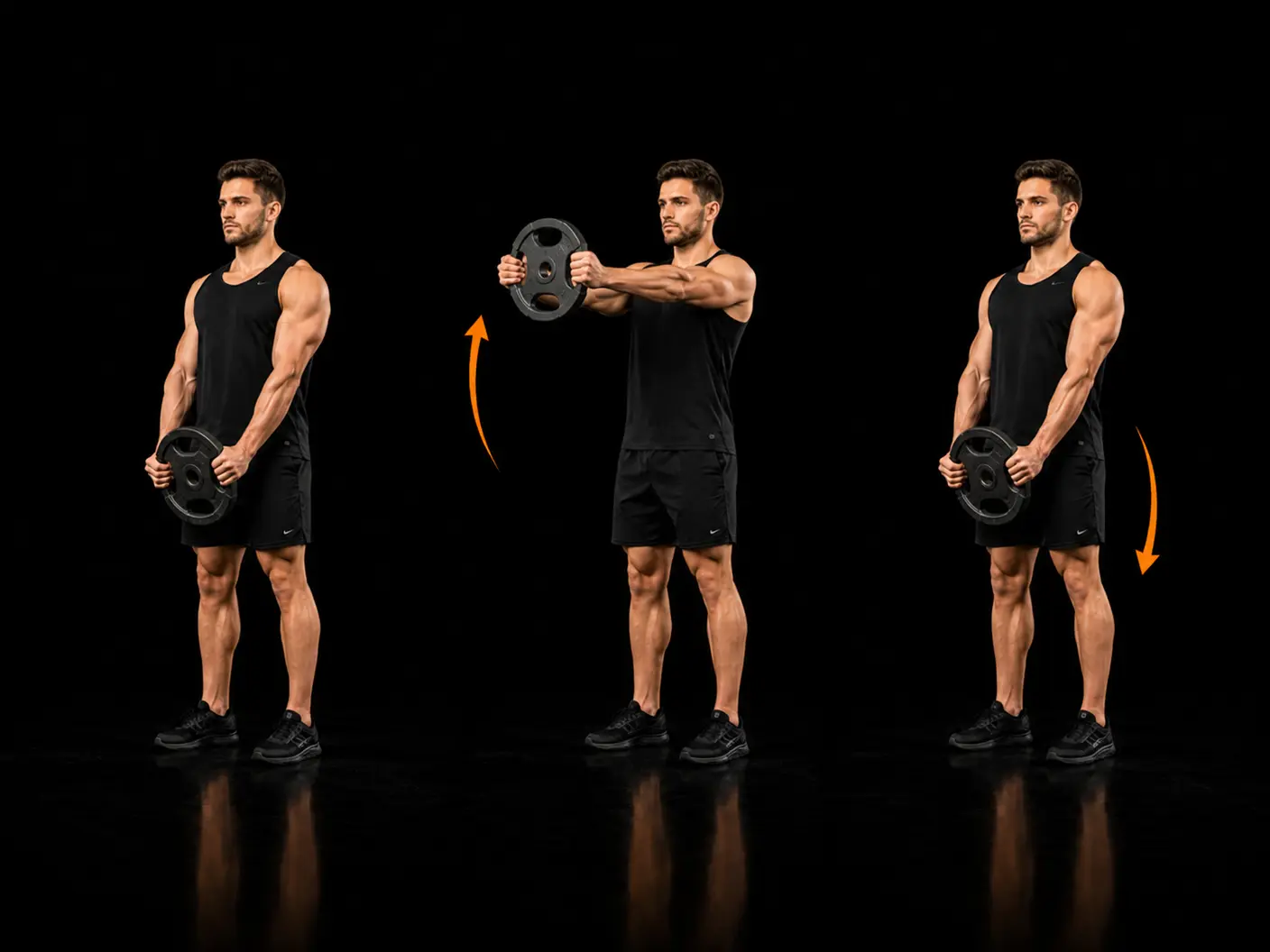
The front raise is an isolation exercise targeting the anterior deltoid, performed by lifting a dumbbell or plate from the thighs to shoulder height in a controlled arc. It trains the shoulder flexion pattern in a direct, focused manner with minimal involvement from surrounding muscle groups. It suits those looking to add dedicated volume to the front of the shoulder, particularly within a hypertrophy-focused programme.
How to do it
Stand tall, weight at the front of the thighs, slight elbow bend. Raise the weight straight up in front to shoulder height. Pause briefly. Lower under control. Alternate arms with dumbbells or lift both together with a plate.
Coaching cues
- Slight elbow bend
- Lift to shoulder height
- Pause at top
- No momentum
Why train it
- Directly loads the anterior deltoid, making it an efficient choice for adding isolated volume to the front of the shoulder.
- The option to use a plate or dumbbells allows for easy load adjustments and variation in grip, keeping the movement accessible across training levels.
- Performing alternating reps with dumbbells or bilateral reps with a plate lets you tailor the exercise to your training structure and fatigue management.
- The slow, controlled tempo demanded by this exercise reinforces disciplined movement habits that carry over to other pressing and raising patterns.
Common mistakes
- Using momentum to swing the weight up — initiate every rep from a dead stop and keep the torso upright throughout.
- Raising the weight above shoulder height — lifting beyond this point shifts stress away from the target muscle and unnecessarily loads the joint.
- Locking the elbows straight — maintain a slight bend throughout to reduce joint stress and keep tension on the anterior deltoid.
- Rushing the lowering phase — control the descent for the full range of motion, as the eccentric portion contributes meaningfully to the training stimulus.
Primary: Anterior Deltoid.
Secondary: Pectoralis Major, Lateral Deltoid.
Equipment
Good for
Easier variation
Cable front raise — constant tension and easier to control.
Similar movements
Frequently asked
- What muscles does the dumbbell or plate front raise work?
- The primary muscle is the anterior deltoid, which sits at the front of the shoulder. The upper pec and medial deltoid contribute as secondary muscles, though they play a supporting rather than a leading role.
- How many sets and reps should I do for the front raise?
- For hypertrophy, 3–4 sets of 10–15 reps at a moderate load works well. Prioritise a controlled tempo over heavy weight, as the anterior deltoid responds better to sustained tension than to loaded momentum.
- Should I use dumbbells or a plate for the front raise?
- Both are effective. A plate encourages a neutral, pronated grip and suits bilateral lifting, while dumbbells allow you to work each arm independently, which can be useful for addressing asymmetries or managing fatigue across a set.
- Where should I programme the front raise in a session?
- It works best as an accessory movement placed after compound pressing exercises such as the overhead press or bench press, when the anterior deltoid has already been warmed up and the primary lifts are complete.
- Is the front raise suitable for beginners?
- Yes, it is classified as a foundational movement and is appropriate for most training levels. Beginners should start with a light load, focus on eliminating momentum, and establish a consistent pause at the top before progressing the weight.
Want this movement in a plan built for you?
Adaptiv programmes the right exercises for your goal, equipment and experience — then adapts them as you train.
Build my programme