Cable Front Raise
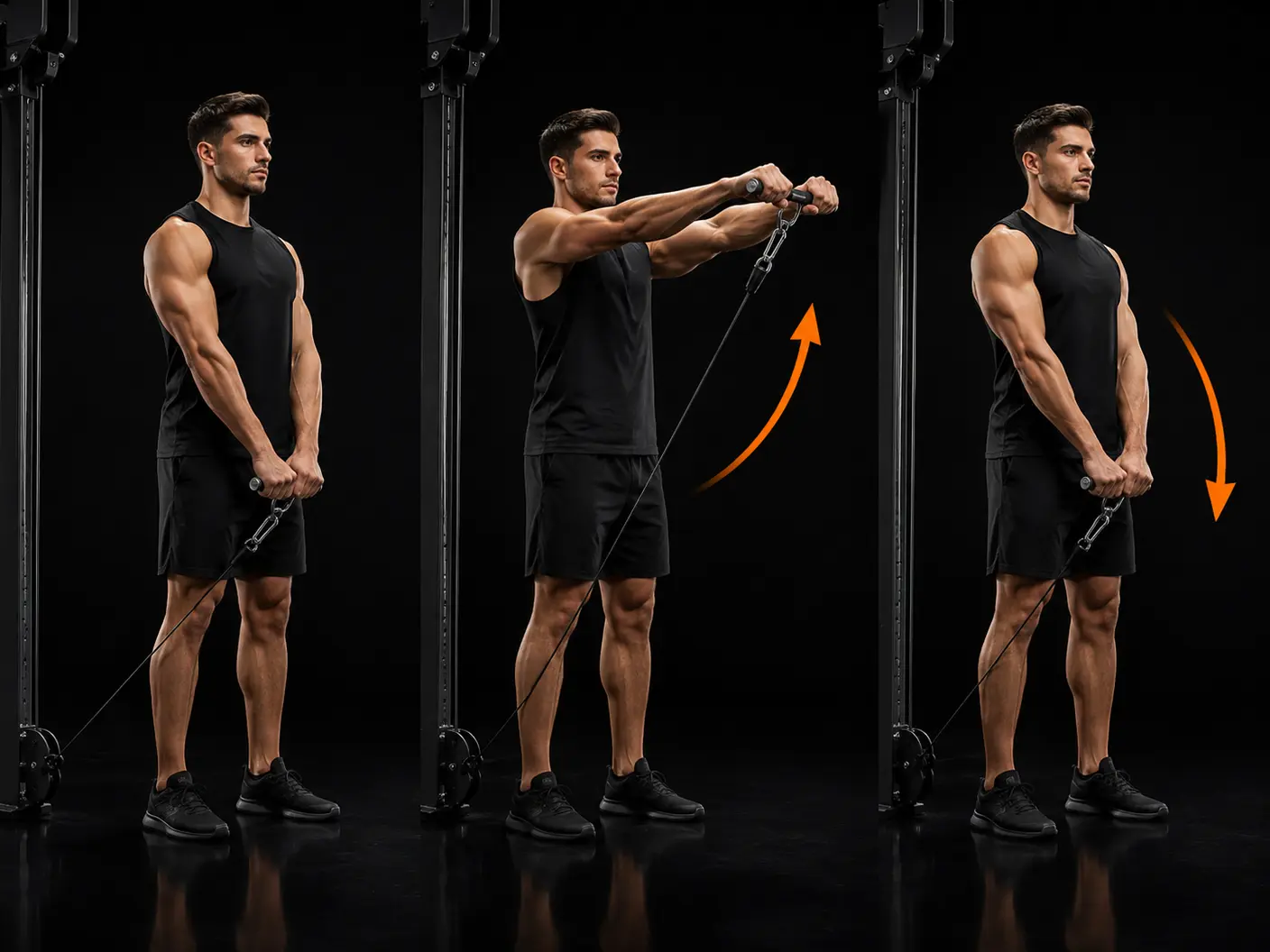
The cable front raise is a foundational isolation exercise targeting the anterior deltoid through a forward-flexion pattern in the shoulder joint. Using a low cable pulley keeps constant tension on the working muscle throughout the range of motion, which distinguishes it from the dumbbell equivalent where resistance drops at the top. It suits lifters building shoulder volume as part of a hypertrophy programme, and those looking to reinforce anterior deltoid development with controlled, repeatable mechanics.
How to do it
Set a cable low. Face away from the stack, bar between the legs. Raise the bar to shoulder height in front with a slight elbow bend. Pause briefly. Lower under control.
Coaching cues
- Slight elbow bend
- Shoulder height
- Pause at peak
- Slow eccentric
Why train it
- Constant cable tension across the full range of motion provides a more consistent stimulus to the anterior deltoid compared with free-weight alternatives where resistance varies with lever angle.
- The slow eccentric phase prescribed in the coaching cues increases time under tension, a key driver of muscle hypertrophy in the shoulder.
- The movement pattern isolates the anterior deltoid with secondary contribution from the upper pec and medial deltoid, making it a precise tool for addressing specific shoulder development.
- As a foundational-level exercise, it is accessible to newer lifters learning to control shoulder flexion without the balance demands of more complex pressing patterns.
Common mistakes
- Using momentum to swing the bar up — initiate the lift deliberately from the shoulder and keep the torso stationary throughout.
- Raising the bar above shoulder height — stop when the bar is level with the shoulder to maintain tension on the target muscle and avoid shifting load onto the traps.
- Locking the elbow straight — maintain a slight, consistent bend in the elbow throughout the movement to reduce joint stress and keep the emphasis on the deltoid.
- Rushing the lowering phase — control the descent over two to three seconds rather than allowing the cable to pull the arm back down, as the eccentric portion is where significant stimulus occurs.
Primary: Anterior Deltoid.
Secondary: Pectoralis Major, Lateral Deltoid.
Equipment
Good for
Easier variation
Dumbbell front raise — simpler setup.
Similar movements
Frequently asked
- What muscles does the cable front raise work?
- The primary muscle is the anterior deltoid, which drives shoulder flexion. The upper pec and medial deltoid contribute as secondary movers throughout the lift.
- How many sets and reps should I do for the cable front raise?
- For hypertrophy, three to four sets of ten to fifteen reps works well, with a controlled tempo that emphasises the eccentric. Rest sixty to ninety seconds between sets to maintain quality of movement.
- What is the difference between the straight bar and rope attachment for this exercise?
- The straight bar keeps both hands in a fixed, pronated position, while the rope allows a small degree of wrist rotation and can feel more natural depending on individual shoulder mechanics. Both are effective; the choice comes down to comfort and what keeps tension in the right place for you.
- Is the cable front raise enough to train the whole shoulder?
- No — it is an isolation exercise for the anterior deltoid specifically. A complete shoulder programme would also include work for the medial and posterior deltoids through movements such as lateral raises and rear delt flyes.
- Can I do the cable front raise if I have shoulder discomfort?
- If you are experiencing shoulder pain or have a history of shoulder issues, check with a qualified professional before including this or any overhead or front-raise movement in your programme.
Want this movement in a plan built for you?
Adaptiv programmes the right exercises for your goal, equipment and experience — then adapts them as you train.
Build my programme