Dumbbell Fly
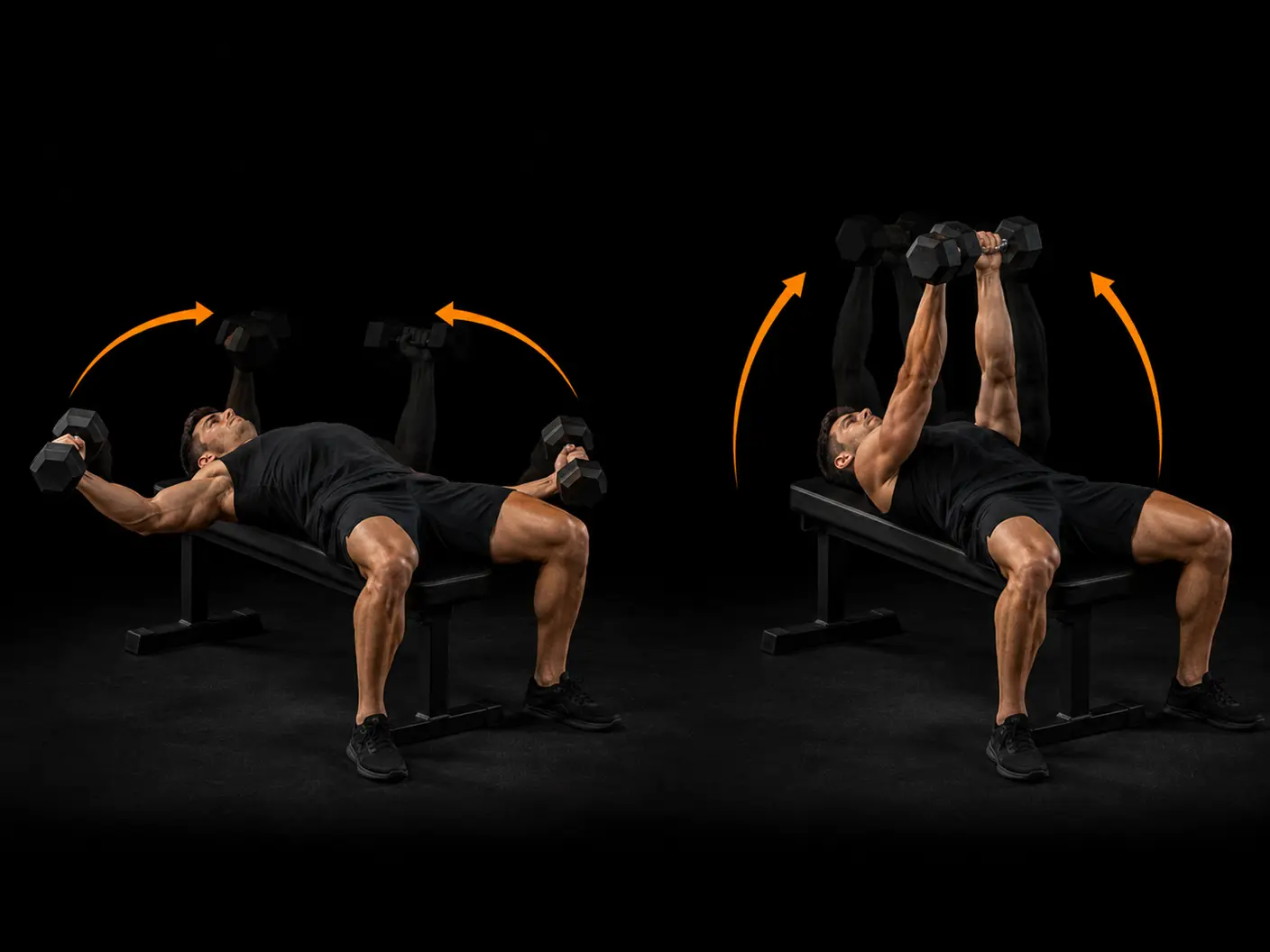
The dumbbell fly is a horizontal push movement performed lying flat on a bench, in which the arms sweep through a wide arc to load the pectoralis major across a large range of motion. Unlike pressing movements, the fly isolates the pecs by keeping the elbows at a fixed angle throughout, making it a reliable choice for targeted chest hypertrophy. It suits intermediate lifters who have already established a foundation in pressing and can control load through an extended range of motion.
How to do it
Lie flat, dumbbells pressed straight over the chest, palms facing each other, slight elbow bend. Lower the arms out and down in a wide arc until a strong pec stretch is felt. Reverse the arc, hugging the dumbbells back toward each other. Maintain the elbow bend throughout.
Coaching cues
- Slight elbow bend
- Wide arc
- Deep stretch
- Meet at the top
Why train it
- The wide arc places the pectoralis major under a deep stretch at the bottom of the movement, a stimulus strongly associated with hypertrophic adaptation.
- By fixing the elbow angle and removing the triceps from the equation, the fly directs a greater proportion of the work to the chest compared with compound pressing movements.
- The anterior deltoid contributes as a secondary mover, meaning the shoulder is trained in a complementary role without excessive loading.
- Dumbbells allow each arm to move independently, helping to identify and address side-to-side strength or range-of-motion asymmetries over time.
Common mistakes
- Straightening the arms during the descent — maintain a consistent slight bend at the elbow throughout the entire arc to protect the elbow joint and keep tension on the pecs.
- Using too much weight and cutting the range of motion short — choose a load that allows the arms to lower until a genuine stretch is felt across the chest before reversing.
- Turning the movement into a press by bending the elbows further on the way up — keep the elbow angle fixed and think of hugging the dumbbells together rather than pushing them.
- Allowing the lower back to arch excessively off the bench — keep the feet flat and the torso stable so the chest, not the spine, absorbs the load.
Primary: Pectoralis Major.
Secondary: Anterior Deltoid.
Equipment
Good for
Easier variation
Cable fly — constant tension is easier to control than free weights at the stretch.
Similar movements
Frequently asked
- What muscles does the dumbbell fly work?
- The primary muscle is the pectoralis major, which drives the arc motion and receives a deep stretch at the bottom of the movement. The anterior deltoid works as a secondary muscle throughout the exercise.
- How many sets and reps should I do for the dumbbell fly?
- For hypertrophy, 3–4 sets of 10–15 reps is a well-supported range. The fly is typically placed after compound pressing work in a session, where it functions as an isolation finisher rather than a primary strength movement.
- What is the difference between a dumbbell fly and a dumbbell press?
- A press involves significant elbow flexion and extension, recruiting the triceps as a primary contributor alongside the chest. A fly maintains a fixed elbow angle throughout, removing the triceps from the movement and concentrating the load on the pectoralis major.
- Is the dumbbell fly suitable for building chest size?
- Yes — it is classified specifically as a hypertrophy movement. The combination of a large range of motion and a pronounced stretch on the pectoralis major makes it a practical addition to a chest-focused programme.
- What are good alternatives to the dumbbell fly?
- Cable flys performed on a cable machine replicate the arc pattern while maintaining constant tension throughout the range of motion, which some lifters find more effective for hypertrophy. If you are working without a bench, a floor fly reduces the range of motion but remains a viable option.
Want this movement in a plan built for you?
Adaptiv programmes the right exercises for your goal, equipment and experience — then adapts them as you train.
Build my programme