Cable Chest Fly
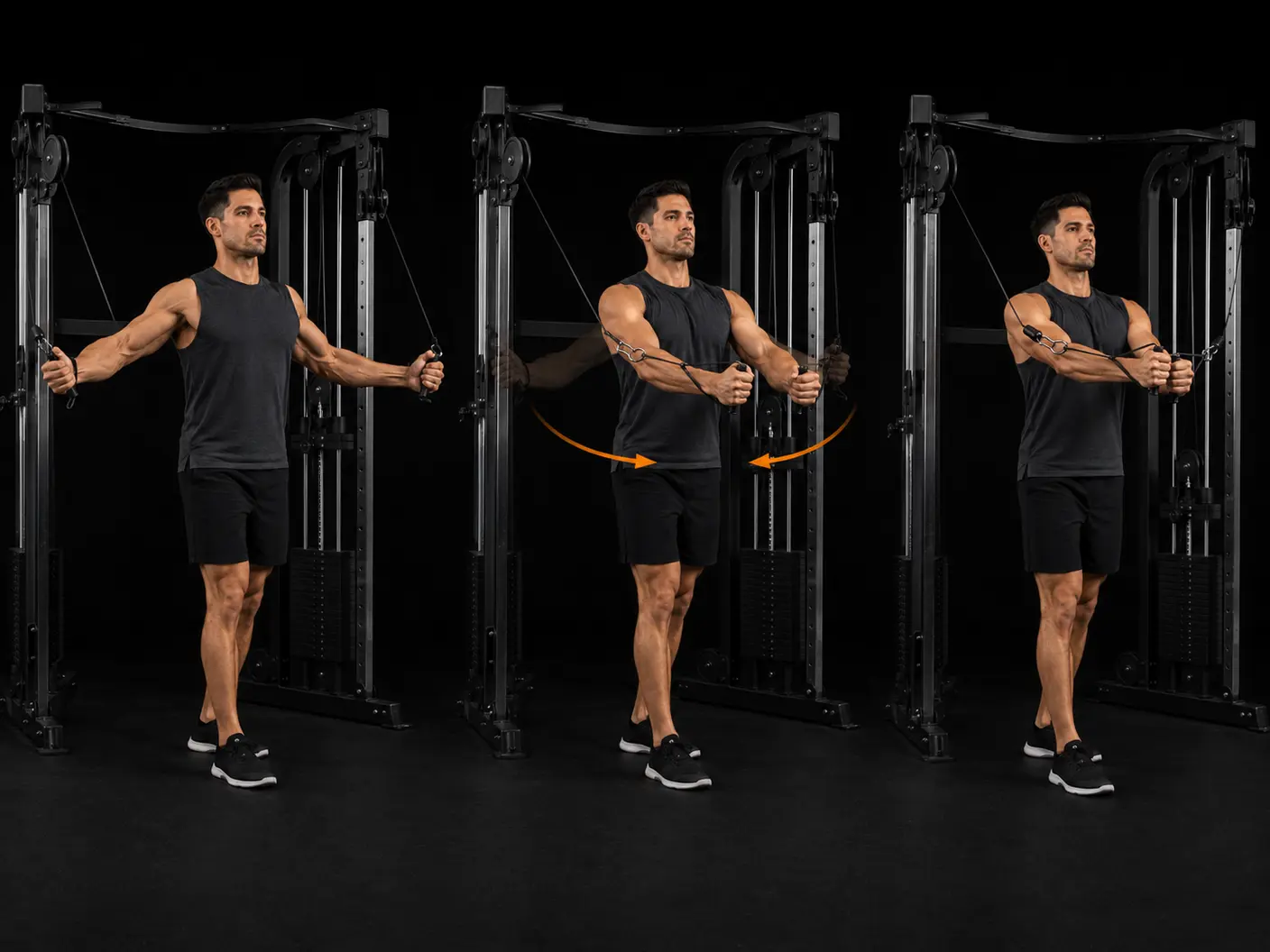
The cable chest fly is a single-joint isolation movement that trains the pectoralis major through a wide arc of horizontal adduction, keeping the muscle under constant tension throughout the range of motion — something free weights cannot replicate as consistently. Set with cables at shoulder height, the exercise suits intermediate trainees who have already established foundational pressing strength and are looking to develop greater chest mass and definition. The continuous cable resistance makes it a reliable hypertrophy tool when programmed alongside compound pressing movements.
How to do it
Set cables at shoulder height. Hold a handle in each hand, slight bend in the elbows. Split stance. Hug the arms forward and together as if hugging a barrel. Pause at peak contraction with handles touching. Return slowly into a deep stretch.
Coaching cues
- Bend the elbows slightly
- Hug a barrel
- Squeeze at peak
- Deep stretch at the bottom
Why train it
- Constant mechanical tension through the full arc challenges the pectoralis major more evenly than dumbbell flies, where resistance drops off at the top of the movement.
- The deep stretch position at the bottom of each rep places the chest under load at a lengthened range, which research associates with greater hypertrophic stimulus.
- The anterior deltoid contributes as a secondary mover, meaning the shoulder musculature receives meaningful accessory work without requiring a separate isolation exercise.
- The adjustable cable stack allows precise load increments, making it straightforward to apply progressive overload over successive training blocks.
Common mistakes
- Straightening the arms completely — maintain a slight, consistent bend in the elbows throughout to keep stress on the pectorals rather than shifting it to the elbow joint.
- Using too much weight and shortening the range of motion — select a load that allows a full, controlled stretch at the bottom and a genuine pause at peak contraction.
- Rushing the return phase — lower the handles slowly into the stretched position rather than letting the cables pull the arms back, as the eccentric portion drives much of the hypertrophic response.
- Leaning excessively forward from the hips — adopt a stable split stance and keep the torso upright so that shoulder-height cables are working the chest through true horizontal adduction.
Primary: Pectoralis Major.
Secondary: Anterior Deltoid.
Equipment
Good for
Easier variation
Low-to-high cable fly — bias the upper pec; lighter load easier to control.
Similar movements
Frequently asked
- What muscles does the cable chest fly work?
- The primary muscle trained is the pectoralis major, which drives horizontal adduction of the arms. The anterior deltoid acts as a secondary mover, assisting throughout the arc.
- How many sets and reps should I do for hypertrophy?
- For muscle growth, three to four sets of ten to fifteen repetitions works well, with a controlled eccentric and a deliberate pause at peak contraction. Rest 60 to 90 seconds between sets to maintain metabolic stress.
- Where should I set the cable pulleys for a chest fly?
- Set both pulleys at shoulder height. This angle directs the line of pull through horizontal adduction, placing the greatest demand on the pectoralis major across the full range of motion.
- Is the cable chest fly suitable as a standalone chest exercise?
- It works best as an accessory movement after a primary compound press such as a bench press or push-up variation. As an isolation exercise it lacks the multi-joint loading needed to serve as the sole chest stimulus in a well-rounded programme.
- What is a good alternative if I do not have access to a cable machine?
- Dumbbell flies performed on a flat or incline bench are the closest substitute, though the resistance curve differs — tension is highest at the bottom of the arc rather than constant. Pec deck machines offer a similarly consistent resistance profile if available.
Want this movement in a plan built for you?
Adaptiv programmes the right exercises for your goal, equipment and experience — then adapts them as you train.
Build my programme